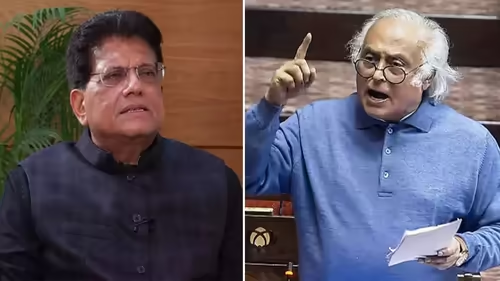
In a fiery political salvo that’s reignited the national debate on trade policy, Union Commerce Minister Piyush Goyal has dismissed the Congress party’s concerns over the newly concluded India-EU FTA with a classic Hindi idiom: “Angoor khate hai” (The grapes are sour). This isn’t just a political quip; it’s a direct challenge to the Congress’s entire economic legacy, accusing them of negotiating trade deals that compromised India’s interests while the current government is building a robust, balanced framework for global commerce.
Table of Contents
- The Landmark India-EU FTA: A New Chapter
- Goyal’s ‘Angoor Khate Hai’ Charge Against Congress
- A Deep Dive into the UPA Era’s Trade Record
- Why the India-EU FTA is a Strategic Game-Changer
- Conclusion: Beyond Political Rhetoric
- Sources
The Landmark India-EU FTA: A New Chapter
On January 27, 2026, after nearly two decades of on-and-off negotiations, India and the European Union officially concluded their historic Free Trade Agreement [[10]]. This deal, often dubbed the “Mother of all Trades,” is far more than just a tariff reduction pact. It’s a comprehensive strategic partnership covering trade in goods and services, investment, intellectual property, and digital trade [[15]]. With the EU being India’s largest trading partner, accounting for a staggering €120 billion in annual trade, this agreement is poised to be a massive catalyst for India’s economic growth, particularly for its manufacturing and services sectors [[13]].
Goyal’s ‘Angoor Khate Hai’ Charge Against Congress
Goyal’s defense of the India-EU FTA was swift and sharp in response to Congress leaders like Jairam Ramesh raising concerns about potential negative impacts on domestic industries [[8]]. He framed the opposition not as a genuine policy critique but as a case of envy from a party that failed to deliver such a deal during its own tenure. “They are saying ‘Angoor khate hai’ because they couldn’t achieve this in 10 years of their rule,” Goyal stated, highlighting the current government’s ability to negotiate from a position of strength [[1]].
He went further, accusing the Congress-led UPA government of a dangerous “negative mindset” that led to rushed and unbalanced trade pacts. His most serious allegation was that the UPA’s approach inadvertently made China India’s biggest trade partner, contributing to a massive and persistent trade deficit that continues to plague the Indian economy [[6]].
A Deep Dive into the UPA Era’s Trade Record
Goyal’s criticism points to a specific set of agreements signed between 2004 and 2014. The UPA government was active in the FTA space, concluding deals with major economies like ASEAN, South Korea, and Japan. However, the minister’s argument is that these agreements were often asymmetrical.
For instance, the India-ASEAN FTA, which came into full effect in 2010, has been widely criticized for allowing a flood of cheaper Chinese goods (often routed through ASEAN nations) into the Indian market, while Indian exports struggled to gain similar access [[22]]. Similarly, while deals with South Korea and Singapore were significant, critics argue they were negotiated without sufficient safeguards for vulnerable domestic sectors, leading to a net negative impact on India’s trade balance in those specific corridors [[18]].
Goyal’s central thesis is that the UPA’s strategy was reactive and lacked a coherent long-term vision, often conceding more than it gained [[4]]. In contrast, he positions the current government’s approach—evident in the India-EU FTA and the ongoing talks with the UK—as one of careful negotiation, mutual benefit, and strategic alignment.
Why the India-EU FTA is a Strategic Game-Changer
The significance of the new India-EU FTA extends well beyond economics. It’s a powerful geopolitical statement in an increasingly fragmented world order.
Key strategic advantages include:
- Diversification away from China: The deal offers a crucial alternative to China-centric supply chains, aligning with the EU’s own “de-risking” strategy and providing a massive new market for Indian goods [[15]].
- Boost to ‘Make in India’: By securing better market access for Indian pharmaceuticals, automobiles, textiles, and engineering goods in the high-value EU market, the FTA is a direct shot in the arm for domestic manufacturing [[5]].
- A rules-based partnership: Unlike some past agreements, the India-EU FTA is built on a foundation of shared democratic values and a commitment to a transparent, rules-based trading system, offering long-term stability for businesses [[13]].
This stands in stark contrast to the alleged “secret deals” and lack of transparency that Goyal claims characterized the UPA era [[6]]. The current government is framing this FTA as a win-win, not a zero-sum game, designed to create opportunities for both sides [[4]].
Conclusion: Beyond Political Rhetoric
While Piyush Goyal’s “Angoor khate hai” remark is undeniably a potent political soundbite, it opens a critical conversation about India’s trade philosophy. The conclusion of the India-EU FTA marks a definitive shift from the perceived reactive and concessionary model of the past to a more assertive, strategic, and value-driven approach. The true test will lie in the implementation phase, where the government must ensure that domestic industries are adequately protected and supported to seize the immense opportunities this landmark deal presents. For now, the ball is firmly in the Congress’s court to move beyond criticism and articulate a clear, credible alternative trade vision for India.
Sources
- [[1]] Zee News: “Union Minister Piyush Goyal rejected Congress criticism of the India-EU Free Trade Agreement, calling it ‘sour grapes.'”
- [[4]] IANS: “Trade pacts were rushed in UPA era, India often conceded far more than it gained: Piyush Goyal.”
- [[5]] India Today: “Sour grapes? Piyush Goyal rebuts Congress, calls India-EU FTA a driver of economic growth.”
- [[6]] The Indian Express: “Under UPA regime, secret deals made China India’s biggest trade partner: Piyush Goyal.”
- [[8]] Live Mint: “‘Angoor khatte hain’: Piyush Goyal flags Cong’s handling of free trade agreements amid India-EU deal criticism.”
- [[10]] Motozite: “India-EU FTA 2026 Explained: Key Details & Impact.”
- [[13]] European Commission: “EU-India agreements – EU Trade.”
- [[15]] Kiel Institute: “The EU–India Trade Deal: Strategic Diversification in an Age of Fragmentation.”
- [[22]] Business Today: “Current India UK FTA a game changer, unlike UPA’s ASEAN deals: says Piyush Goyal.”