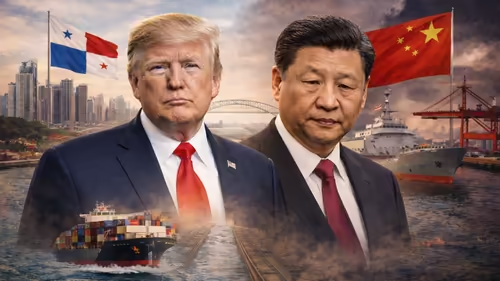
In a stunning legal and geopolitical maneuver, Panama’s highest court has just delivered a verdict that reverberates from Washington D.C. to Beijing. The nation’s Supreme Court has officially voided the concession contracts held by Hong Kong-based CK Hutchison, a company with deep ties to mainland China, to operate two critical container terminals on the Panama Canal [[1]].
This isn’t just a local contract dispute; it’s a high-stakes chess move in the grand game of global power. For supporters of former President Donald Trump, it’s a resounding validation of his hardline foreign policy vision for the Americas. For China, it represents a major roadblock in its ambitious plan to weave a network of strategic commercial assets across the globe.
Table of Contents
- Why the Panama Canal Ports Matter
- The Court Ruling and Its Official Reasoning
- The Donroe Doctrine: A Trump Strategic Win
- A Setback for China’s Global Port Strategy
- What Happens Next in Panama?
- Conclusion
- Sources
Why the Panama Canal Ports Matter
The Panama Canal is one of the world’s most vital maritime chokepoints, handling roughly 6% of global maritime trade. Controlling the ports at either end—specifically the Port of Balboa on the Pacific and the Port of Cristobal on the Atlantic—is akin to holding the keys to a major artery of the global economy [[6]].
For over two decades, CK Hutchison, founded by billionaire Li Ka-shing, has managed these terminals through its subsidiary, Hutchison Ports. While the company is headquartered in Hong Kong, its operations are deeply intertwined with the broader economic and strategic interests of the People’s Republic of China. This arrangement has long been a source of concern for U.S. policymakers, who view any Chinese presence near such a critical waterway as a potential national security threat [[5]].
The Court Ruling and Its Official Reasoning
The Panamanian Supreme Court’s decision was not based on overtly geopolitical grounds. Instead, the justices ruled that the original 2021 contract extension, which would have granted CK Hutchison control until 2037, was “unconstitutional” [[3]]. The court found that the government had bypassed proper legislative procedures and failed to conduct a competitive bidding process, effectively granting an unfair advantage to the incumbent operator [[4]].
While the legal justification appears procedural, the timing and context are impossible to ignore. The ruling comes amid heightened scrutiny of Chinese investments in Latin America and a concerted effort by the United States to reassert its influence in its traditional “backyard.”
The Donroe Doctrine: A Trump Strategic Win
This ruling is being hailed as a major victory for what has become known as the “Donroe Doctrine”—a term coined to describe Donald Trump’s aggressive foreign policy stance towards Latin America, which echoes the historical Monroe Doctrine but with a distinctly modern, anti-China focus [[8]].
The core tenet of this doctrine is simple: the Western Hemisphere is a U.S. sphere of influence, and the expansion of rival powers, particularly China and Russia, will be actively countered [[9]]. By successfully pressuring or incentivizing a key regional ally like Panama to eject a major Chinese-linked firm from a strategic asset, the U.S. has demonstrated the tangible power of this policy. It sends a clear message to other nations in the region about the potential costs of deepening ties with Beijing [[10]].
A Setback for China’s Global Port Strategy
For China, this is a significant blow to its meticulously crafted global trade and infrastructure strategy, often referred to as the Belt and Road Initiative (BRI). A cornerstone of this strategy is the acquisition or operation of port facilities in key locations worldwide—from Piraeus in Greece to Gwadar in Pakistan [[12]].
These geopolitical trade routes are not just about commerce; they are about securing long-term strategic leverage, ensuring the smooth flow of Chinese goods, and projecting soft power. Losing a foothold at the Panama Canal ports—arguably one of the most valuable pieces of real estate in global logistics—disrupts this carefully laid plan [[13]].
It also sets a dangerous precedent. If a company can be removed from such a critical location on procedural grounds, it could embolden other nations to re-examine their own deals with Chinese firms, potentially unraveling Beijing’s global port network [[17]].
What Happens Next in Panama?
The immediate future of the ports is now in limbo. The Panamanian government must now manage the transition and decide on the next steps. The most likely scenario involves a new, transparent international tender process to find a new operator.
Key questions remain:
- Will the U.S. actively lobby for an American or allied company (like a European firm) to take over?
- Can CK Hutchison mount a legal challenge or negotiate a new, compliant deal?
- How will this affect Panama’s own economic stability and its relationship with both superpowers?
Whatever the outcome, the balance of power in the region has undeniably shifted. This event underscores the growing reality that in today’s world, commercial infrastructure is inseparable from national security and geopolitical strategy.
Conclusion
The Panamanian Supreme Court’s decision to void CK Hutchison’s Panama Canal ports contracts is far more than a legal footnote. It is a watershed moment in the intensifying strategic competition between the United States and China. It validates the aggressive tactics of the Donroe Doctrine, delivers a sharp rebuke to Beijing’s global ambitions, and serves as a stark reminder that control over the world’s trade arteries is the ultimate prize in 21st-century geopolitics. The ripple effects of this ruling will be felt for years to come, as nations across Latin America and beyond watch closely to see who will ultimately control the gates of global commerce.
Sources
- Panama top court voids CK Hutchison concession for 2 ports
- Panama court voids Hong Kong company’s port contracts
- Panama’s Supreme Court ruled that the port contract of the Li Ka-shing firm’s subsidiary was “unconstitutional”
- The ‘Donroe Doctrine’
- Panama court rules Chinese control of canal ports unconstitutional
- China’s Global Port Investments: It’s About Control and the Reshaping of Trade Flows