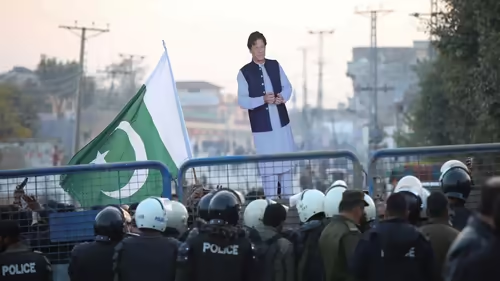
In a nation where speaking truth to power can land you in a high-security cell with no visitors, the phrase “democratic backsliding” feels like an understatement. Across Pakistan, a disturbing pattern has emerged: peaceful dissent is increasingly being recast as a threat to national security. The result? A chilling atmosphere where journalists, lawyers, activists—and even former prime ministers like Imran Khan—are ensnared in a web of legal traps designed not to deliver justice, but to enforce silence [[1]].
Table of Contents
- The New Playbook for Silencing Dissent
- Imran Khan: A Symbol of Resistance and Repression
- Legal Weapons Used to Crush Criticism
- The Military’s Shadow Role
- International Reactions and Human Rights Concerns
- Is There Any Hope for Democracy?
- Conclusion
- Sources
The New Playbook for Silencing Dissent
Gone are the days of overt censorship. Today, silencing dissent in Pakistan is a sophisticated operation cloaked in legal procedure. Authorities invoke vague national security laws, anti-terrorism statutes, and cybercrime regulations to target anyone deemed inconvenient. Lawyers representing political prisoners face disbarment or even imprisonment. Family members are denied prison visits. Court proceedings are delayed indefinitely.
This isn’t random enforcement—it’s systemic suppression. And it’s working.
Imran Khan: A Symbol of Resistance and Repression
No case illustrates this better than that of Imran Khan. Once Pakistan’s prime minister and now its most prominent political prisoner, Khan has been slapped with over 170 charges ranging from corruption to leaking state secrets and even “terrorism.” Many of these cases rely on flimsy evidence or testimonies extracted under duress [[2]].
His incarceration in Adiala Jail—a facility known for its harsh conditions—has been marked by extreme isolation. For weeks, he was denied access to his legal team and family. When visits were finally permitted, they were heavily monitored and restricted to minutes. Supporters argue this isn’t punishment for crime, but punishment for defiance.
Legal Weapons Used to Crush Criticism
Pakistani authorities have weaponized several laws to neutralize opposition:
- Prevention of Electronic Crimes Act (PECA): Used to jail journalists and activists for social media posts critical of the military or judiciary.
- Anti-Terrorism Act (ATA): Allows for extended detention without bail and trials in special courts with limited transparency.
- Official Secrets Act: Vaguely worded provisions criminalize any disclosure deemed “prejudicial to national security”—a label easily applied to whistleblowers or investigative reporters.
- Sedition laws: Though rarely used in court, the mere threat of sedition charges forces self-censorship.
Even lawyers aren’t safe. In one shocking case, a defense attorney was sentenced to 10 years in prison for allegedly sharing “anti-state” content online—simply for doing his job [[3]].
The Military’s Shadow Role
While civilian courts issue the verdicts, few analysts doubt who pulls the strings. Pakistan’s powerful military establishment, led by figures like Army Chief Gen. Asim Munir, has long viewed independent political voices—especially those with mass appeal like Khan’s—as destabilizing [[4]].
The military denies direct involvement, insisting these are “lawful measures against destabilization.” But the timing is telling: crackdowns intensify whenever public protests gain momentum or elections loom. Critics argue that the goal isn’t stability—it’s control.
International Reactions and Human Rights Concerns
Global watchdogs are sounding the alarm. Amnesty International and Human Rights Watch have repeatedly condemned Pakistan’s shrinking civic space. The United Nations has expressed “deep concern” over the targeting of political opponents under the guise of legality [[5]].
Yet, geopolitical realities often mute international pressure. Pakistan’s strategic location and nuclear arsenal make Western powers hesitant to impose meaningful consequences. Meanwhile, regional allies like China remain silent on human rights issues altogether.
For verified data on global press freedom, refer to the authoritative Reporters Without Borders World Press Freedom Index.
Is There Any Hope for Democracy?
Despite the repression, resistance persists. Underground networks share censored news. Young activists use encrypted apps to organize. Families of detainees hold quiet vigils outside courthouses. And within Pakistan’s judiciary, a few courageous judges still push back—though at great personal risk.
Still, the path forward is steep. True democratic revival requires not just electoral reform, but the depoliticization of state institutions—especially the judiciary and the military. Until then, every courtroom becomes a theater of control, and every prison cell, a monument to silenced voices.
For more on how authoritarian regimes use law as a weapon, see our analysis on [INTERNAL_LINK:legal-repression-in-authoritarian-states].
Conclusion
Silencing dissent in Pakistan is no longer an anomaly—it’s institutionalized. Through a combination of draconian laws, judicial complicity, and military oversight, the state has perfected a system that punishes not just actions, but ideas. As Imran Khan’s ordeal shows, even the highest office offers no immunity. For Pakistan’s democracy to survive, its citizens must be allowed to speak, protest, and dissent—without fear of vanishing into a legal black hole.
Sources
- [[1]] Times of India: “Legal traps, jail terms, seclusion: How Pakistan has perfected the art of silencing dissent”
- [[2]] BBC News: “Imran Khan: The rise and fall of Pakistan’s cricket star turned PM”
- [[3]] Dawn: “Lawyer sentenced to 10 years for ‘anti-state’ social media post”
- [[4]] Al Jazeera: “Who is General Asim Munir, Pakistan’s new army chief?”
- [[5]] Human Rights Watch: “Pakistan: Events of 2025”