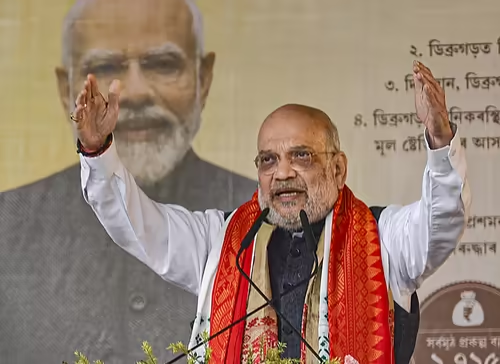
In the run-up to Assam’s crucial assembly elections, Union Home Minister Amit Shah has launched a blistering attack on the Congress, accusing the party of fundamentally altering the state’s demographic fabric. At a high-voltage rally in Dhemaji, Shah declared that the number of infiltrators in Assam rose from “zero to 64 lakh” during Congress rule—a provocative claim designed to galvanize voter sentiment around identity, security, and cultural preservation [[1]].
Table of Contents
- The ‘0 to 64 Lakh’ Claim: What Did Shah Say?
- Historical Context of Infiltration in Assam
- Congress Response and Fact-Checking the Claim
- BJP’s Political Strategy in Assam
- The Mising Community and Identity Politics
- NRC, CAA, and the Electoral Calculus
- Conclusion
- Sources
The ‘0 to 64 Lakh’ Claim: What Did Shah Say?
Speaking to a packed crowd in upper Assam, Amit Shah stated: “When the Congress came to power in 1972, there were zero infiltrators in Assam. By the time they left, that number had ballooned to 64 lakh.” He framed this as a betrayal of Assamese identity and urged voters to re-elect the BJP for a third consecutive term to “protect the soil, language, and culture of Assam” [[1]].
This statement is not just a statistical assertion—it’s a potent political narrative that taps into decades-old anxieties about migration from Bangladesh and its perceived impact on land rights, employment, and electoral outcomes.
Historical Context of Infiltration in Assam
The issue of illegal immigration has been a flashpoint in Assam since the 1970s. The Assam Agitation (1979–1985) was a massive student-led movement demanding the detection and deportation of undocumented migrants, primarily from East Bengal (now Bangladesh). This culminated in the historic Assam Accord of 1985, which set March 24, 1971, as the cutoff date for identifying “foreigners” [[2]].
Despite the accord, implementation remained inconsistent. Successive governments—both Congress and AGP—were accused of turning a blind eye to migration for electoral gains, particularly in border constituencies where migrant populations could sway results.
Congress Response and Fact-Checking the Claim
The Congress has dismissed Shah’s “0 to 64 lakh” figure as “politically motivated exaggeration.” Senior leader Ripun Bora countered that the BJP itself has failed to deport a single infiltrator despite being in power at the Centre since 2014 and in Assam since 2016 [[3]].
As for the number “64 lakh,” it appears to be derived from a controversial 2005 report by the then-Governor of Assam, Lt. Gen. (Retd.) Ajai Singh, which estimated 5 million to 6 million undocumented migrants. However, independent demographers caution against treating such figures as definitive. The Office of the Registrar General, India, does not officially track “infiltrators,” making precise quantification nearly impossible [[4]].
BJP’s Political Strategy in Assam
The Amit Shah Assam infiltration narrative is a cornerstone of the BJP’s 2026 election playbook. By positioning itself as the sole guardian of Assamese identity, the party aims to consolidate its base among indigenous communities while countering anti-incumbency over issues like unemployment and inflation.
Key elements of this strategy include:
- Reiterating NRC promises: Despite the National Register of Citizens (NRC) update in 2019 excluding 1.9 million people, no deportations have occurred. The BJP vows to “complete the process.”
- Leveraging CAA: The Citizenship Amendment Act, which grants amnesty to non-Muslim migrants from neighboring countries, remains deeply divisive in Assam. The BJP is walking a tightrope—appealing to Hindu refugees while assuring locals that their identity won’t be diluted.
- Community-specific outreach: Targeting ethnic groups like the Mising, Bodo, and Karbi with development packages and symbolic recognition.
The Mising Community and Identity Politics
Notably, Shah highlighted the role of the Mising community—one of Assam’s largest Scheduled Tribes—in the fight against infiltration. He praised their vigilance along riverine borders and promised continued support for their cultural and economic upliftment [[1]].
This is a strategic move. The Mising, concentrated in Majuli and Dhemaji, have historically leaned toward regional parties or Congress. By courting them directly, the BJP seeks to fracture opposition unity and expand its social coalition beyond its traditional Hindu nationalist base.
NRC, CAA, and the Electoral Calculus
The interplay between the NRC and CAA remains a minefield. While the NRC targets all undocumented migrants regardless of religion, the CAA excludes Muslims from its benefits—creating a perception of religious discrimination. In Assam, however, even non-Muslim migrants are viewed with suspicion by many indigenous groups, who fear demographic displacement.
The BJP’s challenge is to reassure these communities that the CAA won’t lead to an influx of Bengali Hindus, while simultaneously using the law to mobilize refugee votes in Barak Valley and other regions.
For deeper insights into how identity shapes Indian elections, explore our analysis on [INTERNAL_LINK:identity-politics-in-indian-elections].
Conclusion
Amit Shah’s “0 to 64 lakh” remark is less about verifiable data and more about emotional resonance. In the high-stakes arena of Assam politics, where land, language, and lineage are sacred, such rhetoric can be electorally decisive. Whether the BJP secures a third term will depend not just on its promises, but on whether voters believe it can deliver on its core pledge: to protect Assam’s soul from external threats—real or perceived.
Sources
- [[1]] Times of India: “Population of infiltrators rose from 0 to 64 lakh: Amit Shah in Assam”
- [[2]] Ministry of Home Affairs, Government of India: “The Assam Accord, 1985”
- [[3]] The Hindu: “Congress hits back at Amit Shah’s infiltration claims”
- [[4]] Census of India: Official Website (https://censusindia.gov.in/)