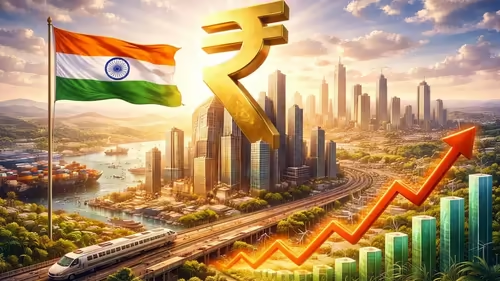
The Economic Survey 2025-26 didn’t just present data; it delivered a philosophical sermon. In an unexpected yet profound move, it reached back over two millennia to the Katha Upanishad, invoking the wisdom of Yama, the Lord of Death, to make a critical point about India’s economic future: the nation must learn the art of delayed gratification. Now, the billion-dollar question is whether the upcoming Budget 2026 will translate this ancient wisdom into modern, actionable policy, particularly for the crucial pillars of manufacturing and exports.
Table of Contents
- The Ancient Wisdom in the Economic Survey
- Why Delayed Gratification Matters for India’s Economy
- Budget 2026: The Critical Test of Will
- Industry Expectations for Manufacturing and Exports
- Conclusion: Will India Choose Well?
- Sources
The Ancient Wisdom in the Economic Survey
The preface of the Economic Survey 2025-26 explicitly quotes the dialogue between the young seeker Nachiketa and Yama. In the story, Yama offers Nachiketa worldly pleasures as a distraction, but the boy insists on seeking the ultimate knowledge of the self—a choice for long-term, eternal truth over immediate, fleeting satisfaction [[9]].
The Survey draws a direct parallel to India’s current economic crossroads. It argues that a national “impatience” and a preference for shortcuts have become a drag on sustainable development [[6]]. The core message is clear: “In other words, the country stands to gain immensely when all of us embrace delayed gratification,” the document states [[7]]. This isn’t just about personal finance; it’s a call for a collective, national mindset shift towards long-term strategic investments.
Why Delayed Gratification Matters for India’s Economy
In today’s fragmented global economy, marked by geopolitical tensions and supply chain reconfigurations, India has a golden opportunity. However, seizing it requires patience and sustained effort—classic delayed gratification. The Survey underscores that manufacturing and exports are the twin engines that will drive the next phase of growth [[1]].
This path demands significant upfront investment in infrastructure, skill development, and R&D. It means creating a stable, predictable policy environment that encourages businesses to build for the future, not just the next quarter. It’s the opposite of quick-fix subsidies or populist measures that offer immediate relief but create long-term fiscal burdens. The real payoff—the creation of high-quality jobs, a robust industrial base, and a $1.3 trillion export economy [[11]]—lies years down the road.
Budget 2026: The Critical Test of Will
The Union Budget is the government’s annual statement of intent. It’s where philosophy meets the balance sheet. Budget 2026 is now the ultimate test of whether the government is serious about the Survey’s call for delayed gratification.
Will the Finance Minister prioritize capital expenditure on roads, ports, and power that connect manufacturing hubs to global markets [[13]]? Or will the focus shift to revenue expenditure that provides immediate, but temporary, political gains? The choices made in the budget allocations will reveal the government’s true commitment to playing the long game.
Industry Expectations for Manufacturing and Exports
The business community is watching closely, and their expectations are a clear roadmap for a “delayed gratification” budget:
- Reinforcing Make in India 2.0: Extending and expanding the Production Linked Incentive (PLI) schemes to new sectors and ensuring their smooth implementation [[12]].
- Export-Oriented Measures: Simplifying GST compliance for exporters and expanding support under schemes like the Remission of Duties and Taxes on Exported Products (RoDTEP) [[14]].
- Infrastructure Push: A continued and significant thrust on infrastructure spending to de-bottleneck logistics and reduce the cost of doing business [[18]].
- Access to Capital: Measures to improve access to affordable working capital for MSMEs, which form the backbone of the manufacturing ecosystem [[16]].
As FICCI has highlighted, the expectation is for a budget that maintains “fiscal discipline” while providing a “continued thrust towards growth” through these strategic channels [[18]].
Conclusion: Will India Choose Well?
The Economic Survey has laid out a compelling, almost spiritual, argument for India’s economic path forward. By invoking Yama’s message, it has framed the choice not just as an economic one, but as a moral and philosophical imperative. The story of Nachiketa is about choosing the enduring over the ephemeral. For India, the enduring prize is a self-reliant, globally competitive economy built on strong manufacturing and vibrant exports. The ephemeral alternative is the comfort of short-term fixes that ultimately lead nowhere. Budget 2026 is our moment of choice. Will we, as a nation, be like Nachiketa and choose well? The answer will shape our economic destiny for decades to come.
Sources
- Times of India. “Why Economic Survey draws on Yama’s message in Katha Upanishad on delayed gratification.” https://timesofindia.indiatimes.com/… [[9]]
- Fortune India. “Economic Survey 2026: Country stands to gain immensely from delayed gratification.” https://www.fortuneindia.com/… [[7]]
- Press Information Bureau (PIB). “Economic Survey 2025-26.” https://www.pib.gov.in/… [[3]]
- Whalesbook. “India’s Impatience Paradox: Survey vs. Instant Economy.” https://www.whalesbook.com/… [[6]]
- CNBC-TV18. “Union Budget 2026 | FICCI pins hopes on fiscal discipline…” https://www.cnbctv18.com/… [[18]]
- [INTERNAL_LINK:budget-2026-key-announcements]
- [INTERNAL_LINK:make-in-india-success-stories]