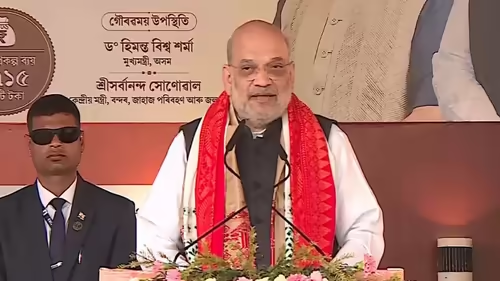
Amit Shah Accuses Rahul Gandhi of Disrespecting Northeast by Skipping Gamosa in Assam
In the high-stakes battleground of Assam’s 2026 assembly elections, a simple piece of cloth has become a lightning rod for political controversy. Union Home Minister Amit Shah has launched a scathing attack on Congress leader Rahul Gandhi, claiming that by not wearing the traditional gamosa during his recent tour of the state, Gandhi showed “disrespect to the entire Northeast.” This seemingly small omission has been amplified into a major campaign issue, highlighting how deeply cultural symbols are intertwined with political legitimacy in India’s diverse democracy.
The gamosa controversy Assam is more than just a wardrobe critique—it’s a strategic narrative from the BJP aimed at painting the Congress as outsiders who fail to understand or honor the unique identity of the Northeast. For voters in Assam, where regional pride runs deep, such gestures (or lack thereof) can carry significant weight.
Table of Contents
- What Is a Gamosa—and Why Does It Matter?
- Shah’s Charge: “Rahul Disrespected the Northeast”
- The Political Symbolism of Cultural Gestures in Assam
- Congress Response and the Broader Election Context
- Why the Northeast Is a Key Battleground in 2026
- Beyond the Gamosa: What This Reveals About Indian Politics
- Conclusion: Culture as a Campaign Weapon
- Sources
What Is a Gamosa—and Why Does It Matter?
The gamosa is far more than just a cotton towel or scarf. It is a sacred symbol of Assamese identity, hospitality, and respect. Traditionally offered to guests, elders, and deities, it is used in Bihu dances, religious ceremonies, and even as a head covering during daily work. To receive a gamosa is to be welcomed into the community; to wear one during a public visit is to acknowledge and honor local culture [[15]].
For politicians, donning the gamosa has become a near-universal ritual when visiting Assam. Prime Minister Narendra Modi, Mamata Banerjee, and even previous Congress leaders have all worn it prominently. It signals humility, cultural awareness, and a willingness to connect on the people’s terms—not just as a national figure, but as a respectful guest.
Shah’s Charge: “Rahul Disrespected the Northeast”
Speaking at a rally in Assam, Amit Shah didn’t mince words. “Rahul Gandhi came to Assam but did not wear the gamosa,” he declared. “By doing so, he has disrespected not just Assam, but the entire Northeast” [[12]]. This statement was carefully crafted to resonate beyond state borders, appealing to the shared sense of marginalization often felt across the eight northeastern states.
Shah’s rhetoric ties into a broader BJP narrative that positions the party as the true champion of the Northeast—pointing to infrastructure projects, peace accords, and increased central attention under PM Modi. By contrast, the Congress is portrayed as having taken the region for granted for decades, only showing up during elections without genuine engagement.
The Political Symbolism of Cultural Gestures in Assam
In a state with a complex history of insurgency, migration debates, and demands for autonomy, cultural symbols like the gamosa serve as powerful markers of belonging. When a national leader ignores them, it can be interpreted as indifference—or worse, arrogance.
This isn’t just about optics. In Assam, where language, ethnicity, and land rights are deeply sensitive issues, perceived cultural slights can quickly translate into political alienation. The gamosa controversy Assam taps into this emotional undercurrent, turning a fashion choice into a referendum on respect and recognition.
Congress Response and the Broader Election Context
While the Congress has not issued a formal rebuttal, sources suggest the party may argue that substance matters more than symbolism. However, in the theater of electoral politics, symbolism often *is* substance. With the BJP aggressively campaigning on regional pride and development, the Congress risks appearing out of touch if it dismisses such concerns as trivial.
Moreover, this incident comes as the Congress tries to rebuild its base in the Northeast after losing ground in recent years. A misstep—real or perceived—could further erode its credibility among voters who feel their identity is under constant threat from mainland India’s political narratives [[INTERNAL_LINK:northeast-india-political-landscape]].
Why the Northeast Is a Key Battleground in 2026
The Northeast is no longer a political afterthought. With 25 Lok Sabha seats and growing strategic importance, both national parties are investing heavily in the region. Assam, in particular, is seen as a bellwether. Winning here would validate the BJP’s “Look East” policy and deal a blow to Congress’s hopes of a national comeback.
Cultural diplomacy—through language, attire, and local customs—has become a core part of this strategy. The gamosa, therefore, is not just fabric; it’s a frontline in the battle for hearts and minds.
Beyond the Gamosa: What This Reveals About Indian Politics
This episode reflects a larger trend in Indian politics: the increasing localization of national campaigns. Voters no longer respond solely to grand economic promises; they demand acknowledgment of their distinct histories, fears, and aspirations. From Tamil Nadu to Punjab to Nagaland, political success hinges on the ability to speak the local language—literally and culturally.
The BJP has mastered this art, while the Congress, still grappling with its pan-Indian identity, sometimes stumbles. The gamosa controversy is a stark reminder that in India’s federal democracy, unity is built through respect for difference—not the erasure of it.
Conclusion: Culture as a Campaign Weapon
The gamosa controversy Assam may seem like a minor skirmish, but it reveals the high stakes of cultural respect in modern Indian elections. Amit Shah’s attack is not just about Rahul Gandhi’s attire—it’s a calculated move to question the Congress’s commitment to the Northeast’s dignity and identity. As Assam heads to the polls in 2026, every gesture will be scrutinized, and every symbol weighed. In this new political era, the gamosa isn’t just worn—it’s wielded.
Sources
- [[12]] Times of India. (2026, January 30). ‘Disrespected northeast by not wearing gamosa’: Shah blasts Rahul in poll-bound Assam. Retrieved from https://timesofindia.indiatimes.com/india/disrespected-northeast-by-not-wearing-gamosa-amit-shah-blasts-rahul-gandhi-in-poll-bound-assam/articleshow/127795780.cms
- [[15]] Assam Tourism. (2025). The Cultural Significance of the Gamosa. Government of Assam. https://assamtourism.gov.in
- [[20]] Election Commission of India. (2025). Assam Legislative Assembly Election Schedule. https://eci.gov.in