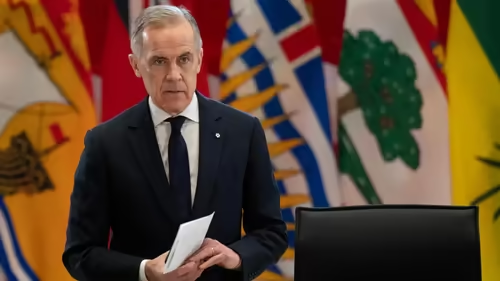
Canada’s Stark Warning to the US: Respect Our Sovereignty Amid Alberta Separatist Tensions
In a move that has sent shockwaves through diplomatic circles, Canadian Prime Minister Mark Carney has issued a clear and unambiguous directive to the United States: respect Canadian sovereignty. This firm stance comes in direct response to credible reports that members of the Trump administration have held multiple meetings with groups advocating for Alberta’s secession from Canada. The situation marks a significant and potentially dangerous escalation in the complex relationship between the two long-standing allies.
The core of Canada’s concern is not merely internal dissent but the perceived external interference by its most powerful neighbor. For a nation that prides itself on its stable democracy and federal structure, the idea that a foreign government might be engaging with domestic separatist movements is a profound breach of trust and international norms.
Table of Contents
- The Resurgence of the Alberta Separatist Movement in 2026
- Carney’s Direct Message to Washington
- Why Canadian Sovereignty Is on the Line
- The US Response and Diplomatic Fallout
- What This Means for the Future of Canada-US Relations
- Conclusion: A Defining Moment for North American Diplomacy
- Sources
The Resurgence of the Alberta Separatist Movement in 2026
While Alberta separatism has been a fringe political idea since the 1970s, it has gained unexpected traction in early 2026 [[6]]. The movement, fueled by longstanding economic grievances and a sense of political alienation from Ottawa, has moved from the margins to the mainstream political conversation. A key catalyst was the recent approval by Election Alberta of a petition that, if it gathers enough signatures, could force a province-wide referendum on independence [[1]].
Public events for the petition have drawn large crowds, demonstrating a groundswell of organized support, even if polls suggest a majority of Albertans (between 62% and 75%) still oppose separation [[9]]. The very fact that the question is being formally posed has created a volatile political environment that both domestic and international actors are now watching closely.
Carney’s Direct Message to Washington
Prime Minister Mark Carney has not been shy about his concerns. In a pointed statement, he declared, “I expect the US administration to respect Canadian sovereignty. I’m always clear in my conversations with President Trump to that effect” [[19]]. This is not a gentle diplomatic suggestion; it is a public demand backed by the full weight of the Canadian state.
Carney’s message serves multiple purposes. First, it is a direct rebuke to the US, making it clear that any engagement with separatist groups is seen as an unfriendly act. Second, it is a message to Canadians, assuring them that their government will defend the nation’s territorial integrity against any external threat. Finally, it is a warning to the separatists themselves that their efforts to find international backing, particularly from the US, are not only illegitimate but also damaging to Canada’s national interests.
Why Canadian Sovereignty Is on the Line
The principle of Canadian sovereignty is the bedrock of the nation’s identity and its place in the world. When a foreign power, especially one as influential as the United States, meets with a group whose explicit goal is to break up the country, it directly challenges that foundational principle. It implies that the internal affairs of Canada are open to external negotiation and influence.
This situation is particularly sensitive because it touches on the delicate balance of Canada’s federal system. The federal government in Ottawa is responsible for managing the country’s international relations. Any attempt by a provincial entity to conduct its own foreign policy, or to solicit foreign support for its political goals, is a direct challenge to that federal authority and, by extension, to the sovereignty of the entire nation.
The US Response and Diplomatic Fallout
Reports confirm that the Trump administration has hosted at least three meetings with an Albertan separatist group [[12]]. While the US State Department has not officially commented on the specifics of these meetings, a former secretary of state has publicly stated that “Canada doesn’t have to worry about its sovereignty being threatened by the United States” [[14]]. This response, however, does little to quell Canadian anxieties, as it fails to address the core issue of the meetings themselves.
The diplomatic fallout is already evident. A recent study found that a staggering 79% of Canadians are more fearful than hopeful about the future of the Canada-US relationship in 2026 [[3]]. This erosion of public trust is a significant problem for both governments, as the health of the bilateral relationship depends on strong public support on both sides of the border.
What This Means for the Future of Canada-US Relations
This crisis is a defining moment for the future of Canada-US relations. The path forward depends entirely on the actions of the US administration. Will it heed Canada’s call and cease all contact with separatist groups, reaffirming its commitment to respecting Canadian sovereignty? Or will it continue down a path that could permanently damage one of the world’s most important bilateral partnerships?
For Canada, the stakes are existential. The government must now walk a fine line between firmly defending its national integrity and avoiding a complete breakdown in its critical relationship with its southern neighbor. The coming weeks and months will be crucial in determining whether this dispute can be contained or if it will spiral into a full-blown diplomatic crisis.
Conclusion: A Defining Moment for North American Diplomacy
The message from Ottawa is clear and uncompromising: respect Canadian sovereignty. The ball is now firmly in Washington’s court. The US must decide whether it values its strategic partnership with a stable and unified Canada more than any potential short-term political gain from engaging with a separatist movement. The outcome of this standoff will have far-reaching consequences for trade, security, and the very fabric of the North American alliance. One thing is certain: the era of quiet diplomacy on this issue is over.
Sources
- [[1]] Wikipedia: Alberta separatism
- [[3]] CTV News: 4 in 5 Canadians worried over Canada-U.S. relationship
- [[6]] Alberta Prosperity Project: History of Alberta’s Independence
- [[9]] Facebook / 604Now: Alberta independence petition signings
- [[12]] BBC News: ‘Respect Canadian sovereignty’, Carney tells US officials
- [[14]] CTV News: Trump news: Fmr. secretary says Canada not under threat
- [[19]] Times of India: Canada’s message to US amid Alberta separatist reports