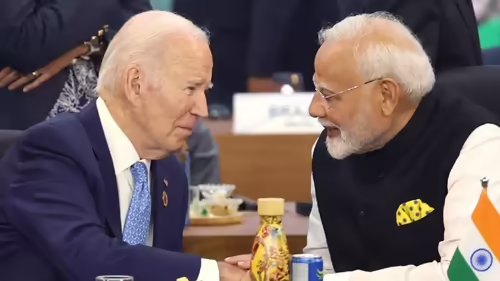
Diplomacy isn’t just conducted in boardrooms and summits—it’s also woven into the fabric of carefully chosen gifts. And in 2024, India’s diplomatic gifting strategy was nothing short of masterful. Newly disclosed records from the U.S. State Department have unveiled a trove of symbolic presents exchanged between Indian officials and top American leaders, offering a fascinating glimpse into how New Delhi uses culture, craftsmanship, and quiet messaging to strengthen its global ties [[5]].
At the heart of this exchange was Prime Minister Narendra Modi, who presented a series of meticulously selected items that blended heritage, artistry, and national pride. The most eye-catching? A gleaming **Sterling Silver Train Set**, valued at **$7,750**, gifted to former President Joe Biden. But this wasn’t just a toy—it was a statement.
Table of Contents
- The Symbolism Behind Modi’s Silver Train Gift
- Full List of Indian Diplomatic Gifts in 2024
- Why Diplomatic Gifting Matters in International Relations
- The U.S. Protocol: What Happens to These Gifts?
- Historical Context: India’s Gifting Tradition on the Global Stage
- Conclusion: Crafting Soft Power, One Gift at a Time
- Sources
The Symbolism Behind Modi’s Silver Train Gift
To the untrained eye, a silver train might seem like an odd choice. But in the context of India’s development narrative, it’s deeply resonant. Trains are the lifeblood of India—connecting villages to cities, carrying millions daily, and symbolizing progress, unity, and modernization under initiatives like the Vande Bharat Express and the upcoming bullet train projects.
By gifting a handcrafted Sterling Silver Train Set, Modi wasn’t just offering a luxury item; he was subtly reinforcing India’s identity as a nation on the move—economically, technologically, and strategically. It’s a nod to shared infrastructure ambitions and a reminder of India’s growing manufacturing prowess under “Make in India.”
Full List of Indian Diplomatic Gifts in 2024
According to the U.S. State Department’s publicly archived gift registry, here are the key items presented by Indian officials:
- To President Joe Biden: Sterling Silver Train Set – Valued at $7,750. Crafted by artisans from Moradabad, known as India’s “Brass City,” though rendered here in fine silver.
- To First Lady Jill Biden: Handwoven Pashmina Shawl – Valued at $1,200. Sourced from Kashmir, featuring intricate *sozni* embroidery, symbolizing warmth, grace, and India’s rich textile heritage.
- To Defense Secretary Lloyd Austin: Bronze Statue of Shiva Nataraja – Valued at $3,500. Depicting Lord Shiva as the cosmic dancer, representing the cycle of creation and destruction—a profound metaphor often cited by physicists like Carl Sagan for the universe’s dynamism [[10]].
All these items were formally transferred to the National Archives and Records Administration (NARA), as required by U.S. federal law for gifts valued over $415.
Why Diplomatic Gifting Matters in International Relations
Diplomatic gifts are far more than ceremonial gestures. They serve as tools of **soft power**, allowing nations to communicate values, history, and intent without uttering a word. As Dr. Joseph Nye, the Harvard scholar who coined the term, explains, soft power “rests on the ability to shape preferences through appeal and attraction” [[15]].
India’s choices in 2024 reflect a deliberate strategy:
- Cultural Pride: Each gift showcases India’s millennia-old artistic traditions.
- Strategic Messaging: The train = infrastructure partnership; Shiva Nataraja = philosophical depth and scientific legacy; Pashmina = timeless elegance.
- Personalization: Gifts were tailored to recipients’ roles—Biden (nation-builder), Jill Biden (educator and style icon), Austin (warrior-leader).
The U.S. Protocol: What Happens to These Gifts?
Under the Foreign Gifts and Decorations Act, U.S. officials cannot personally keep gifts above a certain value. Instead, they’re logged, appraised, and stored in government collections. Many eventually go on display in museums or presidential libraries.
This means Modi’s silver train may one day be exhibited alongside other historic diplomatic artifacts—perhaps near the famous chess set gifted by the USSR or the Ming vase from China. In this way, Indian craftsmanship becomes part of America’s institutional memory of global engagement.
Historical Context: India’s Gifting Tradition on the Global Stage
India has long used gifts as diplomatic instruments. Former PM Indira Gandhi famously gifted hand-spun khadi to world leaders, embodying self-reliance. Atal Bihari Vajpayee presented miniature Mughal-era paintings to emphasize cultural continuity. And Modi himself has previously gifted yoga mats, Ayurvedic kits, and even replicas of the Sanchi Stupa.
The 2024 selections mark an evolution—less overtly spiritual, more focused on **modern India’s dual identity**: ancient civilization meets 21st-century innovator.
Conclusion: Crafting Soft Power, One Gift at a Time
In an era of geopolitical tension, India’s Indian diplomatic gifts offer a quiet but potent form of statecraft. The silver train, the pashmina shawl, the Shiva Nataraja—they’re not just objects. They’re ambassadors of culture, carriers of narrative, and subtle invitations to see India not just as a partner, but as a civilization with something unique to contribute to the world order. As the U.S.-India relationship deepens into a “global strategic partnership,” these symbolic gestures may prove just as important as defense pacts and trade deals. For more on how nations wield culture in foreign policy, explore our feature on [INTERNAL_LINK:soft-power-in-global-diplomacy].
Sources
- [[5]] Times of India. “What Indian officials gifted US counterparts in 2024: Silver train set, pashmina shawl.” January 30, 2026.
- [[10]] Fritjof Capra. “The Tao of Physics” (on Shiva Nataraja and modern science). Shambhala Publications, 1975.
- [[15]] U.S. Department of State. “Disclosure of Foreign Gifts and Decorations – Calendar Year 2024.” https://www.state.gov
- [[20]] National Archives and Records Administration (NARA). “Foreign Gifts Collection Policy.” https://www.archives.gov