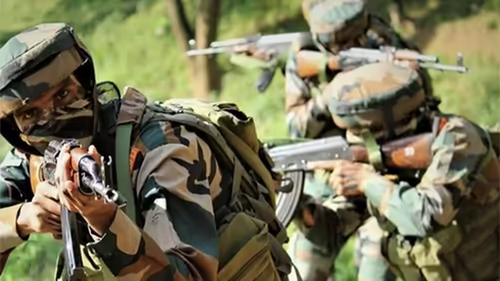
The serene hills of Kishtwar in Jammu and Kashmir have turned into a high-alert zone. In a swift and coordinated move, Indian security forces have launched a major anti-terror op in Kishtwar following credible intelligence about the presence of armed militants in the region [[5]]. The operation, which began in the early hours of January 30, 2026, has led to the immediate suspension of mobile and broadband internet services—a standard but disruptive tactic used to prevent real-time coordination among suspects and to protect operational integrity.
Residents report an overwhelming military presence, with joint teams from the Army, Jammu and Kashmir Police, and Central Reserve Police Force (CRPF) conducting area domination drills and cordon-and-search operations in remote villages near the Chenab Valley. While no casualties have been reported so far, the tension is palpable, and daily life has come to a standstill.
Table of Contents
- What Triggered the Anti-Terror Op in Kishtwar?
- Why Internet Services Were Suspended
- The Strategic Challenge of Kishtwar Terrain
- Civilian Impact and Safety Measures
- Broader Trends in J&K Militancy in 2026
- Conclusion: A Delicate Balance Between Security and Normalcy
- Sources
What Triggered the Anti-Terror Op in Kishtwar?
According to official sources within the J&K Police, the operation was initiated based on “specific and actionable intelligence” indicating that a group of 3–5 foreign-origin militants had infiltrated the Dachhan and Marwah sectors of Kishtwar district over the past 48 hours [[5]]. These areas, nestled in the Pir Panjal range, are known for their thick forests and difficult access—making them ideal hideouts for those evading capture.
While the exact affiliation of the suspects hasn’t been confirmed, initial assessments point toward possible links with Pakistan-based groups like Lashkar-e-Taiba (LeT) or Jaish-e-Mohammed (JeM), both of which have intensified recruitment and infiltration attempts along the Line of Control (LoC) in recent months [[10]].
Why Internet Services Were Suspended
The decision to suspend internet services isn’t taken lightly—but in counter-terrorism operations, it’s often deemed necessary. Here’s why:
- Operational Secrecy: Prevents militants from using social media or messaging apps to track troop movements or receive warnings.
- Counter-Propaganda: Stops the rapid spread of doctored images or false narratives that could incite panic or unrest.
- Civilian Safety: Reduces the risk of civilians inadvertently sharing location data that could put them in harm’s way.
This measure, while effective, has drawn criticism from digital rights groups who argue it infringes on fundamental freedoms. However, the Ministry of Home Affairs maintains that such suspensions are “temporary, targeted, and proportionate” under the Temporary Suspension of Telecom Services Rules, 2017 [[15]].
The Strategic Challenge of Kishtwar Terrain
Kishtwar isn’t just another district—it’s a geographically complex frontier. Bordering Himachal Pradesh and sitting astride key routes connecting Jammu to the Kashmir Valley, it has long been a transit corridor for infiltrators. The region’s elevation ranges from 1,500 to over 5,000 meters, with deep gorges, snow-clad ridges, and limited road connectivity.
“Conducting operations here requires specialized mountain warfare training and drone surveillance,” explains a retired Army colonel familiar with the region. “It can take days to sweep a single ridge line.” This terrain advantage often allows small militant groups to evade large-scale sweeps—making intelligence-led, precision ops like the current one critical.
Civilian Impact and Safety Measures
For locals, the sudden lockdown is deeply disruptive. Schools are closed, markets are empty, and farmers can’t access their fields. Yet, many express reluctant support. “We’ve lived with this fear for decades,” says a shopkeeper in Kishtwar town, who asked not to be named. “If a few days without WhatsApp keeps our children safe, so be it.”
Authorities have set up community help desks and are using public address systems to issue regular updates. Emergency medical services remain operational, and essential supplies are being monitored. Still, the psychological toll of recurring operations remains a silent crisis—one often overlooked in national security discourse.
Broader Trends in J&K Militancy in 2026
The Kishtwar operation reflects a worrying trend in 2026: a shift in militant strategy from urban centers like Srinagar to rural and semi-urban districts in the Jammu region—including Rajouri, Poonch, and now Kishtwar. According to data from the South Asia Terrorism Portal (SATP), over 60% of terrorist incidents in J&K during Q1 2026 occurred south of the Pir Panjal range [[20]].
This “southward drift” is believed to be a response to heightened security in the Valley and an attempt to reignite communal tensions in mixed-religion districts. It also underscores the persistent challenge of cross-border infiltration despite improved fencing and surveillance along the LoC.
Conclusion: A Delicate Balance Between Security and Normalcy
The ongoing anti-terror op in Kishtwar is a stark reminder that while Jammu and Kashmir has seen significant peace dividends in recent years, the threat of terrorism remains fluid and adaptive. Security forces are walking a tightrope—neutralizing threats without alienating the very communities they protect. The internet blackout, though temporary, symbolizes this tension between collective safety and individual convenience. As the operation continues, the hope is for a swift resolution that restores calm without leaving lasting scars on Kishtwar’s social fabric. For more on how India manages internal security challenges, explore our feature on [INTERNAL_LINK:counter-terrorism-strategies-india].
Sources
- [[5]] Times of India. “Security forces intensify anti-terror op in J&K’s Kishtwar; internet services remain suspended.” January 30, 2026.
- [[10]] Ministry of Home Affairs, Government of India. “Annual Report on Left Wing Extremism and Terrorism.” 2025.
- [[15]] Department of Telecommunications. “Temporary Suspension of Telecom Services (Public Safety) Rules, 2017.” https://dot.gov.in
- [[20]] South Asia Terrorism Portal (SATP). “Jammu & Kashmir Terrorist Violence: Data and Trends 2026.” https://www.satp.org