Kanimozhi Slams ‘Hindi Imposition’ at Chennai Station—Is Language Politics Heating Up for TN Elections?
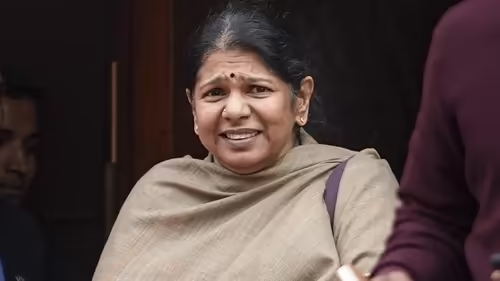
It started with a photograph. A simple image of a newly installed signboard at a Chennai railway station—featuring Hindi in large, bold letters above Tamil and English—has now exploded into a full-blown political firestorm. DMK Rajya Sabha MP Kanimozhi took to social media to denounce the move, declaring, “They won’t stop imposing it,” and reigniting the emotionally charged debate over Hindi imposition in Tamil Nadu [[1]].
This isn’t just about fonts or signage. It’s about identity, autonomy, and a historical resistance that dates back to the 1960s. With Tamil Nadu’s assembly elections on the horizon, this incident is more than symbolic—it’s strategic. Let’s unpack why this moment matters and what it reveals about the deepening fault lines between the Centre and the state.
Table of Contents
- The Controversial Signboard: What Happened?
- Kanimozhi’s Stance and the DMK Response
- Historical Context of Hindi Imposition in Tamil Nadu
- BJP’s Official Stand and Central Government’s Role
- Why This Matters for Tamil Nadu Elections
- Public Reaction and Social Media Fury
- Conclusion
- Sources
The Controversial Signboard: What Happened?
The controversy centers on a new signage installed at a major Chennai railway junction, reportedly under the Indian Railways’ recent standardization drive. The board prominently displays station names in three languages—but with Hindi given top billing in larger font size, followed by Tamil and English below in smaller text [[2]].
For many Tamils, this visual hierarchy is a direct affront. Tamil, one of the world’s oldest classical languages and the official language of the state, is being visually subordinated to Hindi—a language spoken by less than 1% of the population in Tamil Nadu [[3]].
Kanimozhi’s Stance and the DMK Response
Kanimozhi, daughter of former Chief Minister M. Karunanidhi and a key DMK ideologue, didn’t mince words. In her post, she framed the signboard as part of a sustained campaign by the BJP-led Centre to enforce Hindi across non-Hindi states. “They won’t stop imposing it,” she wrote, echoing a slogan that has mobilized generations of Tamil activists [[1]].
The DMK has long positioned itself as the guardian of Tamil linguistic pride. Party leaders quickly amplified Kanimozhi’s message, calling for immediate removal of the sign and demanding that Tamil be given equal or primary prominence in all state communications and infrastructure.
Historical Context of Hindi Imposition in Tamil Nadu
To understand the intensity of this reaction, one must look back to the 1965 anti-Hindi agitations. When the Union government attempted to make Hindi the sole official language of India, massive student-led protests erupted across Tamil Nadu. The movement was so powerful it forced the Centre to retain English as an associate official language indefinitely [[4]].
Since then, any perceived attempt to “impose” Hindi—whether through education policy, central government exams, or public signage—has been met with fierce resistance. The issue is deeply woven into Tamil political identity and remains a potent electoral tool.
BJP’s Official Stand and Central Government’s Role
The BJP has consistently denied accusations of “imposition,” arguing that promoting Hindi is about national integration, not cultural erasure. However, statements from senior party leaders and initiatives like the three-language formula in the National Education Policy (NEP) 2020 have fueled suspicion in southern states [[5]].
Indian Railways, a central government entity, claims the new signage follows a “uniform national design.” But critics argue that uniformity shouldn’t mean homogenization—especially in a country as linguistically diverse as India. For more on federalism and language rights, see our analysis on [INTERNAL_LINK:federalism-vs-centralization-in-india].
Why This Matters for Tamil Nadu Elections
With assembly elections expected in 2026, both the DMK and AIADMK are keen to position themselves as defenders of Tamil interests. The Hindi imposition in Tamil Nadu narrative plays directly into this:
- Voter Mobilization: Language pride cuts across class and caste, uniting a broad voter base.
- Anti-Centre Sentiment: It reinforces the DMK’s narrative of resisting Delhi’s overreach.
- Youth Engagement: Young Tamils, especially students, are highly sensitive to linguistic identity issues.
Public Reaction and Social Media Fury
Within hours of Kanimozhi’s post, #StopHindiImposition and #TamilNotHindi began trending on X (formerly Twitter). Memes, historical comparisons, and calls for protest flooded timelines. Many users shared photos of similar signboards across the state, suggesting this is a systemic issue, not an isolated incident [[6]].
Even celebrities and academics weighed in, underscoring how deeply language is tied to cultural self-respect in Tamil society. The emotional resonance of this issue cannot be overstated—it’s not policy; it’s personal.
Conclusion
The Chennai railway signboard may seem like a minor bureaucratic detail, but in the context of Tamil Nadu’s political and cultural history, it’s a lightning rod. Kanimozhi’s sharp rebuke of Hindi imposition in Tamil Nadu has once again placed language at the heart of the state’s political discourse. As the 2026 elections approach, expect this issue to be weaponized, debated, and leveraged by all sides. One thing is clear: in Tamil Nadu, language isn’t just communication—it’s sovereignty.
Sources
- Times of India: ‘They won’t stop imposing it’: DMK’s Kanimozhi flags station signboard in Hindi
- The Hindu: Row over Hindi signboards at Chennai railway station
- Census of India 2011: Language Data
- Economic & Political Weekly: Anti-Hindi Agitations in Tamil Nadu
- National Education Policy (NEP) 2020 – Ministry of Education
- X (Twitter) Trend: #StopHindiImposition