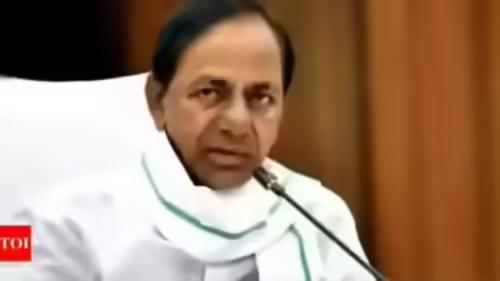
SIT Summons KCR in Phone-Tapping Probe: Is Telangana’s Political Crisis Deepening?
In a dramatic turn of events that has sent shockwaves through the political corridors of Hyderabad, the Special Investigation Team (SIT) probing the alleged phone-tapping scandal has officially summoned former Chief Minister K. Chandrashekar Rao (KCR). This move marks a critical juncture in the investigation, confirming that the KCR phone tapping probe has now climbed to the very top rung of the previous state administration [[2]].
The SIT served the notice at KCR’s residence in Nandinagar, Banjara Hills, on January 29, 2026, directing him to appear for questioning on Friday, January 30, at 3 PM [[4]]. The notice stated that the probe so far had found KCR was “acquainted with facts and circumstances relevant to the case,” making his testimony crucial [[2]].
Table of Contents
- What is the Phone-Tapping Scandal?
- Why the Summons of KCR is a Major Escalation
- The Broader Investigation Targeting the BRS Regime
- Political Reactions and Allegations of Vendetta
- Legal Framework and Privacy Concerns
- What Happens Next in the KCR Phone Tapping Probe?
- Conclusion
- Sources
What is the Phone-Tapping Scandal?
The controversy erupted after the current Congress-led government in Telangana initiated an investigation into allegations that the previous BRS administration, under KCR, had illegally intercepted the phones of a wide range of individuals. These reportedly included opposition party members, prominent businessmen, and other citizens [[6]].
Such surveillance, if proven to be unauthorized, would be a severe violation of privacy rights and a potential abuse of state power. The case has reignited a national debate on the balance between state security and individual liberty.
Why the Summons of KCR is a Major Escalation
Until now, the probe had primarily focused on officials and ministers within the BRS government. The summoning of KCR, the founder of the BRS and the most powerful figure in the state for over a decade, is a watershed moment. It signals that the SIT believes there is credible evidence or information that places the former CM at the center of the decision-making process regarding these alleged surveillance activities [[1]].
This is not just a routine call for a witness; it’s a direct challenge to the legacy of the BRS regime. It raises serious questions about the chain of command and who ultimately authorized such operations.
The Broader Investigation Targeting the BRS Regime
KCR is not the first high-profile BRS leader to be summoned. Just days earlier, his son and BRS working president, K.T. Rama Rao (KTR), was also called in for questioning by the SIT [[5]]. This coordinated approach suggests a systematic effort to map the entire structure of the alleged surveillance apparatus.
The investigation appears to be following a clear path: from the technical operators to the mid-level bureaucrats, then to the ministers, and now to the apex leadership. This methodical climb up the ladder underscores the seriousness with which the new state government is treating the allegations.
Political Reactions and Allegations of Vendetta
Unsurprisingly, the BRS has cried foul. The party has dismissed the summons as a politically motivated “vendetta” by the ruling Congress government, aimed at tarnishing KCR’s image and destabilizing the opposition [[9]].
However, legal experts argue that a properly constituted SIT, operating under judicial oversight, has a duty to follow the evidence wherever it leads—even if it points to the highest office in the land. The key will be whether the SIT can present concrete, admissible evidence to support its line of inquiry.
Legal Framework and Privacy Concerns
In India, phone tapping is governed by Section 5(2) of the Indian Telegraph Act, 1885, and must adhere to strict procedural safeguards laid out in Rule 419A of the Indian Telegraph Rules. Any interception without proper authorization from the competent authority is illegal.
The Supreme Court of India, in the landmark Justice K.S. Puttaswamy (Retd.) vs Union Of India case, has unequivocally declared the right to privacy as a fundamental right under the Constitution [[7]]. This case provides a strong legal foundation for any citizen whose privacy may have been violated by state surveillance.
What Happens Next in the KCR Phone Tapping Probe?
All eyes are now on KCR’s response to the summons. Will he appear before the SIT as directed? His cooperation—or lack thereof—will be a major indicator of how this political and legal drama will unfold. For more on navigating political scandals, see our analysis on [INTERNAL_LINK:political-crisis-management].
Potential next steps include:
- Recording of Statement: If KCR appears, his statement will be recorded, which could either exonerate him or lead to further lines of inquiry.
- Forensic Evidence Analysis: The SIT is likely examining server logs, authorization files, and financial records to build a technical case.
- Possible Charges: If sufficient evidence is found, the SIT could recommend filing formal charges against those responsible.
Conclusion
The summoning of KCR in the KCR phone tapping probe is far more than a procedural formality; it’s a pivotal moment for Telangana’s democracy. It tests the independence of its investigative agencies and the accountability of its most powerful leaders. As the probe continues, it serves as a stark reminder that in a democratic republic, no one is above the law—not even a former chief minister. The coming days will be crucial in determining whether this investigation leads to justice or becomes another chapter in the state’s ongoing political feud.
Sources
- Times of India: Phone-tapping probe reaches top rung as SIT summons KCR
- Indian Express: KCR summoned for questioning in phone tapping case
- Daijiworld: Telangana SIT summons K Chandrasekhar Rao in phone tapping case
- Deccan Herald: SIT Issues Notice to K T Rama Rao
- MSN: KCR served notice to appear before SIT, BRS calls it vendetta
- Indian Kanoon: Section 5(2), Indian Telegraph Act, 1885
- Supreme Court of India: Justice K.S. Puttaswamy (Retd.) vs Union Of India