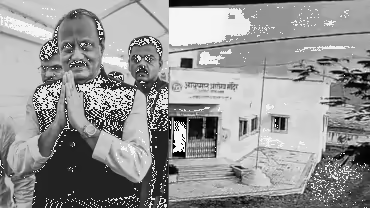
On a fog-drenched morning in Baramati, Maharashtra, a routine flight turned into a national tragedy. The private Learjet 45XR carrying Deputy Chief Minister Ajit Pawar and five others never reached its destination. Instead, newly released CCTV footage—grainy but chillingly clear—captures the aircraft’s horrifying final seconds: a sudden, violent left roll followed by a near-vertical descent into the earth [[1]]. All six aboard, including Pawar, perished instantly.
This isn’t just another aviation incident. The Ajit Pawar plane crash has sent shockwaves through Indian politics and raised urgent questions about private jet safety, pilot training, and emergency protocols in low-visibility conditions. With preliminary analysis pointing to a total loss of control at an altitude too low for recovery, experts are demanding a transparent, independent investigation—and systemic reforms before another life is lost.
Table of Contents
- The Footage: What the CCTV Video Reveals
- Sequence of Events: From Takeoff to Tragedy
- Possible Causes: Engine Failure, Icing, or Control Surface Malfunction?
- India’s Private Aviation Safety Gaps Exposed
- Political Fallout and Public Outcry
- Conclusion: A Wake-Up Call for India’s Skies
- Sources
The Footage: What the CCTV Video Reveals
Obtained by local media and verified by aviation analysts, the CCTV clip shows the Learjet at approximately 300–400 feet above ground during its initial climb after takeoff from Baramati airstrip. Suddenly, without warning, the aircraft banks sharply to the left, its left wing dipping almost vertically. Within two seconds, it enters a steep, uncontrolled dive—hitting the ground with devastating force [[1], [3]].
“This is classic ‘loss of control in flight’ (LOC-I),” explains retired Air Marshal S.K. Singh, an aviation safety consultant. “At that altitude, even the most skilled pilots have less than three seconds to react. Recovery is virtually impossible.”
Sequence of Events: From Takeoff to Tragedy
According to eyewitnesses and air traffic data, the flight departed around 7:15 AM on January 28, 2026, amid dense fog and visibility below 1,000 meters—conditions that require instrument flight rules (IFR). The pilots had filed an IFR plan, but Baramati’s airstrip lacks advanced navigation aids like an Instrument Landing System (ILS), increasing reliance on pilot skill and onboard avionics [[5]].
Within 90 seconds of takeoff, radar contact was lost. Emergency services arrived within minutes, but the impact was so severe that all occupants were killed on site. Among the victims were two crew members, two aides, and a senior NCP official, alongside Pawar [[2]].
Possible Causes: Engine Failure, Icing, or Control Surface Malfunction?
While the official investigation by the Directorate General of Civil Aviation (DGCA) is ongoing, early technical assessments suggest several plausible scenarios:
- Engine failure or asymmetric thrust: A sudden loss of power in one engine could cause uncontrollable yaw and roll, especially during climb-out.
- Atmospheric icing: In freezing fog, ice can accumulate on wings and tail surfaces, disrupting airflow and causing stalls—even in modern jets.
- Control surface jam or malfunction: A mechanical failure in the ailerons or rudder could lead to abrupt, unrecoverable movements.
- Spatial disorientation: In low visibility, pilots can lose sense of attitude, leading to incorrect control inputs—a known risk in non-precision airports like Baramati.
Notably, the Learjet 45XR is generally considered a reliable aircraft, but its performance margins shrink dramatically in adverse weather without proper ground support systems.
India’s Private Aviation Safety Gaps Exposed
The Ajit Pawar plane crash has spotlighted a dangerous blind spot in India’s aviation ecosystem: the rapid growth of private and charter flights operating out of under-equipped airstrips. According to DGCA data, over 60% of India’s 450+ operational airstrips lack ILS or precision approach capabilities [[7]].
“Politicians and business leaders often use these small airports for convenience,” says Dr. Anjali Rao, an aerospace safety researcher at IIT Bombay. “But convenience shouldn’t override safety. Flying IFR in zero visibility from a non-instrumented strip is playing with fire.”
For more on regulatory challenges, see our deep dive on [INTERNAL_LINK:private-jet-safety-regulations-india].
Political Fallout and Public Outcry
Ajit Pawar’s death has triggered a leadership crisis in Maharashtra’s ruling coalition. But beyond politics, citizens are demanding accountability. Why was a high-risk flight authorized in such conditions? Why wasn’t a better-equipped airport used? And will this tragedy finally push for mandatory safety upgrades at regional airstrips?
Civil society groups have launched petitions calling for a Supreme Court-monitored probe, citing past incidents like the 2021 Kevadia crash that also involved a VIP on a private jet [[9]].
Conclusion: A Wake-Up Call for India’s Skies
The Ajit Pawar plane crash is more than a personal or political loss—it’s a systemic failure captured in real-time video. As investigators comb through wreckage and black box data, the nation must confront an uncomfortable truth: India’s aviation infrastructure hasn’t kept pace with its elite’s flying habits. Until every airstrip meets minimum safety standards and every flight prioritizes protocol over expediency, the skies over India will remain perilously vulnerable.