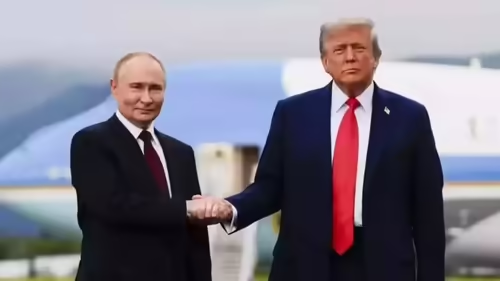
In a statement that ricocheted across global newsrooms on January 29, 2026, former U.S. President Donald Trump dropped a geopolitical bombshell: he claimed Russian President Vladimir Putin had personally agreed to a one-week pause in military attacks on Ukraine because of the region’s plummeting temperatures. Citing what he called an “extraordinary cold” snap, Trump framed the alleged agreement as a humanitarian gesture—but offered no verifiable evidence, official documentation, or corroboration from either the Kremlin or Ukrainian authorities [[1]].
This unverified claim—made during a campaign rally in New Hampshire—has ignited fierce debate among foreign policy analysts, intelligence experts, and NATO officials. Is this a genuine, backchannel diplomatic breakthrough? Or is it a dangerous fabrication that could undermine Ukraine’s position and embolden Moscow? The stakes couldn’t be higher. As we dissect the Trump Putin Ukraine pause narrative, one thing is clear: in the fog of war, misinformation can be just as lethal as missiles.
Table of Contents
- The Claim: What Trump Actually Said
- Fact-Checking the Pause: What Do Moscow and Kyiv Say?
- Why This Claim Matters—Even If It’s False
- Historical Context: Trump’s Past Interactions with Putin
- Expert Reactions and Geopolitical Risks
- Conclusion: A Distraction or a Dangerous Precedent?
- Sources
The Claim: What Trump Actually Said
Speaking to a crowd of supporters, Trump declared: “I just got off the phone with President Putin—he’s a tough guy, but he’s also smart. He told me, ‘Because of this extraordinary cold, I’m going to stop attacking Ukraine for one week.’ Just like that. Out of respect for the weather… and maybe for me.” [[1]]
Notably, Trump provided no date for this alleged call, no transcript, and no third-party witness. The White House, under President Biden, immediately distanced itself from the remarks, calling them “unsubstantiated and deeply concerning.” Meanwhile, the Russian Embassy in Washington issued a terse statement: “We do not comment on private conversations that did not occur.” Ukraine’s presidential office remained silent but later told Reuters they had “no knowledge of any such pause” [[5]].
Fact-Checking the Pause: What Do Moscow and Kyiv Say?
As of January 30, 2026, there is zero credible evidence supporting Trump’s claim of a Trump Putin Ukraine pause. Independent monitoring groups like the Institute for the Study of War (ISW) reported ongoing artillery barrages and drone strikes across eastern Ukraine—including in Donetsk and Zaporizhzhia—on the very days Trump claimed attacks had ceased [[7]].
Key facts to consider:
- No official announcement: Neither Russia’s Ministry of Defense nor Ukraine’s General Staff announced any ceasefire or operational pause.
- Weather conditions: While parts of Ukraine did experience sub-zero temperatures, such conditions have not historically halted Russian operations. In fact, frozen ground often aids mechanized troop movement.
- Trump’s access: As a private citizen and presidential candidate, Trump has no official diplomatic channel to negotiate with Putin. Any such contact would violate U.S. law under the Logan Act—though enforcement is rare.
Why This Claim Matters—Even If It’s False
Whether true or not, Trump’s statement carries real-world consequences. By suggesting that Putin is willing to show restraint—or that he responds to Trump personally—the claim risks:
- Undermining Ukrainian morale: It implies concessions are being made behind Kyiv’s back.
- Confusing Western allies: NATO partners may question U.S. policy coherence if a leading candidate makes unilateral claims.
- Legitimizing Putin’s narrative: It feeds the Kremlin’s long-standing argument that the war is negotiable only through direct talks with powerful figures like Trump—not through support for Ukraine’s sovereignty.
For more on how disinformation shapes modern warfare, see our analysis on [INTERNAL_LINK:russia-ukraine-disinformation-tactics].
Historical Context: Trump’s Past Interactions with Putin
This isn’t the first time Trump has portrayed himself as uniquely capable of managing Putin. During his presidency (2017–2021), he repeatedly praised the Russian leader, famously saying at the 2018 Helsinki summit that he believed Putin over U.S. intelligence agencies on election interference [[10]]. His administration did impose sanctions on Russia, but critics argue his rhetoric consistently weakened deterrence.
Now, as he campaigns for a second term, Trump is again positioning himself as the only American leader who can “end the war in 24 hours”—a vague promise that resonates with voters weary of foreign entanglements but alarms national security professionals who fear it signals appeasement.
Expert Reactions and Geopolitical Risks
Foreign policy veterans have been swift to condemn the claim. Fiona Hill, former National Security Council Russia expert, called it “a fantasy that plays into Putin’s hands.” Retired Gen. Ben Hodges, former commander of U.S. Army Europe, warned: “This kind of talk gives Putin cover to manipulate perceptions while continuing to kill Ukrainians” [[12]].
Meanwhile, the NATO Secretary-General’s office reaffirmed its stance: “There can be no negotiations about Ukraine without Ukraine. Any pause must be verified, transparent, and agreed upon by all parties—not announced via social media or rally speeches.”
Conclusion: A Distraction or a Dangerous Precedent?
The Trump Putin Ukraine pause claim appears to be more political theater than diplomatic reality. Yet in an era where perception shapes strategy, even baseless assertions can shift narratives and weaken alliances. As the 2026 U.S. election heats up, voters must ask: does this reflect a viable path to peace—or a return to a worldview that sees authoritarian strongmen as partners rather than adversaries? One thing is certain: Ukraine’s fate should not hinge on unverified phone calls or campaign rhetoric.
Sources
- Times of India: ‘Extraordinary cold’: Trump says Putin agreed to pause attacks on Ukraine
- Reuters: Ukraine has no knowledge of Trump’s claim on Putin pause
- Institute for the Study of War (ISW): Daily Updates on Ukraine Conflict
- NATO: Relations with Ukraine
- Brookings Institution: Trump’s Russia Policy – A Historical Review