Table of Contents
- The Boycott Bombshell: ‘Nahi Khelenge’
- Why Now? The Timing of Latif’s Statement
- Pakistan India T20 WC Boycott: What Does It Mean?
- Historical Context: Cricket as Diplomacy
- Reactions from Cricket and Political Circles
- Impact on ICC and World Cup Logistics
- Can a Government Decide Who a Team Plays?
- Conclusion
- Sources
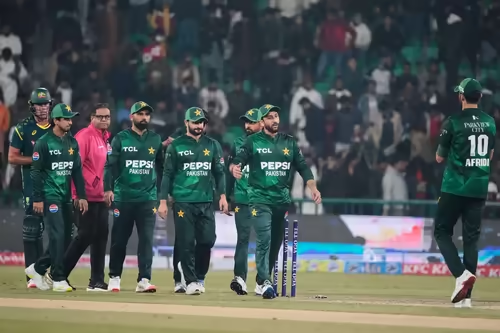
In a statement that has sent shockwaves through the cricketing world, former Pakistan captain Rashid Latif has openly suggested that Pakistan should refuse to play India in the upcoming ICC Men’s T20 World Cup 2026. Using the blunt phrase “Nahi khelenge” (We won’t play), Latif argued that while a full tournament boycott is no longer viable—especially after Bangladesh’s exclusion—the symbolic act of skipping the high-profile India match could still send a powerful message [[1]]. Crucially, he stressed that such a decision must come not from the Pakistan Cricket Board (PCB), but from the federal government itself.
The Boycott Bombshell: ‘Nahi Khelenge’
Latif, known for his candid views on cricket politics, made his remarks during a recent media appearance where he revisited his earlier call for a complete T20 World Cup boycott. He now concedes that moment has passed. “After Bangladesh was left out, a full boycott would have no impact,” he admitted. “But if we don’t play India, that’s different. That’s a statement.”
His comments come amid heightened geopolitical tensions between the two nuclear-armed neighbors, where cricket has long served as both a bridge and a battleground. The proposed Pakistan India T20 WC boycott isn’t just about sport—it’s deeply entangled with national identity, politics, and decades of unresolved conflict.
Why Now? The Timing of Latif’s Statement
The timing is significant. With the T20 World Cup scheduled for June 2026 in the West Indies and USA, teams are finalizing preparations, and the ICC is locking in fixtures. India and Pakistan are almost certain to be placed in the same group, guaranteeing at least one marquee clash—a match that typically draws over a billion viewers globally.
Latif’s intervention appears to be a reaction to growing domestic pressure in Pakistan. Nationalist voices have criticized the PCB for maintaining any form of sporting engagement with India, especially after New Delhi suspended bilateral series following the 2019 Pulwama attack. By shifting responsibility to the government, Latif is effectively calling for a policy-level decision, not a sporting one.
Pakistan India T20 WC Boycott: What Does It Mean?
If Pakistan were to skip the India match, the consequences would be far-reaching:
- ICC Sanctions: The International Cricket Council could penalize Pakistan with fines, point deductions, or even suspension from future events.
- Financial Loss: Broadcasters and sponsors pay premium rates for India-Pakistan matches. A no-show would cost millions in revenue.
- Fan Backlash: Cricket fans across South Asia—and the global diaspora—would be deeply disappointed, potentially damaging the sport’s popularity.
- Diplomatic Fallout: It could further strain already fragile India-Pakistan relations, turning a sporting event into a geopolitical flashpoint.
Moreover, forfeiting a World Cup match against a top rival like India would severely hurt Pakistan’s chances of advancing to the knockout stages.
Historical Context: Cricket as Diplomacy
Since their first Test in 1952, India-Pakistan cricket has been more than a game. Matches have been canceled during wars (1965, 1971), used as peace overtures (“cricket diplomacy” in 1987, 2004), and suspended after terrorist attacks (2008 Mumbai, 2019 Pulwama).
While bilateral series are currently frozen, the two teams still meet in ICC tournaments—a rare space where competition is allowed under neutral conditions. This arrangement has been carefully maintained by the ICC to preserve the sport’s global appeal. Disrupting it now would break an unspoken truce that has held for over a decade.
Reactions from Cricket and Political Circles
As of now, neither the PCB nor the Pakistani government has officially responded to Latif’s comments. However, social media is ablaze:
- Pro-Boycott Voices: “Sport shouldn’t normalize relations with a state that supports terrorism,” tweeted a prominent nationalist leader.
- Anti-Boycott Voices: “Cricket is our last connection. Don’t take that away too,” pleaded a fan on Instagram.
- Neutral Analysts: Many experts warn that politicizing ICC events sets a dangerous precedent that could lead to more exclusions and fragmentation in global cricket.
In India, the BCCI has remained silent, but insiders suggest they view any boycott as a non-starter. “The ICC framework exists precisely to keep politics out of multi-nation tournaments,” said a senior Indian official anonymously.
Impact on ICC and World Cup Logistics
The ICC has strict regulations requiring all participating nations to play scheduled matches. A refusal to play would trigger Article 2.10 of the ICC Code of Conduct, which addresses “failure to participate in a match without valid reason.”
Given the commercial importance of the India-Pakistan fixture, the ICC is unlikely to tolerate a boycott. For more on how global sports bodies handle political interference, see our feature on [INTERNAL_LINK:sports-and-geopolitics].
Can a Government Decide Who a Team Plays?
Technically, yes—but at great cost. In 2022, the ICC suspended Russia and Belarus from international cricket due to the Ukraine invasion, showing that geopolitical actions can override sporting participation. Similarly, Pakistan’s government has previously directed the PCB on matters of national interest.
However, doing so in an ICC event risks isolating Pakistan from the global cricket community. As former ICC chief Haroon Lorgat once stated, “When governments dictate who you play, you cease to be a sport and become a pawn.”
Conclusion
Rashid Latif’s call for a Pakistan India T20 WC boycott is less a practical proposal and more a political provocation—one that reflects deep-seated frustrations within certain segments of Pakistani society. While the likelihood of an actual refusal to play remains low, the mere suggestion underscores the fragile intersection of sport, nationalism, and diplomacy in South Asia. For now, fans worldwide can only hope that cricket’s greatest rivalry remains confined to the boundary ropes—and not the corridors of power.