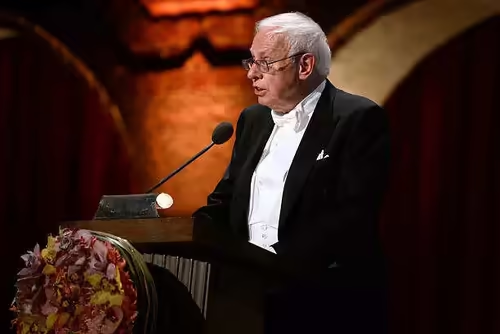
From Failing Grade to Nobel Glory: The Tomas Lindahl Paradox
We’ve all been there—staring at a red mark on a test, feeling like our future just crumbled. Now, imagine that test was in chemistry, and your teacher’s personal bias sealed your fate. That was the reality for a young Tomas Lindahl. Fast forward a few decades, and that same man was accepting the highest honor in science: the Nobel Prize in Chemistry. His story isn’t just inspiring; it’s a scathing critique of an education system obsessed with early, often arbitrary, judgments.
Table of Contents
- The High School Setback: A Teacher’s Grudge
- What is DNA Repair and Why Does it Matter?
- Lindahl’s Nobel-Winning Breakthrough
- Lessons for Education and Talent-Spotting
- Conclusion: The Enduring Legacy of a “Failure”
- Sources
The High School Setback: A Teacher’s Grudge
Lindahl’s tale of academic woe is legendary in scientific circles. He has openly stated, “At school I had a teacher that didn’t like me and I didn’t like him. At the end of the year he decided to fail me” [[18]]. This wasn’t just a poor performance; it was a personal verdict that branded him a failure in the very subject he would one day master. He even joked about holding “the distinction of being the only chemistry laureate who failed the topic in high school!” [[10]]. This early experience highlights a critical flaw in traditional assessment: it often measures a student’s relationship with a teacher or their performance on a single day, not their innate curiosity, resilience, or long-term potential. It’s a stark reminder that a bad grade is not a life sentence, a lesson every student struggling today needs to hear. For more on rethinking educational paths, see [INTERNAL_LINK:alternative-education-success-stories].
What is DNA Repair and Why Does it Matter?
Before we dive into Lindahl’s genius, we need to understand the battlefield: our own DNA. We often think of DNA as a stable blueprint, but it’s under constant attack. From UV rays from the sun to toxins in our environment and even the natural byproducts of our own metabolism, our genetic code suffers thousands of damaging events every day [[19]]. If left unchecked, this damage leads to mutations, which are the root cause of cancer, aging, and many other diseases.
This is where DNA repair mechanisms come in. They are the body’s internal team of molecular mechanics, constantly scanning, identifying, and fixing errors in our genetic code. These intricate systems are fundamental to maintaining what scientists call “genomic stability”—the integrity of our entire genetic library [[26]]. Without them, complex life as we know it would be impossible. Understanding these processes is therefore not just academic; it’s central to developing new treatments for cancer and other genetic disorders [[24]].
Tomas Lindahl‘s Nobel-Winning Breakthrough
In the 1970s, the prevailing scientific dogma was that DNA was inherently stable. Lindahl, however, was skeptical. His meticulous experiments revealed that DNA actually decays at a surprisingly rapid rate—a rate that, if left unrepaired, would make the development of life impossible [[5]]. This was his eureka moment. He realized there *had* to be active, dedicated cellular pathways for repairing this constant damage.
Lindahl’s pioneering work led him to discover one of the most fundamental of these pathways: base excision repair (BER). This mechanism specifically targets and corrects small, non-helix-distorting base lesions in the DNA—damage caused by oxidation, alkylation, or deamination [[25]]. His work, alongside that of Paul Modrich (who mapped mismatch repair) and Aziz Sancar (who deciphered nucleotide excision repair), provided the first complete picture of how our cells safeguard their genetic information [[1]]. In 2015, their collective efforts were recognized with the Nobel Prize in Chemistry “for mechanistic studies of DNA repair” [[1]].
Lessons for Education and Talent-Spotting
The Tomas Lindahl story offers profound lessons far beyond the laboratory:
- Grades Are Not Gospel: An exam score is a snapshot, not a biography. It can be influenced by countless factors unrelated to a student’s true ability or passion.
- Curiosity Trumps Compliance: Lindahl’s success came from his relentless questioning of established dogma, not from rote memorization for a test. Our education systems should foster this kind of critical thinking.
- Resilience is a Core Skill: Being failed by a teacher could have derailed him. Instead, he used it as fuel. Teaching students to navigate failure is as important as teaching them the curriculum.
- Talent is Multifaceted: A student who struggles in one area may have extraordinary gifts in another. A rigid, one-size-fits-all approach to education will always miss its mark.
Conclusion: The Enduring Legacy of a “Failure”
Tomas Lindahl’s journey from a failed high school chemistry student to a Nobel Laureate is more than a feel-good anecdote. It’s a powerful, evidence-based argument against the tyranny of early academic labels. His life’s work not only revealed the hidden machinery that keeps us alive but also stands as a monument to the idea that potential is often hidden, waiting for the right environment and opportunity to flourish. His story should inspire every educator to look deeper and every student to never let a single setback define their future.