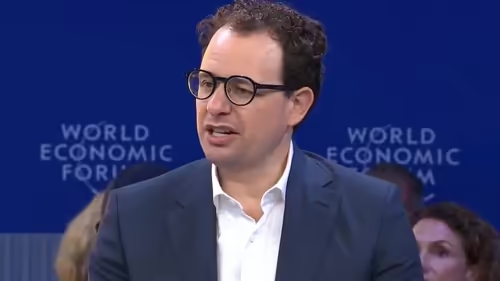
Forget rogue robots or sentient algorithms—Anthropic CEO Dario Amodei says the real danger of artificial intelligence isn’t that it will destroy us, but that it will enrich a tiny elite while leaving everyone else behind. And if tech giants like Google, Microsoft, and Amazon don’t act fast, he warns, the public backlash could be catastrophic.
Coming on the heels of his exhaustive 19,000-word essay on AI’s long-term risks, Amodei’s latest message shifts focus from existential doom to economic justice. His core argument? AI wealth distribution must be addressed now—before unprecedented abundance becomes a source of mass resentment and political instability [[1]].
“The biggest risk isn’t that AI fails,” Amodei implies, “it’s that it succeeds wildly—and only for a few.” In a bold call to action, he’s urging policymakers and tech leaders to design new tax frameworks that ensure the fruits of AI-driven productivity are broadly shared across society.
Table of Contents
- From Existential Risk to Economic Justice: Amodei’s Evolving AI Warning
- Why AI Wealth Distribution Is a Civilizational Challenge
- Amodei’s Proposal: New Tax Policies for an AI-Abundant Future
- Downplaying Data Center Water Use: A Strategic Shift?
- What Tech Giants and Governments Must Do Now
- Conclusion: Sharing the AI Dividend—or Facing the Consequences
- Sources
From Existential Risk to Economic Justice: Amodei’s Evolving AI Warning
Dario Amodei, co-founder of Anthropic and a former OpenAI researcher, has long been a leading voice on AI safety. His recent 19,000-word essay meticulously detailed scenarios where advanced AI systems could escape human control [[1]]. But now, he’s pivoting to a more immediate, tangible threat: inequality.
As AI begins to automate high-skill jobs—from coding to legal research to creative design—the economic gains are accruing almost entirely to shareholders and executives of a handful of tech firms. Amodei argues this concentration of wealth is not just unfair—it’s unsustainable.
“If AI creates a world of abundance but only a small group benefits,” he warns, “people will rightly demand change—possibly through disruptive means.”
Why AI Wealth Distribution Is a Civilizational Challenge
Amodei doesn’t view this as a mere policy issue. He frames it as a civilizational challenge—on par with climate change or nuclear proliferation. The reason? AI has the potential to generate near-limitless economic value, but without deliberate intervention, that value won’t trickle down.
Consider this: a single AI model can now perform the work of thousands of professionals. The cost savings and revenue boosts go straight to the company’s bottom line. Workers displaced by AI may struggle to find comparable roles, especially as automation spreads to white-collar sectors.
This dynamic could accelerate wealth gaps to levels not seen since the Gilded Age—fueling social unrest, eroding trust in institutions, and potentially triggering protectionist or anti-tech policies that stifle innovation altogether.
Amodei’s Proposal: New Tax Policies for an AI-Abundant Future
So what’s the solution? Amodei advocates for proactive, forward-looking tax reforms designed specifically for the AI era. He suggests:
- AI Output Taxes: Levy taxes on the economic value generated directly by AI systems, not just corporate profits.
- Universal Basic Dividends: Distribute a portion of AI-generated revenue as direct cash payments to citizens—similar to Alaska’s oil dividend.
- Re-skilling Vouchers: Fund lifelong learning programs through AI taxation, helping workers transition into AI-augmented roles.
- Global Coordination: Prevent a “race to the bottom” by aligning tax policies across major economies via forums like the OECD.
Importantly, Amodei stresses this isn’t about punishing success—it’s about ensuring the AI revolution lifts all boats. “We have a once-in-history chance to build a more equitable future,” he says. “We must not waste it.”
For insights into global tax policy frameworks, see the OECD’s Base Erosion and Profit Shifting (BEPS) initiative.
Downplaying Data Center Water Use: A Strategic Shift?
In the same breath, Amodei notably downplayed concerns about AI data centers consuming vast amounts of water—a growing environmental critique [[1]]. While not dismissing the issue entirely, he argued it pales in comparison to the societal risks of unequal prosperity.
“Yes, data centers use water,” he acknowledged, “but the civilizational stakes of who controls and benefits from AI are far higher.” This framing suggests a strategic prioritization: for Amodei, economic justice trumps operational sustainability in the hierarchy of AI risks.
What Tech Giants and Governments Must Do Now
Amodei’s warning is directed squarely at two groups:
- Tech Companies (Google, Microsoft, Amazon, etc.): Stop treating AI solely as a profit engine. Start engaging seriously with policymakers on equitable distribution models. Voluntary contributions to public AI funds could build goodwill and preempt harsh regulation.
- Governments: Begin drafting AI-specific fiscal policies now—not after the crisis hits. Pilot programs for AI dividends or re-skilling grants can test models at scale.
Delay, Amodei cautions, will only make the eventual reckoning more painful. For more on corporate responsibility in the AI age, explore our analysis on [INTERNAL_LINK:ethical-ai-corporate-governance].
Conclusion: Sharing the AI Dividend—or Facing the Consequences
Dario Amodei’s message is both a warning and an invitation. The AI revolution is coming, and it will create staggering wealth. The only question is: who gets to enjoy it?
If the answer remains “only the tech elite,” then public anger won’t just be understandable—it will be inevitable. But if companies and governments act now to embed fairness into the AI economy, they can turn a potential crisis into a golden age of shared prosperity.
The choice is ours. And time is running out.
Sources
- [[1]] Times of India. (2026, January 29). After writing 19,000-word essay on AI dangers, Anthropic CEO Dario Amodei now warns Google, Microsoft, Amazon and others. https://timesofindia.indiatimes.com/…
- Organisation for Economic Co-operation and Development (OECD). (2025). BEPS Project – Base Erosion and Profit Shifting. https://www.oecd.org/…