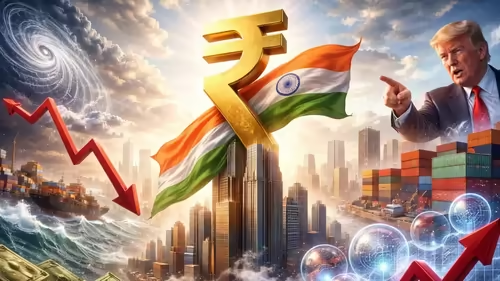
Remember 2008? The year the world economy nearly collapsed under the weight of reckless lending and opaque financial instruments? According to India’s latest Economic Survey, we might be heading toward something even more dangerous—and this time, it’s not just about banks.
Released ahead of the Union Budget 2026, the Survey paints a chilling picture: a confluence of rising global protectionism, an overheated artificial intelligence market, and a fundamental shift in how nations view trade could spark an economic crisis 2026 with deeper and more lasting consequences than the Great Recession [[1]].
But it’s not all doom and gloom. The document also lays out a clear, actionable roadmap for India to not just survive—but thrive—in this volatile new world order. So what’s really going on, and why should you care?
Table of Contents
- Why the Economic Crisis 2026 Could Be Worse Than 2008
- The Death of Efficiency: Trade Is Now About Power
- The AI Bubble: Is It a Ticking Time Bomb?
- India’s Three-Point Survival Strategy
- Conclusion: Navigating the Storm with Strategic Resilience
- Sources
Why the Economic Crisis 2026 Could Be Worse Than 2008
The 2008 crisis was largely a financial system failure. Today’s threats are systemic, structural, and geopolitical. The Economic Survey identifies three key fault lines:
- The Return of Aggressive Tariff Wars: Nations are abandoning free trade in favor of “friend-shoring” and national security-driven tariffs, fragmenting the global economy.
- The AI Valuation Bubble: Sky-high investments in AI startups with unproven business models mirror the dot-com boom—and could burst with similar force.
- Erosion of Multilateralism: Institutions like the WTO are losing relevance as countries prioritize bilateral deals and strategic alliances over global rules.
Unlike 2008, where coordinated central bank action could stabilize markets, today’s crises are rooted in political will, technological hype, and supply chain nationalism—making them far harder to fix with interest rates alone.
The Death of Efficiency: Trade Is Now About Power
One of the Survey’s most profound insights is this: “Trade policy is no longer primarily about economic efficiency or comparative advantage. It is now driven by security and political considerations.” [[1]]
This marks a historic pivot. For decades, globalization was sold on the promise of cheaper goods and optimized supply chains. Now, resilience trumps efficiency. Countries want control over critical inputs—semiconductors, rare earths, pharmaceuticals—even if it costs more.
For India, this is both a threat and an opportunity. On one hand, export-led growth models may falter. On the other, India can position itself as a trusted alternative manufacturing hub for democracies seeking to reduce dependence on China—a strategy already visible in initiatives like the India-Middle East-Europe Economic Corridor (IMEC).
The AI Bubble: Is It a Ticking Time Bomb?
The Survey doesn’t dismiss AI’s potential—but it cautions against irrational exuberance. With global AI funding surging past $100 billion in 2025, many valuations are detached from revenue realities [[1]].
Consider this: during the dot-com crash, companies with no profits and vague business plans lost 90% of their value overnight. The same could happen to AI firms that promise “revolutionary” tech but deliver little practical utility.
For Indian investors and policymakers, the lesson is clear: support AI innovation, but anchor it in real-world applications—like agriculture, healthcare diagnostics, and vernacular language processing—rather than speculative hype. This aligns with India’s own IndiaAI Mission, which focuses on public-good use cases over pure profit.
For deeper context on global financial stability risks, see the IMF’s Global Financial Stability Report.
India’s Three-Point Survival Strategy
So what should India do? The Economic Survey outlines a pragmatic, three-pillar approach to build resilience against the looming economic crisis 2026:
- 1. Accelerate Domestic Manufacturing: Double down on PLI (Production-Linked Incentive) schemes in electronics, solar, and defense to reduce import dependency and create jobs.
- 2. Forge Strategic Trade Alliances: Deepen ties with the EU, UAE, and ASEAN through comprehensive FTAs that prioritize mutual security and tech collaboration—not just tariff cuts.
- 3. Build a “Digital Public Infrastructure” Export Model: Leverage successes like UPI, Aadhaar, and ONDC to offer sovereign, low-cost digital solutions to the Global South—creating a new export category beyond goods and services.
Critically, the Survey urges fiscal discipline. Even as global uncertainty rises, India must avoid populist spending that could inflate its debt-to-GDP ratio beyond sustainable levels. Smart investment, not blanket stimulus, is the way forward.
For more on India’s digital infrastructure success, explore our analysis on [INTERNAL_LINK:india-digital-public-infrastructure].
Conclusion: Navigating the Storm with Strategic Resilience
The warning in the Economic Survey isn’t meant to scare—it’s meant to prepare. An economic crisis 2026 may be brewing, but India is better positioned today than it was in 2008. With robust foreign reserves, a young workforce, and a growing digital backbone, the country has the tools to turn global chaos into strategic advantage.
The key lies in staying focused: avoid the AI hype trap, build real industrial capacity, and remember that in the new world order, trust is the ultimate currency. As the Survey wisely notes, “Efficiency built on fragility is no efficiency at all.”
Sources
- [[1]] Times of India. (2026, January 29). Tariff war, AI bubble: Crisis worse than 2008 looming? Economic Survey explains what India should do. https://timesofindia.indiatimes.com/…
- International Monetary Fund (IMF). (2025). Global Financial Stability Report. https://www.imf.org/…