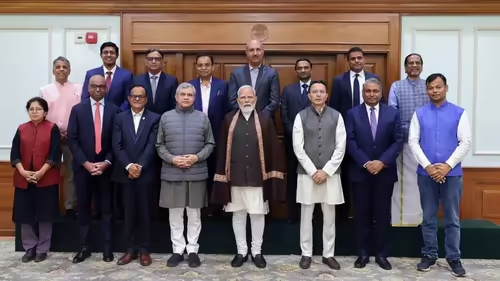
In a high-stakes meeting that could shape the next decade of India’s technological destiny, Prime Minister Narendra Modi didn’t just talk to the country’s top AI minds—he issued a challenge. The mission? To build a world-class India AI Mission that’s as transformative for artificial intelligence as UPI was for digital payments. But with this grand ambition comes a stark warning: there will be “no compromise on ethical use” [[7]].
This isn’t just another government initiative. It’s a clarion call for self-reliance, innovation, and a uniquely Indian approach to one of the most powerful technologies of our time. So, what exactly is on the table, who are the key players, and can India truly navigate the treacherous ethical landscape of AI?
Table of Contents
- The UPI Blueprint for AI
- Inside Modi’s India AI Mission Roadmap
- The Ethical Tightrope: Walking the AI Wire
- Who Are the Architects? Indian AI Startups in the Spotlight
- Conclusion: Can India’s AI Vision Deliver?
- Sources
The UPI Blueprint for AI
PM Modi’s reference to UPI is no casual analogy. The Unified Payments Interface is a globally lauded success story—a public digital infrastructure that democratized finance, fostered a startup boom, and became a model for other nations. Now, the Prime Minister wants to replicate that magic for AI [[7]].
The core idea is to create a foundational, open, and accessible AI ecosystem. Just as UPI provided a common language for banks and fintech apps, the India AI Mission aims to build shared resources like affordable computing power (IndiaAI Compute) and a vast, centralized repository of datasets (IndiaAI Datasets Platform) [[11]]. This would lower the barrier to entry for innovators across the country, especially those outside the major tech hubs.
Inside Modi’s India AI Mission Roadmap
The India AI Mission, officially approved by the Union Cabinet in March 2024, is a comprehensive, multi-pillar strategy designed to position India as a global leader in the field [[20]]. Its structure is built on seven key pillars [[11]]:
- IndiaAI Compute: Providing affordable and scalable GPU access to startups and researchers.
- IndiaAI Datasets Platform: Creating a national repository of high-quality, non-personal datasets across 20 key sectors [[12]].
- IndiaAI Startup Foundry: Offering end-to-end support for promising AI ventures.
- IndiaAI Innovation Centre: Fostering R&D and the development of large-scale AI models.
- IndiaAI FutureSkills: A massive upskilling program to build a future-ready AI workforce [[13]].
- IndiaAI Safe & Trusted AI: Developing frameworks for responsible and ethical AI deployment.
- Application Development: Encouraging the creation of AI solutions for critical national challenges in agriculture, healthcare, and education.
This holistic approach signals a shift from fragmented efforts to a coordinated, all-of-government push to make AI work for every Indian citizen.
The Ethical Tightrope: Walking the AI Wire
While the vision is grand, PM Modi was unequivocal about the risks. He flagged the potential pitfalls of AI, emphasizing that its development must be anchored in strong ethical principles [[7]]. This is where the recently released India AI Governance Guidelines come into play [[31]].
These guidelines, structured around seven core “Sutras” or principles, lay the foundation for a human-centric AI ecosystem. The key tenets include [[37]]:
- Trust & Accountability
- People First
- Innovation over Restraint
- Fairness & Inclusivity
- Safety & Security
- Good Data & Good Design
- Sustainable & Socially Responsible AI
The challenge now is to operationalize these principles. How do you ensure fairness in an algorithm trained on biased data? How do you maintain accountability when an AI system makes a critical error? These are the complex questions that the India AI Mission must answer to build genuine public trust. For more on the global debate, see the European Commission’s AI Act, a leading regulatory framework.
Who Are the Architects? Indian AI Startups in the Spotlight
PM Modi has called Indian AI startups the “co-architects of India’s future” [[3]]. In his recent roundtable, he met with leaders from a dozen homegrown companies that qualified for the “AI for ALL: Global Impact Challenge,” including names like Avataar, BharatGen, Fractal, and Gan AI [[5]].
These startups are at the heart of the mission. They are developing everything from conversational AI for local languages to deep-tech solutions for earth observation and image editing [[22]]. The government is backing them with strategic funding, international acceleration programs (like the one with Station F in Paris [[29]]), and direct access to the resources being built under the India AI Mission [[26]].
This focus on indigenous talent is a clear signal of the government’s intent to avoid dependency on foreign tech giants and to build a sovereign, home-grown AI capability. You can learn more about the government’s broader support for innovation in our guide on [INTERNAL_LINK:startup-ecosystem-in-india].
Conclusion: Can India’s AI Vision Deliver?
PM Modi’s vision for an “UPI for AI” is a powerful and necessary ambition. The India AI Mission provides a robust structural framework, and the emphasis on ethics is a crucial safeguard. The success of this grand plan, however, hinges on flawless execution.
It requires seamless collaboration between government, industry, and academia. It demands a relentless focus on building not just technology, but also the talent and the ethical guardrails to manage it. If India can pull this off, it won’t just fuel its own growth—it could offer a new, democratic, and responsible model for AI development to the rest of the world. The upcoming India AI Impact Summit in February 2026 will be a critical milestone to watch [[10]].
Sources
- [[7]] Times of India. (2026, January 29). ‘No compromise on ethical use’: PM Modi engages with AI CEOs, experts; pitches UPI-style model for growth.
- [[11]] ICC-TCA. (2025). India’s AI Roadmap and Current Developments.
- [[20]] PIB. (2025, October 12). Transforming India with AI.
- [[3]] The Hindu. (2026, January 8). AI start-ups ‘co-architects’ of India’s future, says PM Modi.
- [[5]] PIB. (2026, January 8). PM chairs Roundtable with Indian AI Start-Ups.
- [[22]] PIB. (2025, May 29). 10 Cutting-Edge Indian Startups Selected for Prestigious AI Opportunity.
- [[29]] PIB. (2025, December 30). Transforming India with AI.
- [[26]] Chase Advisors. (2025). Navigating IndiaAI Mission: The Startups Perspective.
- [[37]] PIB. (2025, November 5). India AI Governance Guidelines.
- [[10]] Times of India. (2026, January 5). India AI Impact Summit 2026: 100+ global CEOs may gather in Delhi.