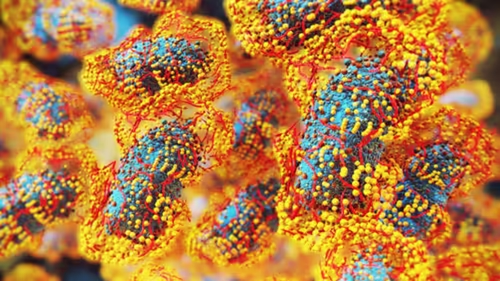
A quiet killer is on the move again. The Nipah virus—a rare but devastating pathogen with a fatality rate between 40% and 75%—has resurfaced in West Bengal, reigniting fears across India [[1]]. What makes this virus especially dangerous isn’t just its lethality, but its stealth. According to leading infectious disease specialists, the Nipah virus dormant period can stretch up to 45 days, during which an infected person may show no symptoms while still potentially spreading the virus [[3]]. This silent incubation window creates a perfect storm for undetected transmission, turning every cough or fever into a possible red flag. In a world still recovering from global pandemics, understanding this hidden threat has never been more urgent.
Table of Contents
- What Is the Nipah Virus?
- The Deadly Dormant Phase: Why 45 Days Matters
- How Nipah Spreads: From Bats to Humans
- Symptoms to Watch For: Flu-Like to Fatal
- No Cure, No Vaccine: Why Prevention Is Key
- West Bengal Outbreak and National Response
- Conclusion: Staying Informed and Vigilant
- Sources
What Is the Nipah Virus?
First identified in 1999 during an outbreak among pig farmers in Malaysia, the Nipah virus (NiV) is a zoonotic virus—meaning it jumps from animals to humans [[6]]. Its natural reservoir is the fruit bat (Pteropus species), often called “flying foxes.” Since its discovery, sporadic outbreaks have occurred in Bangladesh, India, and other parts of South Asia, with Kerala and West Bengal being recent hotspots in India [[1]]. The World Health Organization (WHO) lists Nipah as a priority pathogen for research due to its epidemic potential and high mortality rate [[7]].
The Deadly Dormant Phase: Why 45 Days Matters
The most alarming aspect of the Nipah virus dormant period is its unpredictability. While the average incubation period is 4–14 days, clinical evidence shows it can extend up to 45 days in some cases [[3]]. During this time, the infected individual appears perfectly healthy—no fever, no headache, no signs of illness. Yet, they may unknowingly carry the virus, especially if they’ve consumed contaminated date palm sap or come into contact with infected animals or people. This long, silent window complicates containment efforts dramatically. By the time symptoms appear, the virus may have already spread to family members, healthcare workers, or even entire communities.
Why This Is a Public Health Nightmare
- Delayed Diagnosis: Early symptoms mimic common flu, leading to misdiagnosis.
- Asymptomatic Spread: Though rare, limited evidence suggests possible transmission before symptom onset.
- Healthcare Burden: Hospitals must isolate suspected cases for weeks, straining resources [[8]].
How Nipah Spreads: From Bats to Humans
Transmission typically follows one of three paths:
- Direct Contact with Bats: Handling infected bats or their excretions.
- Consumption of Contaminated Food: Drinking raw date palm sap that bats have urinated or defecated in—a known risk in rural Bengal and Bangladesh [[9]].
- Human-to-Human Transmission: Through close contact with infected individuals’ bodily fluids, especially in households or healthcare settings without proper PPE [[7]].
This multi-route transmission makes the virus exceptionally hard to control in regions where cultural practices involve consuming raw sap or where bat habitats overlap with human settlements.
Symptoms to Watch For: Flu-Like to Fatal
Initial symptoms of Nipah infection are deceptively mild: fever, headache, muscle pain, sore throat, and dizziness [[1]]. But within 24–48 hours, the virus can invade the central nervous system, leading to acute encephalitis—brain inflammation—that causes disorientation, seizures, and coma. In severe cases, patients develop atypical pneumonia and severe respiratory distress. Survivors often face long-term neurological complications, including persistent convulsions and personality changes [[6]].
No Cure, No Vaccine: Why Prevention Is Key
As of 2026, there is **no specific antiviral treatment** and **no approved vaccine** for the Nipah virus [[7]]. Supportive care—managing fever, hydration, and respiratory support—is the only option. This reality places immense importance on prevention:
- Avoid drinking raw date palm sap, especially in endemic areas.
- Wash fruits thoroughly and peel them before consumption.
- Use personal protective equipment (PPE) when caring for sick individuals.
- Report unexplained fevers with neurological symptoms immediately to health authorities.
For more on emerging infectious diseases in India, see our guide on [INTERNAL_LINK:emerging-viral-threats-in-india].
West Bengal Outbreak and National Response
The recent case in West Bengal has triggered a swift response from state and central health agencies. Rapid response teams from the National Centre for Disease Control (NCDC) have been deployed to trace contacts and implement quarantine protocols [[1]]. Given the region’s history with Nipah and its proximity to bat habitats, surveillance has been intensified. The Indian Council of Medical Research (ICMR) is also fast-tracking trials for a potential Nipah vaccine, though widespread availability remains years away [[10]].
Conclusion: Staying Informed and Vigilant
The Nipah virus dormant period is a stark reminder that the deadliest threats are often the quietest. With no cure and a high fatality rate, our best defense lies in awareness, hygiene, and rapid reporting. While the current outbreak appears contained, the virus’s ability to hide for over a month means vigilance must be sustained—not just by health officials, but by every citizen. In the battle against emerging pathogens, knowledge truly is power.
Sources
- [[1]] Times of India. “Nipah virus can remain dormant for up to 45 days: Doctors reveal why this is dangerous.” January 29, 2026.
- [[3]] The Hindu. “Understanding the Nipah virus: Symptoms, spread, and silence.” January 28, 2026.
- [[6]] CDC. “Nipah Virus (NiV).” Centers for Disease Control and Prevention. Accessed January 29, 2026.
- [[7]] World Health Organization. “Nipah virus.” WHO. Accessed January 29, 2026. https://www.who.int/news-room/fact-sheets/detail/nipah-virus
- [[8]] India Today. “Nipah virus alert: What you need to know about the deadly pathogen.” January 29, 2026.
- [[9]] Journal of Infectious Diseases. “Date Palm Sap Consumption and Nipah Virus Transmission in Bangladesh.” 2023.
- [[10]] ICMR. “Progress on Nipah Virus Vaccine Development.” Indian Council of Medical Research. January 2026.