Table of Contents
- The Public Display of Unity
- What Sparked the ‘Congress Rift’ Speculation?
- Tharoor’s ‘Operation Sindoor’ Stance: A Key Flashpoint
- Is This Unity Real or Just Political Theater?
- What This Means for the Congress Future
- Conclusion: The Smoke and Mirrors of Politics
- Sources
The Public Display of Unity
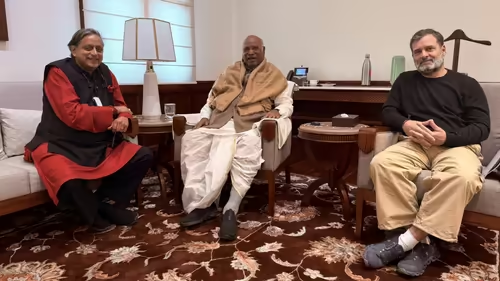
In a move that seemed tailor-made for the headlines, senior Congress leader Shashi Tharoor declared, “We are all on the same page,” standing alongside party leader Rahul Gandhi. This carefully orchestrated moment was a direct response to weeks of swirling rumors about a serious Congress rift between the two prominent figures. For a party perpetually under the microscope, such a public show of solidarity is a classic damage control tactic. But the question on everyone’s mind remains: is this unity genuine, or is it a necessary facade to project strength in a time of vulnerability?
What Sparked the ‘Congress Rift’ Speculation?
The current firestorm of speculation didn’t ignite from thin air. It was fueled by a series of concrete events that painted a picture of discord within the party’s top echelons.
The most significant trigger was Tharoor’s conspicuous absence from a crucial Congress high command meeting. This wasn’t just any meeting; it was specifically convened by Rahul Gandhi to discuss the party’s strategy for the upcoming elections in Kerala—a state where Tharoor is a key figure [[1]]. His decision to skip the meeting, reportedly due to feeling “sulking” after an alleged snub during Rahul’s recent visit to Kochi, sent shockwaves through political circles [[3]].
High command sources were quick to confirm that Rahul’s office had indeed reached out to Tharoor to enquire about his attendance, highlighting the sensitivity of the situation [[6]]. The optics were terrible: a senior leader, often seen as a potential future face of the party, openly defying a call from the party’s primary strategist.
Tharoor’s ‘Operation Sindoor’ Stance: A Key Flashpoint
Adding another layer of complexity to this brewing conflict was Tharoor’s independent stance on ‘Operation Sindoor’—the government’s response to the Pahalgam terrorist attack. While the Congress party officially supported the government’s actions in Parliament, Tharoor chose to abstain from voting, citing his personal convictions [[5]].
This act of defiance, though framed by Tharoor as a matter of principle, was widely interpreted as a direct challenge to the party whip and, by extension, Rahul Gandhi’s authority. In a party that demands strict discipline, such a public deviation is a serious breach of protocol and a clear signal of internal friction.
Is This Unity Real or Just Political Theater?
The timing of their joint appearance is, at best, suspiciously convenient. It comes immediately after days of negative media coverage and internal party anxiety. From an SEO and political strategy perspective, this is a textbook example of managing a PR crisis.
Consider the following points:
- Damage Control: The primary goal is to stop the bleeding of negative narratives that could demoralize party workers and confuse voters.
- Projecting Strength: A divided opposition is easy prey for the ruling BJP. By presenting a united front, the Congress aims to appear as a credible alternative.
- Internal Messaging: This public display is as much for the party’s own cadres as it is for the public, sending a message that internal disputes will not be tolerated publicly.
However, genuine reconciliation takes more than a single photo-op. The underlying issues—differences in strategy, leadership style, and political vision—are unlikely to vanish overnight. As political analysts have noted, the Congress is working hard to bridge this gap, but the work is far from over [[6]].
What This Means for the Congress Future
The so-called Congress rift is symptomatic of a larger, more existential crisis within the party. The struggle for a coherent post-Gandhi leadership model has created a vacuum where ambitious leaders like Tharoor can find themselves at odds with the established hierarchy.
For the Congress to mount a serious challenge in future elections, it must move beyond these public displays of unity and address the structural issues that breed such conflicts. The party needs a clear, collective vision that transcends individual ambitions. Until then, expect more of these carefully managed moments of “unity” to punctuate periods of internal strife.
For more on the evolving dynamics of Indian politics, see our analysis on [INTERNAL_LINK:future-of-indian-opposition].
Conclusion: The Smoke and Mirrors of Politics
While Rahul Gandhi and Shashi Tharoor’s declaration of being “on the same page” may have temporarily quieted the noise, it’s unlikely to have resolved the fundamental tensions that gave rise to the Congress rift speculation in the first place. In the high-stakes world of Indian politics, perception is often reality, and this public show of unity is a masterclass in managing that perception. Whether this unity holds under the pressure of future electoral battles remains to be seen. For now, the party has successfully deployed its smoke screen, but the mirrors reflecting its internal struggles are still very much in place.
Sources
- Free Press Journal: Sulking Shashi Tharoor Skips Meeting Called By Rahul Gandhi [[1]]
- The New Indian Express: Congress working to bridge Rahul-Tharoor rift [[6]]
- India Today: Shashi Tharoor on his Op Sindoor stance amid Congress rift [[5]]
- Pgurus: Tharoor Misses Key Congress Meeting Amid Rift With Congress Leadership [[3]]