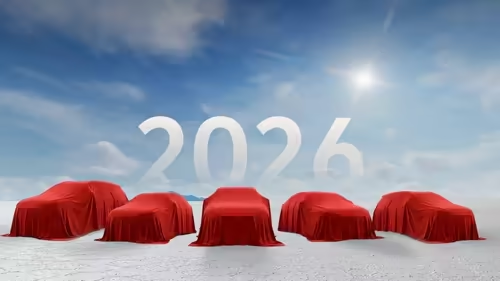
Volkswagen is betting big on India in 2026. After years of playing it safe, the German automaker has unveiled an ambitious plan to launch five new models across SUVs, sedans, and hatchbacks—one every quarter. This isn’t just a refresh; it’s a full-scale relaunch aimed at reigniting consumer interest and clawing back lost ground in a fiercely competitive market.
The first shot across the bow? The India-spec Tayron R-Line—a premium, three-row SUV powered by a 2.0-litre turbo-petrol engine with all-wheel drive. With this move, Volkswagen India is signaling it’s no longer content being a niche player. But in a market dominated by Maruti, Hyundai, and Tata, can VW’s 2026 blitz actually work?
Table of Contents
- Volkswagen India 2026 Strategy Overview
- First Launch: Tayron R-Line – Specs and Significance
- Full 2026 Launch Calendar: What to Expect Each Quarter
- Why Volkswagen Is Doubling Down on India Now
- Challenges Ahead: Can VW Compete in India’s Price-Sensitive Market?
- Conclusion: A Bold Bet with High Stakes
- Sources
Volkswagen India 2026 Strategy Overview
The Volkswagen India 2026 plan marks a strategic pivot from its previous cautious approach. Instead of relying on one or two hero models, VW is adopting a “consistent momentum” strategy—releasing a new vehicle every quarter to maintain media buzz, dealer engagement, and customer footfall [[1]].
This phased rollout covers multiple segments: compact SUVs, midsize sedans, premium hatchbacks, and now, large three-row SUVs. The goal? To offer something for every buyer—from young urban professionals to growing families seeking space and safety.
Industry experts see this as a direct response to shrinking market share. In 2024, Volkswagen’s passenger vehicle sales in India hovered around 15,000 units—less than 1% of the total market [[2]]. Compare that to Hyundai’s 600,000+ or Maruti’s 1.8 million, and the urgency becomes clear.
First Launch: Tayron R-Line – Specs and Significance
Kicking off the Volkswagen India 2026 offensive is the **Tayron R-Line**, a locally adapted version of the global Tiguan Allspace. Positioned as a flagship offering, it’s designed to compete with the likes of the Toyota Fortuner, MG Gloster, and Skoda Kodiaq.
Key highlights include:
- Engine: 2.0-litre TSI turbo-petrol (190 PS, 320 Nm torque)
- Drivetrain: 4Motion all-wheel drive
- Seating: 7-seater configuration with captain seats in the second row
- Features: Digital cockpit, panoramic sunroof, adaptive cruise control, and R-Line sporty aesthetics
Priced expectedly between ₹35–40 lakh (ex-showroom), the Tayron R-Line targets affluent buyers who want German engineering without stepping into luxury territory. It’s also a clever way to leverage Skoda’s success—since both brands share the same parent company and platform architecture under the INDIA 2.0 project [[3]].
Full 2026 Launch Calendar: What to Expect Each Quarter
While only the Tayron R-Line has been officially confirmed, industry insiders and supply chain reports suggest the following rollout pattern for the remaining four models [[4]]:
- Q1 2026: Volkswagen Tayron R-Line (flagship 7-seater SUV)
- Q2 2026: Next-gen Virtus sedan (facelift with updated tech and ADAS)
- Q3 2026: All-new Polo hatchback (based on MQB-A0-IN platform)
- Q4 2026: Compact SUV sibling to the Taigun (possibly named “T-Cross” or “Tavendor”)
- Additional Model: Likely a performance-oriented GTI variant or a long-wheelbase sedan for fleet use
This staggered approach ensures dealerships stay stocked with fresh inventory year-round—a sharp contrast to past years when months passed between meaningful updates.
Why Volkswagen Is Doubling Down on India Now
India is no longer just an emerging market—it’s a strategic battleground. With EV adoption still slow and ICE vehicles dominating 95% of sales, global automakers see a window to capture volume before the transition accelerates [[5]].
Volkswagen’s INDIA 2.0 initiative, launched in 2020 with a ₹8,000 crore investment, laid the groundwork for localized production and cost-efficient platforms. Now, with R&D centers in Pune and Chennai, and a strong Skoda-VW synergy, the company believes it can finally deliver globally competitive cars at India-friendly prices.
Moreover, rising disposable incomes and demand for premium features—even in sub-₹20 lakh segments—play right into VW’s strengths: build quality, safety, and driving dynamics.
Challenges Ahead: Can VW Compete in India’s Price-Sensitive Market?
Despite the optimism, hurdles remain. Indian buyers are notoriously value-conscious. A ₹38 lakh Tayron R-Line competes not just on specs but on perceived value against a ₹28 lakh XUV700 AX7 or a ₹32 lakh Innova HyCross.
Additionally, Volkswagen’s service network is smaller than rivals’, and maintenance costs are still seen as high. Brand recall has also faded among younger buyers who associate VW more with legacy models like the Vento than cutting-edge tech.
And then there’s the elephant in the room: electric vehicles. While VW is pushing ICE models in 2026, competitors like Tata and MG are already scaling EVs. If the EV shift accelerates faster than expected, VW’s 2026 lineup could risk obsolescence sooner than planned.
For deeper insights into automotive market trends, refer to authoritative sources like the Society of Indian Automobile Manufacturers (SIAM).
Conclusion: A Bold Bet with High Stakes
The Volkswagen India 2026 launch plan is more than a product calendar—it’s a make-or-break moment for the brand in one of the world’s fastest-growing auto markets. By flooding showrooms with fresh, segment-diverse models, VW hopes to rebuild trust, expand its customer base, and prove that German engineering still has a place in Indian garages.
Success won’t come from specs alone. It’ll depend on pricing discipline, after-sales experience, and smart marketing that speaks to today’s pragmatic yet aspirational Indian buyer. If executed well, 2026 could mark the start of Volkswagen’s true comeback. If not, it may be remembered as a missed opportunity in a market that rewards speed, scale, and sensitivity to local needs.
Sources
- [[1]] Times of India: Volkswagen India to launch five new models in 2026: Details
- [[2]] SIAM Monthly Reports: Passenger Vehicle Sales Data – 2024
- [[3]] Autocar India: Volkswagen Tayron R-Line India launch details
- [[4]] Economic Times Auto: Volkswagen India’s 2026 product roadmap
- [[5]] BloombergNEF: India Electric Vehicle Outlook 2025