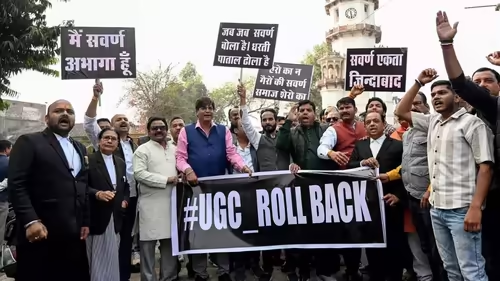
In a decisive move that has sent shockwaves through India’s academic and political corridors, the Supreme Court has hit the pause button on the much-debated UGC Equity Regulations 2026. The court’s intervention, coming just days after the regulations were notified, is a direct response to a firestorm of criticism labeling the new rules as dangerously ambiguous and ripe for abuse.
The bench, led by Chief Justice Surya Kant and Justice Joymalya Bagchi, didn’t mince words, describing the regulations as “vague, capable of misuse“—a damning indictment that has now placed the entire framework in abeyance until at least March 19, 2026 [[1]].
Table of Contents
- What Are the UGC Equity Regulations 2026?
- Why Did the Supreme Court Stay the UGC Rules?
- The Great Uproar: Key Criticisms of the New Guidelines
- What Happens Now? Next Steps and Implications
- Conclusion: A Delicate Balance Between Equity and Justice
- Sources
What Are the UGC Equity Regulations 2026?
On paper, the UGC Equity Regulations 2026 were designed with a noble goal: to create a more inclusive and equitable environment in India’s higher education institutions by providing a robust framework to address caste-based discrimination [[11]]. The regulations mandated universities to establish dedicated Equity Committees and Equal Opportunity Centres to handle complaints swiftly and effectively [[15]].
The intent was to build upon the existing 2012 UGC regulations but with a more urgent and structured approach to grievance redressal [[16]]. However, the devil, as they say, was in the details—or rather, the lack thereof.
Why Did the Supreme Court Stay the UGC Rules?
The Supreme Court’s decision to stay the UGC Equity Regulations 2026 was not taken lightly. The bench was hearing multiple writ petitions that challenged the very foundation of these new rules. The petitioners argued that the regulations were not just flawed in execution but were fundamentally arbitrary, exclusionary, and potentially unconstitutional [[18]].
The core of the court’s concern lay in the language of the regulations. By deeming them “vague” and “capable of misuse,” the justices highlighted a critical flaw: the potential for these well-intentioned rules to be weaponized, leading to false accusations and a chilling effect on campus discourse [[4]]. The court has now ordered that the older 2012 UGC regulations will remain in force while the government goes back to the drawing board [[6]].
The Great Uproar: Key Criticisms of the New Guidelines
The backlash against the UGC Equity Regulations 2026 was swift and severe, cutting across political and social lines. Here are the primary reasons for the intense controversy:
- Exclusionary Definitions: Critics pointed out that the regulations adopted a definition of caste-based discrimination that some felt excluded certain groups, creating a new form of inequity [[13]].
- Fear of Misuse: A major concern, especially among students from the general category, was that the vague wording could lead to a flood of frivolous or malicious complaints, unfairly targeting individuals [[9], [14]].
- Discriminatory in Nature: Several petitions contended that instead of promoting equity, the regulations themselves amounted to discrimination against so-called “general classes,” violating the spirit of the Constitution [[12]].
- Lack of Clarity: The procedural aspects, including the formation and functioning of the new committees, were seen as rushed and lacking clear, objective criteria, opening the door for inconsistent and biased application [[16]].
What Happens Now? Next Steps and Implications
With the regulations officially in abeyance, the ball is now firmly in the government’s court. The Supreme Court has issued notices to both the Union Government and the University Grants Commission, demanding their response by the next hearing date of March 19, 2026 [[2], [5]].
This gives the authorities a crucial window to re-examine and redraft the guidelines. The expectation from the court and the public is clear: any new version must be precise, fair, and balanced, ensuring it protects genuine victims of discrimination without becoming a tool for harassment. For now, universities across the country will continue to operate under the 2012 framework [[6]].
This case also underscores a broader challenge in policy-making: how to craft legislation that effectively addresses deep-seated social issues like caste discrimination without creating new avenues for conflict. It’s a delicate act that requires immense foresight and consultation. For more on the legal intricacies of such policy challenges, you can explore resources from high-authority legal databases like SC Observer.
Conclusion: A Delicate Balance Between Equity and Justice
The Supreme Court’s stay on the UGC Equity Regulations 2026 is more than just a legal ruling; it’s a powerful reminder of the complexities involved in legislating social justice. While the goal of eradicating caste-based discrimination from our educational institutions is non-negotiable, the means to achieve it must be just as righteous as the end.
The court’s intervention has provided a vital opportunity to correct course. The hope is that the revised regulations will emerge as a more nuanced, legally sound, and universally fair instrument that truly fosters an equitable learning environment for all students, regardless of their background. The nation will be watching closely on March 19th to see if this opportunity is seized.
Sources
- [[1]] Indian Express: Supreme Court stays 2026 UGC regulations on what amounts to caste-based discrimination
- [[4]] CNBC TV18: Supreme Court stays new UGC caste equity regulations, asks Centre to redraft it
- [[5]] The Wire: Supreme Court Stays UGC Equity Regulations 2026
- [[6]] LiveLaw: Capable Of Misuse, Vague: Supreme Court Stays UGC Equity Regulations 2026
- [[9]] The Hindu: Uproar intensifies against new UGC equity regulations
- [[12]] LiveLaw: Explainer: UGC’s 2026 Regulations For Tackling Caste-Based Discrimination In HEIs
- [[13]] Rediff: UGC Equity Regulations 2026: Controversy, Protests, and Key Details
- [[14]] X (Twitter) Post by Nethrapal: UGC guidelines 2026 is now clearly against SC ST OBCs..
- [[15]] Testbook: UGC Bill 2026: New Rules, Regulations, Controversy & More
- [[16]] Times of India: UGC’s 2026 equity regulations: A serious idea, an uneven instrument
- [[18]] The Wire: Supreme Court Stays UGC Equity Regulations 2026