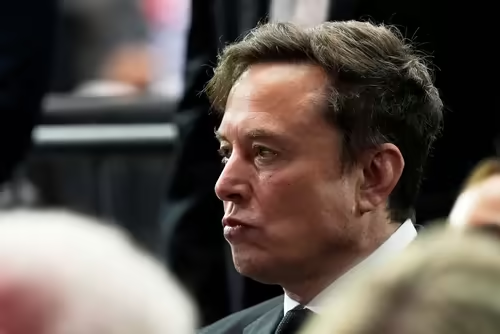
Forget the flashy Cybertruck unveilings or the constant X (formerly Twitter) drama. On his precious Saturdays, Elon Musk is hunched over something far more consequential for Tesla’s long-term survival: the Tesla AI5 chip. This isn’t just another incremental upgrade; it’s a moonshot in silicon form, designed to be the brain powering a fleet of autonomous vehicles and an army of humanoid robots. And according to Musk, its success is non-negotiable [[1]].
Table of Contents
- The AI5 Imperative: Why This Chip is Tesla’s Lifeline
- Inside the Tesla AI5 Chip: A 50x Performance Revolution
- Beyond Cars: Powering the Robotaxi and Optimus Dreams
- The Domestic Dilemma: Securing Silicon for the Future
- Conclusion: The Stakes Couldn’t Be Higher
- Sources
The AI5 Imperative: Why This Chip is Tesla’s Lifeline
Musk has been unusually candid about the existential importance of the Tesla AI5 chip. He’s stated that securing long-term access to these advanced chips is “pretty important” for the company’s future—a massive understatement from a man known for bold claims [[1]]. In essence, the entire vision of a scalable, profitable robotaxi network and a commercially viable Optimus robot hinges on this single component. Without the AI5’s promised capabilities, these multi-billion dollar ventures simply aren’t feasible at the scale and cost Tesla requires.
This focus underscores a strategic pivot. While Tesla built its brand on electric vehicles, its future valuation is increasingly tied to its potential as an AI and robotics company. The AI5 chip is the physical manifestation of that bet. It’s not just about making a better car; it’s about creating an entirely new ecosystem of autonomous machines, all running on Tesla’s proprietary hardware and software stack.
Inside the Tesla AI5 Chip: A 50x Performance Revolution
The numbers behind the Tesla AI5 chip are nothing short of staggering. While some reports cite a 40x improvement over the current HW4 platform, Musk himself has clarified that by certain key metrics, the leap is closer to a 50x performance boost [[1], [3]]. This monumental gain isn’t from one single change but a symphony of architectural improvements:
- Raw Compute Power: An 8x to 10x increase in processing muscle, enabling the complex neural networks needed for true autonomy.
- Memory Capacity: A 9x jump in on-chip memory, crucial for handling the massive data streams from cameras and sensors in real-time without bottlenecks [[1], [4]].
- Memory Bandwidth: A 5x improvement, ensuring that data can flow to and from the processor at unprecedented speeds [[1]].
- Power Efficiency: A 3x gain in efficiency, which is vital for both extending the range of electric vehicles and keeping humanoid robots like Optimus from overheating during operation [[4]].
This combination of power, memory, and efficiency is what will allow a single AI5 chip to handle tasks that currently require multiple, less efficient processors. For a deeper dive into the evolution of Tesla’s custom silicon, check out our analysis on [INTERNAL_LINK:tesla-hardware-evolution].
Beyond Cars: Powering the Robotaxi and Optimus Dreams
The AI5 chip’s primary mission is to serve as the central nervous system for two of Tesla’s most ambitious projects.
The Robotaxi Fleet
Tesla’s vision for a driverless taxi service demands a level of computational power and reliability that current hardware can’t provide at scale. The robotaxi will need to process a 360-degree view from its camera suite, navigate complex urban environments, and make split-second decisions—all while being cost-effective to operate. The AI5’s massive performance-per-watt ratio is designed to meet this exact challenge, making the economics of a robotaxi fleet potentially viable [[13]].
The Optimus Humanoid Robot
Similarly, the Optimus robot is not just a mechanical marvel; it’s an AI problem. It needs to perceive its environment, understand human instructions, and move with dexterity and balance. Tesla has confirmed that Optimus will run on a modified version of its Full Self-Driving technology, powered by a single Tesla System-on-Chip (SoC)—the very same architecture as the AI5 [[11], [17]]. The chip’s efficiency is paramount here, as a humanoid robot cannot afford the power draw or heat generation of a traditional server-grade processor.
The Domestic Dilemma: Securing Silicon for the Future
Musk’s weekend work isn’t just about design; it’s also about supply chain security. He has been a vocal advocate for increasing domestic silicon production in the United States, a sentiment that aligns with the broader national push for semiconductor sovereignty under initiatives like the CHIPS Act [[19], [27]]. Relying on overseas foundries for such a critical component poses a significant strategic risk.
While the idea of a Tesla-owned chip factory remains a distant possibility, Musk’s immediate goal is to ensure that the production of the AI5 and its successors can be secured within a resilient, preferably domestic, manufacturing ecosystem. This move would not only protect Tesla from global supply chain shocks but also position it as a leader in the American semiconductor renaissance that’s gaining momentum in 2026 [[21]].
For context on the global semiconductor landscape, the U.S. government’s efforts are detailed on the official Department of Commerce website.
Conclusion: The Stakes Couldn’t Be Higher
Elon Musk’s decision to dedicate his personal time to the Tesla AI5 chip is a clear signal of its paramount importance. This isn’t a side project; it’s the cornerstone of Tesla’s next decade. The promised 50x performance leap is the key that unlocks the door to a future filled with robotaxis and Optimus robots. However, the path is fraught with challenges, from perfecting the chip’s design to securing its manufacturing future. The success or failure of the AI5 project will likely determine whether Tesla remains a dominant force in the 21st-century tech landscape or becomes a cautionary tale of over-ambition. One thing is certain: the world will be watching.
Sources
- [[1]] Times of India: Elon Musk has been spending his Saturdays working on…
- [[3]] EEWorld: Tesla AI5 chip technology details and insights
- [[4]] Tesla Insider: Elon Musk revealed Tesla’s next-gen AI5 chip
- [[11]] Teslarati: Tesla reveals production Optimus bot’s tentative specs
- [[13]] Yole Group: Tesla’s robotaxi surprise: what you need to know!
- [[17]] Brian D Colwell: A Complete Review Of Tesla’s Optimus Robot
- [[19]] LinkedIn Market Report: United States Silicon-32 Market Share 2026
- [[21]] TokenRing: Silicon Sovereignty: 2026 Marks the Dawn of the American Semiconductor Renaissance
- [[27]] SEMI: SEMI Outlines 2026 U.S. Policy Priorities