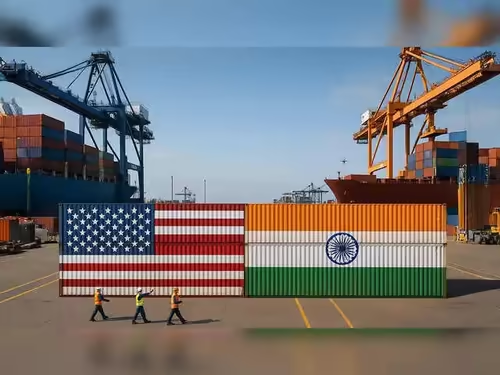
After nearly a decade of fits, starts, and diplomatic hand-wringing, the long-elusive India-US trade deal might—just might—be crossing the finish line in 2026. That’s the tantalizing signal sent by India’s latest Economic Survey, which states that trade negotiations with Washington are “nearing completion” and could soon ease a major source of external uncertainty for the Indian economy [[1]].
For businesses, investors, and policymakers alike, this development is more than just bureaucratic progress—it’s a potential game-changer. A successful pact could unlock new export markets, attract foreign capital, and send a powerful message about India’s reliability as a global trade partner. But the Survey also delivers a sobering caveat: without a serious upgrade in domestic manufacturing competitiveness, even the best trade deal might fall short.
So, what’s really happening behind closed doors? And what does this mean for your business or investment portfolio? Let’s unpack the facts, the stakes, and the road ahead.
Table of Contents
- Is the India-US Trade Deal Finally Happening in 2026?
- Why Previous Talks Stalled—and What Has Changed
- The Economic Survey 2026’s Strategic Warning on Manufacturing
- How a Deal Could Impact Investors and Exporters
- The Road Ahead: Key Hurdles Remain
- Conclusion: A Deal Is Not a Magic Bullet
- Sources
Is the India-US Trade Deal Finally Happening in 2026?
The Economic Survey 2026 doesn’t declare victory—but it comes close. It explicitly notes that “India’s trade talks with the US are nearing completion this year,” suggesting that both sides have moved past the most contentious sticking points [[1]]. This is significant because, for years, negotiations were bogged down by disagreements over tariffs, agricultural market access, data localization, and intellectual property rights.
If finalized, the deal would likely be a limited or “early harvest” agreement rather than a comprehensive free trade pact. Think targeted tariff reductions on key goods like pharmaceuticals, textiles, gems and jewelry, and electronics—sectors where India holds a competitive edge. Such a framework could serve as a foundation for deeper integration down the line.
Crucially, the Survey links the potential deal to improved investor sentiment. In an era of global economic headwinds and deglobalization trends, a stable, rules-based trade relationship with the world’s largest economy would be a major vote of confidence in India’s economic trajectory.
Why Previous Talks Stalled—and What Has Changed
To understand why 2026 might be different, it’s worth revisiting why past efforts failed:
- Asymmetrical Demands: The U.S. pushed hard for greater access to India’s dairy and agricultural markets, while India sought easier visa norms for IT professionals and lower tariffs on its exports.
- Geopolitical Distractions: From the Trump-era trade wars to the pandemic and Ukraine conflict, global crises repeatedly derailed momentum.
- Domestic Politics: Both countries faced internal pressures—farm lobbies in India, labor unions in the U.S.—that made compromise politically risky.
What’s changed now? Three key factors:
- Strategic Alignment: With China’s assertiveness growing, the U.S. sees India as a critical counterweight in the Indo-Pacific. Economic cooperation is now part of a broader strategic partnership.
- India’s Economic Maturity: India’s $4 trillion economy and robust growth make it a more attractive partner than ever before.
- Mutual Urgency: Both nations need wins. The U.S. wants to diversify supply chains away from China; India needs foreign investment to fuel its manufacturing ambitions under [INTERNAL_LINK:make_in_india].
The Economic Survey 2026’s Strategic Warning on Manufacturing
Here’s the twist: the Economic Survey doesn’t just celebrate the prospect of a deal—it issues a stark warning. Even if the India-US trade deal is signed, India won’t reap its full benefits unless it dramatically enhances its manufacturing competitiveness [[1]].
Why? Because trade agreements open doors—but they don’t guarantee you’ll walk through them. If Indian factories can’t produce high-quality goods at globally competitive prices, exporters will miss out on new opportunities. The Survey highlights several gaps:
- High logistics costs (nearly double the global average)
- Inconsistent power supply in industrial zones
- Complex labor laws and regulatory hurdles
- Limited access to affordable credit for MSMEs
In other words, the deal is necessary—but not sufficient. Real gains will come only when India’s “Make in India” vision aligns with export-ready efficiency.
How a Deal Could Impact Investors and Exporters
For stakeholders, the implications are tangible:
- Exporters: Reduced U.S. tariffs could boost margins for sectors like pharma, engineering goods, and apparel. Companies should prepare capacity expansions now.
- Investors: A deal signals policy stability, potentially triggering fresh FDI inflows into manufacturing and infrastructure. Watch for sector-specific rallies in equities.
- Consumers: Lower duties on select U.S. imports (like medical devices or aircraft parts) could eventually reduce costs for businesses and end-users.
For a broader perspective on how trade policy shapes emerging markets, the World Trade Organization’s development resources offer valuable context on global trade dynamics.
The Road Ahead: Key Hurdles Remain
Don’t pop the champagne yet. Finalizing the deal still faces hurdles:
- Election Timelines: With U.S. elections looming, the Biden administration may delay controversial concessions.
- Non-Tariff Barriers: Technical standards, sanitary regulations, and digital trade rules remain complex negotiation points.
- Implementation Gaps: Past trade pacts (like with ASEAN) suffered from poor execution. India must build institutional capacity to monitor and enforce the new agreement.
Conclusion: A Deal Is Not a Magic Bullet
The Economic Survey 2026 offers cautious optimism: the India-US trade deal is closer than ever, and its conclusion could mark a turning point in India’s economic diplomacy. But the real story isn’t just about signing a document—it’s about whether India can transform its industrial base to seize the opportunity. A trade pact opens the door; only a competitive, efficient, and agile manufacturing ecosystem can walk through it and thrive. For policymakers, businesses, and citizens alike, 2026 isn’t just about closing a deal—it’s about building the future that the deal promises.