Introduction: A Diplomatic Earthquake in Beijing
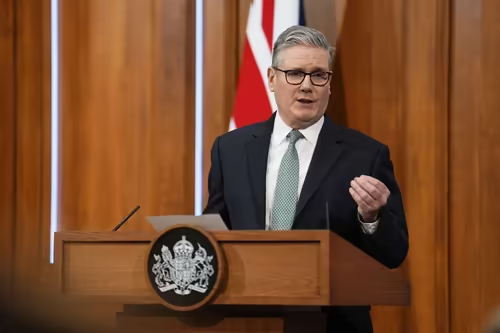
On January 29, 2026, British Prime Minister Keir Starmer touched down in Beijing, marking the first visit by a UK leader to China in nearly a decade [[5]]. But this isn’t just a routine state trip. Starmer’s arrival, accompanied by a 60-member delegation of business and cultural leaders, is a calculated geopolitical maneuver that sends a clear, and potentially controversial, message to an old ally: Donald Trump.
With his now-famous phrase, “like it or not,” Starmer has declared that engagement with the Dragon is firmly in Britain’s national interest [[7]]. This stance directly challenges the more confrontational approach favored by Trump, who has been rattling traditional alliances with his tariff threats and transactional diplomacy [[9]]. This article unpacks the high-stakes strategy behind the Keir Starmer China visit, its implications for the UK-US “special relationship,” and what it means for the future of global trade.
Table of Contents
- The Historic Keir Starmer China Visit
- Decoding ‘Like It or Not’: The Strategic Message
- The Trump Factor: Tensions and Trade Wars
- Beyond Rhetoric: The 60-Member Delegation
- A New UK Foreign Policy Doctrine?
- Conclusion: A Delicate Global Balancing Act
- Sources
The Historic Keir Starmer China Visit
The significance of this trip cannot be overstated. The last time a British Prime Minister visited China was in 2018, under Theresa May’s leadership. Since then, UK-China relations have been strained by a series of issues, from Huawei’s role in the 5G network to concerns over human rights. Starmer’s decision to break this long hiatus signals a deliberate and strategic reset [[4]].
His official itinerary includes high-level meetings in both Beijing and Shanghai, where he will meet with Chinese Premier Li Qiang and other top officials [[6]]. The goal, as stated by Starmer himself, is to build a “long-term, consistent and comprehensive strategic partnership” that acknowledges both shared interests and fundamental differences [[7]].
Decoding ‘Like It or Not’: The Strategic Message
Starmer’s blunt phrase, “like it or not,” is a masterclass in political messaging. It’s a direct acknowledgment of the domestic and international critics who oppose closer ties with Beijing. By using this language, he frames the issue not as a matter of preference, but of cold, hard economic and strategic reality [[7]].
He argues that for the UK to thrive in a post-Brexit world, it must diversify its partnerships and engage with the world’s second-largest economy. This is a pragmatic view that prioritizes national interest over ideological purity. It’s a stance that implicitly rejects the more black-and-white worldview often associated with Trump’s foreign policy [[10]].
The Trump Factor: Tensions and Trade Wars
The timing of the Keir Starmer China visit is no coincidence. It comes at a moment when Donald Trump, having returned to the global stage, is once again pushing his “America First” agenda. His renewed threats of tariffs and his transactional approach to alliances have left traditional partners like the UK feeling unsettled and seeking new options [[9]].
Both Britain and China have been “buffeted by U.S. President Donald Trump’s tariffs,” making them natural partners in seeking to diversify their overseas markets [[10]]. Starmer’s trip can be seen as a direct response to this uncertainty, a way for the UK to hedge its bets and secure its own economic future independent of Washington’s whims. This delicate dance is about maintaining the UK-US alliance while asserting Britain’s own sovereign foreign policy.
Beyond Rhetoric: The 60-Member Delegation
This isn’t just a symbolic gesture. The size and composition of Starmer’s delegation speak volumes about his serious intent. Bringing along 60 business and cultural leaders is a clear signal that the UK is ready to move beyond political rhetoric and into concrete deals [[5]].
The focus areas for potential collaboration are likely to include:
- Green Technology: Joint ventures in renewable energy and climate tech.
- Financial Services: Deepening ties between London and Shanghai financial hubs.
- Education & Culture: Rebuilding academic and cultural exchange programs that were paused during the previous years of tension.
This practical, deal-focused approach is designed to deliver tangible benefits to the British public, thereby building domestic support for this new chapter in UK-China relations [INTERNAL_LINK:uk-china-trade-deals].
A New UK Foreign Policy Doctrine?
Starmer’s actions suggest the emergence of a new UK foreign policy doctrine: one of “principled pragmatism.” He has been careful to state that the UK “does not have to choose between ties with China and the US” [[11]]. This is a nuanced position that seeks to navigate the complex realities of a multipolar world.
It’s a doctrine that recognizes that the UK’s security is tied to its alliance with the US, but its economic prosperity is increasingly linked to its ability to engage with Asia. This balancing act is fraught with difficulty, but Starmer appears to believe it’s the only viable path forward for a modern, global Britain.
Conclusion: A Delicate Global Balancing Act
Keir Starmer’s historic visit to China is far more than a photo op. It’s a bold declaration of Britain’s intent to chart its own course on the world stage. By embracing a “sophisticated” relationship with China, Starmer is directly challenging the simplistic, adversarial framework pushed by figures like Donald Trump. The success of this high-wire act will depend on his ability to deliver real economic wins for the UK while carefully managing the inevitable backlash from both sides of the political spectrum. One thing is certain: the world is watching.
Sources
- Times of India: ‘Like it or not’: Did UK’s Keir Starmer send ‘China matters’ message to ally Trump?
- Ministry of Foreign Affairs of the PRC: UK Prime Minister Keir Starmer to Visit China [[5]]
- CNBC: China and the UK are attempting to reset their relationship [[7], [9]]
- Yahoo Finance: British leader’s trip to China is a balancing act [[10]]
- Morningstar: UK PM says does not have to choose between ties with China and US [[11]]