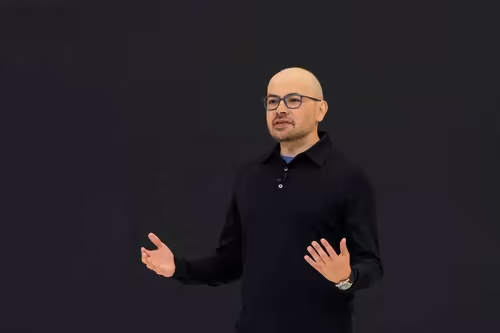
Introduction: The AI Earthquake Nobody Saw Coming
Imagine a single product launch so powerful it sends shockwaves through an entire industry, forcing its biggest rival into emergency mode. That’s exactly what happened when Google unleashed Gemini 3. According to Google DeepMind CEO Demis Hassabis, the model’s arrival was so disruptive that it compelled OpenAI CEO Sam Altman to declare an internal “Code Red,” a move that refocused the entire company on catching up [[1]].
This isn’t just corporate drama; it’s a pivotal moment in the high-stakes race for Artificial General Intelligence (AGI). In this deep dive, we’ll unpack the real story behind the headlines, analyze the shifting AI market share, and explore what Google’s next move—Gemini 4—could mean for the future.
Table of Contents
- The Gemini 3 Revelation: What Hassabis Really Said
- What is a “Code Red” and Why Did Altman Call It?
- The Numbers Don’t Lie: AI Market Share Shifts
- Google’s Secret Weapon: The Pre-Training Team
- The Race to AGI is Far From Over
- Conclusion: What This Means For You
- Sources
The Gemini 3 Revelation: What Hassabis Really Said
In a recent, candid discussion, Demis Hassabis didn’t just boast about Google’s AI prowess; he provided a rare glimpse into the competitive battlefield. He directly linked the launch of Gemini 3 to OpenAI’s state of emergency. The implication was clear: Google’s model wasn’t just an incremental update—it was a leap forward that threatened OpenAI’s dominance [[1]].
Hassabis’s comments are significant because they confirm long-standing rumors within the tech community. Leaked reports from late 2025 had already suggested that Altman was pushing his teams to halt other projects and prioritize a response to Google’s new model [[3]]. Now, we have official confirmation from the horse’s mouth.
What is a “Code Red” and Why Did Altman Call It?
A “Code Red” at a company like OpenAI isn’t a casual alert. It’s a full-blown, all-hands-on-deck emergency protocol. When Altman issued this directive, he was essentially telling his engineers and researchers to drop everything and focus on one goal: regaining their lead in the AI race [[5]].
The trigger? A combination of factors:
- Technical Superiority: Early benchmarks suggested Gemini 3 outperformed GPT-4 in key areas like reasoning and multimodal tasks.
- User Exodus: Reports indicated that ChatGPT was losing millions of users, a terrifying prospect for a platform built on network effects and user data [[1]].
- Strategic Integration: Google’s ability to weave Gemini 3 seamlessly into its vast ecosystem of products (Search, Gmail, Android) gave it an immediate and massive user base that OpenAI could only dream of.
This wasn’t just about a better model; it was about a superior go-to-market strategy that leveraged Google’s core strengths.
The Numbers Don’t Lie: AI Market Share Shifts
The anecdotal evidence is now backed by hard data. The AI chatbot market, once dominated by ChatGPT with a staggering 87% share at the start of 2025, has seen a dramatic shift [[20]].
| AI Platform | Market Share (Jan 2025) | Market Share (Jan 2026) | Change |
|---|---|---|---|
| ChatGPT | 87.2% | 68% | -19.2% |
| Google Gemini | 5.4% | 18.2% | +12.8% |
As you can see, Google’s Gemini 3 has been the fastest-growing competitor, capturing a significant chunk of the market in under a year [[20]]. This rapid adoption is a testament to both the model’s quality and Google’s unparalleled distribution power. For more on how these platforms are changing search, check out our guide on [INTERNAL_LINK:ai-search-engines].
Google’s Secret Weapon: The Pre-Training Team
When asked about the source of Google’s competitive edge, Hassabis didn’t point to flashy marketing or a bigger budget. Instead, he gave a huge shout-out to Google’s pre-training team—the unsung heroes who build the foundational models that power everything else [[1]].
This focus on the core engineering process highlights a key philosophical difference between the two giants. While OpenAI often operates in the public eye with grand announcements, Google appears to be betting on deep, technical excellence and a methodical, integrated approach. Hassabis’s praise underscores that in the AI arms race, the real battle is won in the data centers and research labs, not just on social media.
The Race to AGI is Far From Over
Despite the success of Gemini 3, Hassabis was quick to temper expectations. He emphasized that the ultimate goal—Artificial General Intelligence—is still a distant horizon. “You never quite know when,” he said, referring to the unpredictable nature of breakthroughs in this field [[1]].
All eyes are now on Gemini 4. While there’s no official confirmation of its release date as of January 2026, industry analysts predict a potential launch in the latter half of the year [[7]]. The expectation is that Gemini 4 will represent another significant leap, possibly in areas like autonomous task completion and world modeling [[8]]. This sets the stage for the next major confrontation in the AI war, where the stakes are nothing less than the future of technology itself.
Conclusion: What This Means For You
The “Code Red” saga is more than just a story about two tech titans. It’s a sign of a healthy, dynamic market where innovation is being pushed at an unprecedented pace. For consumers and businesses, this competition means better, faster, and more capable AI tools are arriving sooner than anyone expected. The era of a single dominant player is over, and the multi-front battle for AI supremacy has truly begun. Keep an eye on Gemini 4; it might just be the next earthquake.
Sources
- Times of India: Google AI CEO Demis Hassabis on Gemini model that made OpenAI CEO Sam Altman send ‘Code Red’ to staff
- Fortune: Sam Altman declares ‘Code Red’ as Google’s Gemini 3 launch spooks OpenAI
- Vertu: AI Chatbot Market Share 2026: ChatGPT drops to 68% as Google Gemini surges to 18.2%
- Data Studios: Google Gemini 4: model evolution, ecosystem integration, and roadmap implications