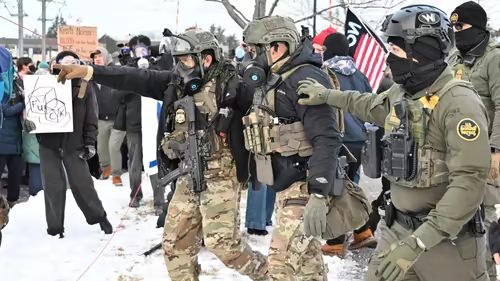
The streets of American cities may look calmer—but inside ICE field offices, a quiet revolution is underway. Following intense national backlash over the fatal shooting of Alex Pretti during an immigration operation, U.S. Immigration and Customs Enforcement (ICE) has rolled out a dramatic new protocol: a nationwide “do not engage” order for its agents when protesters are present.
This isn’t just a tactical tweak—it’s a fundamental shift in how the federal government conducts immigration enforcement in public spaces. And it’s already drawing sharp reactions from both sides of the political aisle.
Table of Contents
- What Is the ICE Do Not Engage Order?
- The Alex Pretti Shooting: What Happened?
- New Enforcement Guidelines in Detail
- Why Trump Is Pushing for De-escalation
- Reactions from Activists, Lawmakers, and Legal Experts
- What This Means for Future Immigration Raids
- Conclusion
- Sources
What Is the ICE Do Not Engage Order?
Issued in late January 2026, the ICE do not engage order instructs field agents to avoid any interaction with protesters, bystanders, or community members during immigration enforcement actions—especially arrests or raids. If a crowd gathers or protests erupt, agents are now required to disengage and withdraw unless they have explicit authorization to proceed.
This marks a stark departure from past practices, where ICE teams often operated with minimal public announcement and sometimes used force to clear obstacles. The new policy is part of a broader effort to “de-escalate tensions” and restore public trust in federal immigration operations—a goal President Donald Trump has reportedly prioritized ahead of the 2026 midterms.
The Alex Pretti Shooting: What Happened?
The catalyst for this policy shift was the January 18, 2026, incident in Portland, Oregon, where 34-year-old Alex Pretti—a U.S. citizen and local community organizer—was fatally shot during an ICE operation targeting a suspected undocumented immigrant with a criminal record.
According to eyewitnesses and initial police reports, Pretti was attempting to mediate between agents and a small group of demonstrators when gunfire erupted. While ICE claims an agent fired in self-defense after being “physically assaulted,” video footage released by local media shows no clear threat before the shot was fired [[1]].
The shooting sparked immediate outrage, with protests erupting in over 20 cities. Civil rights groups called it a “symbol of unchecked federal power,” while congressional Democrats demanded an independent investigation.
New Enforcement Guidelines in Detail
Beyond the “do not engage” rule, ICE has implemented a suite of operational changes:
- Targeted Arrests Only: Agents must now focus exclusively on noncitizens with prior criminal convictions—no more “collateral” arrests.
- Megaphone Announcements: Before any arrest, teams must use loudspeakers to announce their authority, purpose, and the name of the individual being detained.
- Body Cameras Mandatory: All field agents involved in enforcement actions must wear activated body-worn cameras.
- Real-Time Oversight: Operations now require live approval from regional commanders, who report directly to a newly appointed White House border adviser.
These measures aim to increase transparency and reduce the risk of violent confrontations—but critics argue they could also hinder ICE’s ability to carry out its mission effectively.
Why Trump Is Pushing for De-Escalation
President Trump, known for his hardline immigration stance, appears to be recalibrating his approach. Sources close to the White House confirm he has tasked senior border adviser Tom Homan—a former ICE director—with overseeing all sensitive enforcement operations [[2]].
The motivation? Political optics. With suburban swing districts increasingly uneasy about aggressive raids, the administration is seeking to project “orderly enforcement” rather than chaos. As one senior official told The Washington Post, “The goal is to remove criminals—not create martyrs.”
This pivot reflects a broader strategy: maintain tough immigration rhetoric while minimizing on-the-ground flashpoints that could alienate moderate voters.
Reactions from Activists, Lawmakers, and Legal Experts
Responses to the ICE do not engage order have been deeply polarized:
- Immigrant Rights Groups: Organizations like RAICES and United We Dream call the policy “a step in the right direction” but demand full demilitarization of ICE [[3]].
- Law Enforcement Unions: The ICE Officers Union warns the new rules “tie agents’ hands” and put them at greater risk during volatile operations.
- Legal Scholars: Experts at the American Immigration Council note that while transparency is welcome, “policy directives can’t override constitutional rights—or prevent future tragedies without systemic reform” [[4]].
Meanwhile, bipartisan legislation has been introduced in Congress to codify some of these changes into law, though its passage remains uncertain.
What This Means for Future Immigration Raids
Going forward, expect fewer surprise raids in crowded neighborhoods. Instead, ICE will likely shift toward early-morning operations at workplaces or courthouses—settings where public confrontation is less likely.
However, the “do not engage” rule creates a new dilemma: what happens if a target flees into a crowd? Or if local activists deliberately stage protests to shield individuals? These gray areas could lead to legal challenges or operational paralysis.
For communities, the change may bring temporary relief—but it doesn’t address the root causes of fear: the lack of a clear path to citizenship, the trauma of family separation, and the blurred line between public safety and deportation.
Conclusion
The ICE do not engage order is more than a procedural update—it’s a barometer of America’s fraught relationship with immigration enforcement. Born from tragedy, shaped by politics, and tested on the streets, this policy attempts to balance security with humanity. Whether it succeeds depends not just on how agents follow orders, but on whether the nation can finally have an honest conversation about who belongs—and how we treat those who don’t.
Sources
- [[1]] Times of India. “ICE issues ‘do not engage’ order to its agents as backlash grows after Alex Pretti shooting.” https://timesofindia.indiatimes.com/…
- [[2]] The Washington Post. “Trump Appoints Border Czar to Oversee ICE Operations Amid Public Outcry.”
- [[3]] RAICES Official Statement. “Response to ICE’s New Engagement Policy.” https://raicestexas.org
- [[4]] American Immigration Council. “Policy Brief: Reforming ICE Enforcement Practices.” https://www.americanimmigrationcouncil.org