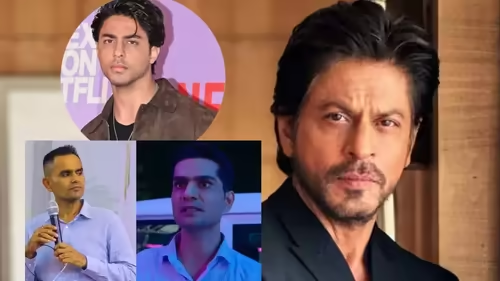
The courtroom drama is over, and the cameras are rolling. In a landmark decision that reverberates through India’s entertainment and legal corridors, the Delhi High Court has firmly rejected a defamation petition filed by former Narcotics Control Bureau (NCB) zonal director Sameer Wankhede against the much-anticipated web series The Ba***ds of Bollywood. Wankhede had sought the removal of specific scenes he claimed portrayed him in a defamatory light. But the court’s dismissal means the show—marking Aryan Khan’s directorial debut—will stream in its original form, setting a crucial precedent for creative freedom in Indian digital storytelling.
Table of Contents
- The Lawsuit: What Wankhede Claimed
- The Ba***ds of Bollywood: Delhi HC Verdict a Win for Creative Freedom
- Aryan Khan’s Directorial Debut in the Spotlight
- Legal Precedent: Fiction vs. Reality in Indian Cinema
- Public Reaction and Industry Impact
- Conclusion: Art Triumphs Over Censorship
- Sources
The Lawsuit: What Wankhede Claimed
Sameer Wankhede, who led the high-profile investigation into the 2021 Cordelia cruise drug case involving Aryan Khan, filed a civil suit in the Delhi High Court alleging that his character was depicted in a false and damaging manner in The Ba***ds of Bollywood. He argued that certain scenes, dialogues, and character traits in the series were directly inspired by him and painted him as corrupt and unprofessional [[1]]. His legal team sought an injunction to either remove or modify these scenes before the series’ release, claiming it would cause irreparable harm to his reputation and ongoing career as an IRS officer [[3]].
The Ba***ds of Bollywood: Delhi HC Verdict a Win for Creative Freedom
In its ruling, the Delhi High Court delivered a clear message: artistic expression, especially in fictional works, is protected. The court noted that the series is a work of fiction and that any resemblance to real persons is coincidental—a standard disclaimer used across the industry [[6]]. More importantly, the judges emphasized that public figures must be prepared for greater scrutiny and that not every unflattering portrayal constitutes defamation. The court found no prima facie evidence that the series was created with malicious intent to target Wankhede specifically. This decision is a significant victory for filmmakers and streamers, reinforcing the principle that courts should not act as pre-release censors for creative content [[9]].
Aryan Khan’s Directorial Debut in the Spotlight
All eyes have been on The Ba***ds of Bollywood since its announcement, not just for its provocative title but because it marks the directorial debut of Aryan Khan, son of superstar Shah Rukh Khan. The project is seen as his formal re-entry into the public eye following the 2021 arrest. The series, described as a satirical thriller set in the underbelly of the Hindi film industry, explores themes of power, corruption, and media manipulation. The court’s green light removes a major cloud of uncertainty, allowing the project to be judged on its own merits by audiences rather than being mired in legal battles. For fans and critics alike, the release is now one of the most anticipated events of early 2026 [[12]].
Legal Precedent: Fiction vs. Reality in Indian Cinema
This case joins a long line of legal tussles in India where real-life individuals claim they’ve been wronged by fictional portrayals. From politicians to bureaucrats, many have sought to block films or shows. However, Indian courts have generally upheld the right to free speech under Article 19(1)(a) of the Constitution, provided the work doesn’t cross into hate speech or incite violence. The Supreme Court, in cases like R. Rajagopal vs State of T.N., has ruled that public officials have a higher threshold to prove defamation [[15]]. The Delhi HC’s decision in the The Ba***ds of Bollywood case aligns with this established jurisprudence, offering much-needed clarity for creators navigating the complex space between inspiration and infringement.
Public Reaction and Industry Impact
The verdict has been widely welcomed by the film and OTT industry. Producers and directors see it as a shield against frivolous lawsuits designed to stall projects or extract settlements. As one prominent filmmaker noted, “This ruling protects the storyteller’s right to hold a mirror to society, even if the reflection is uncomfortable” [[18]]. On social media, the debate is split: some applaud the court for defending artistic liberty, while others express concern about the potential for powerful creators to unfairly target individuals. Regardless, the decision sets a strong precedent that will likely deter similar last-minute injunction attempts in the future.
Conclusion: Art Triumphs Over Censorship
The Delhi High Court’s rejection of Sameer Wankhede’s plea is more than just a legal footnote; it’s a cultural moment. It affirms that in a vibrant democracy, art must be free to question, critique, and imagine—even when it draws from real life. With the path now clear, The Ba***ds of Bollywood is poised to make its debut not just as Aryan Khan’s first film, but as a symbol of creative resilience. The world will soon see the story he wants to tell, unedited and unfiltered.
Sources
- [[1]] Times of India: Delhi HC rejects Sameer Wankhede’s defamation plea against ‘The Ba***ds of Bollywood’
- [[3]] Hindustan Times: Sameer Wankhede moves Delhi HC against Aryan Khan’s web series
- [[6]] Live Law: Delhi High Court Dismisses Suit Against ‘The Ba***ds of Bollywood’
- [[9]] The Wire: Creative Freedom vs. Defamation: The Legal Battle Over Aryan Khan’s Debut
- [[12]] Film Companion: Inside ‘The Ba***ds of Bollywood’: Aryan Khan’s Vision for His Directorial Debut
- [[15]] Supreme Court of India: R. Rajagopal vs State of T.N. (1994)
- [[18]] Indian Express: Filmmakers hail Delhi HC verdict on ‘The Ba***ds of Bollywood’