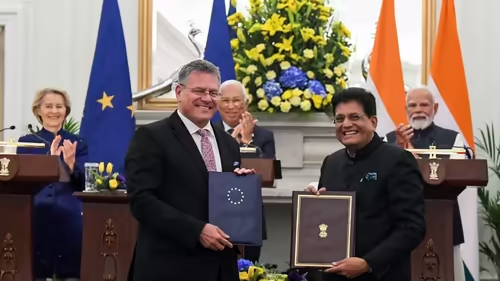
The ink is barely dry on the historic India-EU FTA, signed on January 27, 2026, and already it’s at the center of a fiery political storm [[4]]. On one side, Union Commerce Minister Piyush Goyal is celebrating what he calls a “win-win” and the “mother of all deals,” poised to turbocharge India’s economy [[13]]. On the other, the Congress party, led by Jairam Ramesh, is sounding the alarm, labeling the pact as “hugely-hyped” and warning of significant pitfalls for Indian industry [[15]]. So, what’s the real story behind this landmark agreement?
Table of Contents
- The Deal and the Drama
- Is the India-EU FTA a Landmark Win-Win for India?
- Congress Concerns: What Are the Real Risks?
- The CBAM Conundrum: A Major Sticking Point
- Conclusion: Beyond the Political Rhetoric
- Sources
The Deal and the Drama
After nearly two decades of stop-start negotiations, India and the European Union have finally closed the book on their comprehensive free trade agreement [[1]]. The deal, which covers 96.6% of EU goods exports to India, promises to eliminate or reduce tariffs, boost market access, and create a framework for deeper economic cooperation [[27]]. For the Modi government, it’s a crowning achievement in its aggressive FTA-driven foreign trade policy [[17]].
However, the celebration was short-lived. Congress leader Jairam Ramesh quickly voiced his party’s apprehensions, arguing that the government had conceded too much without securing adequate safeguards for key Indian sectors. In response, Piyush Goyal didn’t mince words, dismissing the criticism as mere “sour grapes” from a party disconnected from economic realities [[14]]. He insisted the deal was meticulously negotiated and represents a massive opportunity for growth and employment.
Is the India-EU FTA a Landmark Win-Win for India?
Minister Goyal’s enthusiasm isn’t entirely without merit. The potential upside of the India-EU FTA is substantial. Here’s what the government is banking on:
- Market Access for Key Sectors: The deal is expected to significantly benefit Indian exporters in sectors like pharmaceuticals, textiles, gems and jewellery, and processed foods, which have long sought better access to the lucrative EU market.
- Boost to Manufacturing: By providing a stable and predictable trade environment, the FTA could attract more foreign direct investment (FDI) into India’s manufacturing sector, aligning with the ‘Make in India’ vision [[18]].
- Diversification of Trade Partners: Reducing reliance on a few major markets and deepening ties with the EU, a $18 trillion economy, is a strategic masterstroke for India’s long-term economic resilience.
Goyal argues that the government has been proactive in its negotiations, engaging on complex issues like intellectual property and services to ensure a balanced outcome [[15]].
Congress Concerns: What Are the Real Risks?
The Congress party’s skepticism, while politically charged, touches on genuine economic anxieties. Their primary concerns revolve around:
- Lack of Safeguards for Sensitive Industries: They worry that a sudden influx of duty-free EU goods, particularly in sectors like automobiles, electronics, and dairy, could flood the domestic market and hurt local manufacturers and farmers who may not be ready to compete.
- Asymmetry in Commitments: Critics argue that the concessions made by India are disproportionate to those offered by the EU, potentially leading to a lopsided trade relationship that favors European exporters.
- Geopolitical Overreach: Some analysts suggest the deal is being used more as a geopolitical tool to counter China, potentially at the cost of India’s own economic interests.
[INTERNAL_LINK:impact-of-ftas-on-indian-agriculture] These concerns highlight the delicate balance between opening up markets and protecting domestic industries during a critical phase of their development.
The CBAM Conundrum: A Major Sticking Point
The most concrete and technically complex point of contention is the EU’s Carbon Border Adjustment Mechanism (CBAM). This new carbon tax, which came into force on January 1, 2026, imposes a cost on imports of carbon-intensive goods like steel, aluminium, cement, and fertilizers based on their embedded emissions [[22]].
Indian exports of these goods to the EU were valued at around $8 billion annually, making them highly vulnerable [[20]]. The iron and steel sector alone accounts for a staggering 90% of India’s CBAM-exposed exports [[25]]. The Congress party has been vocal in its demand for an explicit exemption or a transition period for Indian industry within the FTA framework. However, reports indicate that the final FTA text leaves the CBAM largely untouched [[27]]. This is a significant gap that the government will now have to address through separate diplomatic channels, a challenge that could undermine some of the tariff benefits promised by the FTA.
Conclusion: Beyond the Political Rhetoric
The debate over the India-EU FTA is a classic clash between optimistic vision and cautious pragmatism. Piyush Goyal’s “win-win” narrative captures the immense potential of this agreement to integrate India into high-value global supply chains. Yet, the Congress’s warnings about the CBAM and potential domestic disruption are not baseless fears but legitimate risks that require careful management. The true success of this landmark deal won’t be measured in the signing ceremony’s fanfare, but in how effectively the government can support its industries in navigating the new competitive landscape and in its ability to secure a fair resolution on the CBAM front. The journey has just begun.
Sources
- [[1]] Wikipedia: India–European Union Free Trade Agreement
- [[4]] India Briefing: India-EU Trade Deal Set for January 27 Signing in New Delhi
- [[13]] India Today: Sour grapes? Piyush Goyal rebuts Congress, calls India-EU FTA a ‘win-win’
- [[14]] News18: ‘Sour Grapes?’: Piyush Goyal Counters Congress Criticism
- [[15]] Times of India: ‘Sour grapes?’ Piyush Goyal hits back at Congress
- [[17]] Sunday Guardian: India’s FTA era unfolds under Piyush Goyal
- [[18]] The Economic Times: India-EU FTA not a zero sum deal but a win-win deal
- [[20]] AZB & Partners: Carbon Border Adjustment Mechanism and its Impact in India
- [[22]] Times of India: CBAM impact: Carbon cost hits Indian steel and aluminium exports
- [[25]] ICWA: Carbon Border Adjustment Mechanism: An Impact on India
- [[27]] Argus Media: EU-India FTA leaves CBAM untouched