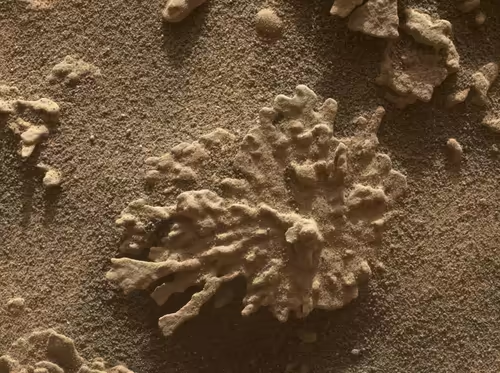
In the rust-colored deserts of Mars, NASA’s Curiosity rover has stumbled upon something that looks like it belongs in a tropical ocean—not a barren, alien world. A newly released close-up image shows a small, porous rock with delicate, branching features eerily reminiscent of Earth’s coral reefs [[1]]. Dubbed the ‘Mars coral rock’ by space enthusiasts, this geological oddity is sparking fresh excitement about the Red Planet’s ancient past and whether it once harbored life.
Table of Contents
- What Does the Mars Coral Rock Look Like?
- Why Scientists Are Excited About This Mars Rock Formation
- The Role of Water in Shaping Mars’ Geology
- Could This Be Evidence of Ancient Life on Mars?
- How Curiosity Rover Captures and Analyzes Rocks
- Conclusion: What the Mars Coral Rock Really Means
- Sources
What Does the Mars Coral Rock Look Like?
Captured by Curiosity’s Mars Hand Lens Imager (MAHLI)—a high-resolution camera mounted on its robotic arm—the rock appears as a small, whitish nodule with a complex, web-like texture. Its surface is riddled with tiny holes and fine ridges that strongly resemble the skeletal structure of marine coral found in Earth’s oceans [[1], [3]].
Of course, there’s no ocean on Mars today, and certainly no coral. But appearances can be deceiving—and scientifically revealing. The resemblance is purely morphological, meaning it’s about shape, not origin. Still, such structures on Earth are often formed in the presence of water, which immediately raises questions about how this feature came to be in Gale Crater, a site believed to have once held a massive lake billions of years ago [[4]].
Why Scientists Are Excited About This Mars Rock Formation
While the Mars coral rock isn’t biological, its texture suggests it may have formed through chemical or sedimentary processes involving liquid water—a key ingredient for life as we know it. On Earth, similar porous, dendritic (branching) mineral deposits can form when groundwater rich in dissolved minerals seeps through rock and precipitates out, creating intricate patterns over time [[5]].
This process, known as diagenesis, can preserve microscopic evidence of past environments—even microbial fossils. So while the rock itself isn’t alive, it could be a time capsule from a wetter, warmer Mars. For NASA’s mission team, every unusual texture is a potential clue in the puzzle of planetary evolution.
The Role of Water in Shaping Mars’ Geology
Gale Crater, where Curiosity has been exploring since 2012, was chosen precisely because orbital data suggested it once contained a lake. Over the past decade, the rover has found overwhelming evidence of this: clay minerals, sulfate salts, and ancient riverbeds—all pointing to a long history of flowing and standing water [[6]].
The newly discovered coral-like rock adds another layer to this story. If confirmed to be a result of aqueous processes, it would reinforce the idea that Mars wasn’t just briefly wet—it had sustained hydrological activity capable of shaping complex geological features. This aligns with NASA’s broader goal of understanding whether Mars ever had conditions suitable for life [[7]].
Could This Be Evidence of Ancient Life on Mars?
It’s tempting to leap to conclusions—but scientists urge caution. “Biology loves to mimic geology,” says Dr. Kirsten Siebach, a Mars geologist and Curiosity science team member [[8]]. Many Earth rocks that look organic are actually purely mineral in origin. The same is likely true here.
However, the possibility remains tantalizing. If this rock formed in a watery environment, it might contain microfossils or organic molecules preserved in its pores. Curiosity doesn’t have the tools to definitively detect biosignatures, but it can analyze the rock’s chemistry using its ChemCam and SAM instruments. Any detection of carbon compounds or unusual element ratios could warrant further investigation by future missions like the Mars Sample Return campaign [[9]].
How Curiosity Rover Captures and Analyzes Rocks
Curiosity’s ability to spot such fine details is a testament to its advanced instrumentation:
- MAHLI Camera: Takes microscopic images of rock textures, down to 12.5 micrometers per pixel—about the width of a human hair [[10]].
- ChemCam: Fires a laser to vaporize rock surfaces and analyzes the resulting plasma to determine chemical composition [[11]].
- SAM (Sample Analysis at Mars): Heats powdered rock samples to release gases, which are then analyzed for organic compounds [[12]].
These tools allow scientists on Earth to conduct virtual fieldwork on another planet. The coral-like rock is just one of thousands of targets Curiosity has studied—but its striking appearance makes it a standout candidate for deeper analysis.
Conclusion: What the Mars Coral Rock Really Means
The discovery of this coral-shaped rock isn’t proof of life on Mars—but it is a powerful reminder of how dynamic and Earth-like the planet once was. It underscores the importance of continued exploration and the value of missions like Curiosity, which keep turning up surprises that challenge our assumptions. While the Mars coral rock is almost certainly a product of geology, not biology, it brings us one step closer to answering humanity’s oldest question: Are we alone in the universe? For now, Mars continues to whisper its secrets—one strange rock at a time.
Sources
- Times of India: NASA’s Curiosity finds a Mars rock shaped like coral in a close-up image
- NASA Jet Propulsion Laboratory: Mars Science Laboratory – Curiosity Mission
- Planetary Society: How We Know Mars Had Water
- Smithsonian Magazine: Ancient Lake in Gale Crater Suggests Mars Was Once Habitable
- Nature Geoscience: Diagenetic processes in Gale Crater, Mars