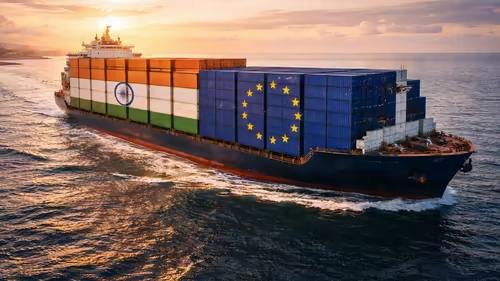
Trade deals are full of fine print—but sometimes, that fine print is the whole story. The newly signed India-EU FTA (Free Trade Agreement) has sparked a wave of excitement among businesses on both continents, promising lower tariffs, smoother supply chains, and billions in new trade. But it’s also raised a sharp question from global traders: Can non-EU countries like Turkey use this deal as a backdoor into the Indian market?
The short answer, confirmed by senior trade officials from both New Delhi and Brussels, is a resounding no. Turkish goods—even if shipped from Rotterdam or transshipped through Hamburg—will not qualify for the preferential tariff rates under the India-EU FTA. And the reason lies in one of the most critical, yet often overlooked, components of any modern trade pact: the Rules of Origin.
Table of Contents
- What Is the India-EU FTA and Why It Matters
- The Turkey Question: Can Ankara Benefit?
- How Rules of Origin Block Backdoor Entries
- Real-World Example: Why a Turkish Car Won’t Get EU Tariffs
- Why This Protection Matters for Indian Industry
- What Turkey Can Do Instead
- Conclusion: No Loopholes in This Trade Deal
- Sources
What Is the India-EU FTA and Why It Matters
After nearly two decades of negotiations, the India-EU Free Trade Agreement was finally concluded in late 2025, with implementation expected to begin in phases through 2026 [[1]]. The deal aims to eliminate tariffs on over 90% of goods traded between the two blocs, covering sectors from pharmaceuticals and textiles to machinery and electronics.
For India, it’s a strategic win—opening access to a $18 trillion consumer market. For the EU, it’s a chance to diversify supply chains away from China and deepen ties with the world’s fastest-growing major economy. But with great opportunity comes great scrutiny—especially around who truly benefits.
The Turkey Question: Can Ankara Benefit?
Turkey, a major manufacturing hub with strong trade ties to the EU, shares a customs union with the bloc since 1995. This allows Turkish goods to move freely within the EU without tariffs. Naturally, some exporters wondered: If a Turkish product enters the EU duty-free, can it then be re-exported to India under the new FTA with preferential treatment?
It’s a clever idea—but it doesn’t work. Officials from India’s Ministry of Commerce and Industry have explicitly stated that the India-EU FTA applies only to goods that are “originating in the European Union” as defined by strict, product-specific criteria [[2]]. Merely passing through an EU port or warehouse doesn’t change a product’s nationality in the eyes of trade law.
How Rules of Origin Block Backdoor Entries
The Rules of Origin (RoO) are the backbone of any credible free trade agreement. They prevent exactly this kind of “trade deflection”—where third-country goods exploit preferential tariffs meant for partner nations.
Under the India-EU FTA, a product must meet one of two key tests to qualify as “EU-originating”:
- Wholly Obtained: The product is entirely made in the EU (e.g., French wine, German wheat).
- Substantial Transformation: Non-EU materials used in the product undergo significant processing in the EU—typically measured by a change in tariff classification or a minimum percentage of local value addition (often 35–50%).
For example, if a Turkish textile is cut and sewn into a finished garment in Italy using Italian design and labor, it might qualify. But if a fully assembled Turkish washing machine is simply boxed in Germany and shipped to Mumbai? It remains a Turkish product—and will face India’s standard Most Favored Nation (MFN) tariffs, which can be as high as 20–30% for certain goods [[3]].
Real-World Example: Why a Turkish Car Won’t Get EU Tariffs
Consider the automotive sector. Turkey is a major car exporter, producing vehicles for brands like Ford and Fiat under contract. Suppose a Turkish-built Ford EcoSport is shipped to Belgium and then sent to India.
Under the India-EU FTA, EU-made cars may see tariffs drop from 70% to 10% over time. But the Turkish EcoSport? It won’t qualify. Unless the vehicle undergoes substantial re-engineering or assembly in an EU country—which is economically unfeasible—it remains a Turkish export. Indian customs will demand a Certificate of Origin, and without valid EU documentation, the full MFN rate applies.
Why This Protection Matters for Indian Industry
This isn’t just bureaucratic pedantry—it’s economic defense. Indian manufacturers, especially in sectors like steel, chemicals, and auto parts, have long feared being undercut by cheaper imports masquerading as “European.”
By enforcing strict RoO, the government ensures that:
- Domestic industries aren’t blindsided by unexpected competition.
- The FTA’s benefits go to genuine EU partners, not opportunistic third parties.
- India maintains leverage in its own bilateral talks—with Turkey currently exploring a separate FTA [[4]].
In essence, the rules protect the integrity of the entire agreement.
What Turkey Can Do Instead
Turkey isn’t out of options. Rather than trying to piggyback on the India-EU deal, Ankara is actively pursuing its own direct trade pact with New Delhi. Preliminary talks have already begun, focusing on mutual tariff reductions and investment protections [[4]].
A dedicated India-Turkey FTA would give Turkish exporters legitimate, transparent access to the Indian market—without relying on legal gray areas. Until then, they’ll have to compete under standard WTO terms.
Conclusion: No Loopholes in This Trade Deal
The India-EU FTA is a landmark achievement—but it’s not a free-for-all. The inclusion of robust, enforceable Rules of Origin ensures that only genuine European products enjoy preferential access to India. Turkish goods, despite Turkey’s close ties to the EU, are firmly excluded from these benefits unless they undergo real transformation on European soil.
For businesses, the message is clear: don’t look for shortcuts. Play by the rules, or negotiate your own deal. For more on how global trade agreements impact local markets, explore our deep dive on [INTERNAL_LINK:global_trade_rules_impact].