Table of Contents
- Match Overview: A One-Sided Affair
- Shivam Dube’s Fireworks: A Masterclass in Power Hitting
- Top Order Fails Again—India’s Recurring Nightmare
- How New Zealand Dominated from Ball One
- Series Impact: What This Loss Means for India
- Red Flags Ahead of the T20 World Cup
- Conclusion: Brilliance Isn’t Enough Without Balance
- Sources
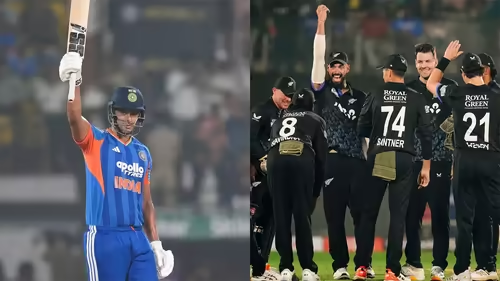
In a stunning display of individual brilliance overshadowed by collective failure, India suffered a crushing 50-run defeat to New Zealand in the fourth T20I on Wednesday. Chasing a mammoth 216, the Men in Blue were bowled out for just 165—despite a breathtaking counterattack from Shivam Dube, who smashed an unbeaten 65 off only 23 balls. But in a game that highlighted both promise and peril, the India vs New Zealand T20 clash laid bare the team’s ongoing struggles with top-order fragility and death-bowling woes. With the series now standing at 3-1, what should have been a dominant whitewash has turned into a cautionary tale just months before the T20 World Cup.
Match Overview: A One-Sided Affair
New Zealand posted a formidable 215/7 in their 20 overs, powered by Finn Allen’s aggressive 58 and Glenn Phillips’ quickfire 45. The Kiwi batters exploited India’s inconsistent bowling, particularly in the middle and death overs, where spinners and pacers alike failed to contain the flow of boundaries. In response, India’s chase never gained momentum. Early wickets derailed the innings, and despite late fireworks from Dube, the target proved insurmountable [[1]].
Shivam Dube’s Fireworks: A Masterclass in Power Hitting
If there was one silver lining for India, it was Shivam Dube’s sensational knock. Walking in at No. 5 with the team reeling at 89/4, Dube unleashed a barrage of sixes that left fans breathless. His 65 came off just 23 deliveries—laced with 3 fours and a staggering **7 sixes**—at a strike rate of 282.60. He targeted every bowler, clearing the ropes with ease over midwicket and long-on, reminding everyone why he’s considered one of India’s most dangerous finishers in T20 cricket [[2]].
Yet, his heroics were tragically isolated. With no support from the other end and wickets falling regularly, even his pyrotechnics couldn’t bridge the 50-run gap. It was a classic case of one man carrying the weight of an entire batting order.
India vs New Zealand T20: Top Order Fails Again—India’s Recurring Nightmare
While Dube shone, the rest of the batting lineup faltered badly. Openers Yashasvi Jaiswal and Ruturaj Gaikwad managed just 22 and 18 respectively before departing. Captain Suryakumar Yadav scored a scratchy 19, and Hardik Pandya fell for a duck. The top six contributed a mere 100 runs—leaving Dube and the tail to chase an impossible total.
This pattern has become alarmingly familiar. In the last five T20Is, India’s top three have averaged under 25. Without a solid foundation, even the most explosive finishers can’t win games alone—a harsh truth this match reinforced.
How New Zealand Dominated from Ball One
New Zealand’s strategy was textbook T20 execution:
- Powerplay Aggression: Finn Allen attacked from the first over, setting the tone.
- Middle-Overs Stability: Phillips and Mitchell Santner rotated strike intelligently.
- Death Bowling Precision: Lockie Ferguson and Ben Sears conceded just 42 runs in the final five overs combined.
Their fielding was sharp, their intent clear, and their execution clinical—everything India’s performance wasn’t.
Series Impact: What This Loss Means for India
With this defeat, India’s perfect 3-0 series lead is now 3-1. While they still hold the series, the momentum has shifted. New Zealand has exposed critical vulnerabilities that could be exploited by stronger teams like Australia or South Africa in the upcoming World Cup. More importantly, it raises questions about squad balance—particularly the reliance on all-rounders who aren’t delivering with either bat or ball consistently.
Red Flags Ahead of the T20 World Cup
Three major concerns emerge from this loss:
- Batting Depth: Over-reliance on Dube and Rinku Singh leaves little room for error.
- Death Bowling: Conceding 50+ runs in the last five overs is unsustainable.
- Top-Order Instability: Without consistent starts, chases become uphill battles.
For deeper insights into India’s T20 strategy, see our analysis on [INTERNAL_LINK:india-t20-world-cup-squad-projections].
Conclusion: Brilliance Isn’t Enough Without Balance
The India vs New Zealand T20 result is a microcosm of modern cricket: individual brilliance can thrill, but only team cohesion wins matches. Shivam Dube’s innings will be replayed for years—but it won’t change the scoreboard. As the World Cup looms, India must address its structural flaws fast. Otherwise, moments of magic will keep turning into lessons in futility.