Table of Contents
- Match Recap: Where India Fell Short
- SKY’s Bold Chasing Strategy—And Why It Backfired
- The Middle-Order Collapse That Changed Everything
- Shivam Dube and Rinku Singh: Glimmers of Hope
- What This Loss Means for World Cup Preparation
- Fan Reactions: Frustration Meets Understanding
- Conclusion: Accountability Over Excuses
- Sources
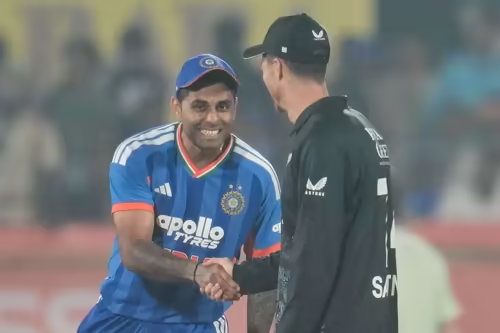
In a high-stakes clash ahead of the T20 World Cup, India suffered a sobering 50-run defeat to New Zealand in the second T20I. Chasing a target of 216, the Men in Blue were bowled out for just 165—a performance that left fans stunned and captain Suryakumar Yadav searching for answers. But rather than point fingers, SKY took a reflective stance: “I wanted guys to take responsibility,” he said in the post-match press conference [[1]]. The India vs New Zealand T20 result wasn’t just a loss—it was a deliberate stress test that exposed critical gaps in India’s batting depth and composure under pressure.
Match Recap: Where India Fell Short
New Zealand posted a formidable 215/7 thanks to explosive cameos from Finn Allen (58 off 32) and Glenn Phillips (45 off 22). Their power-hitting in the death overs set a challenging benchmark. In response, India’s chase started promisingly but unraveled after the fall of key wickets. Despite valiant efforts from Shivam Dube (42 off 28) and Rinku Singh (39 off 24), the innings collapsed under pressure, with the last seven wickets falling for just 68 runs [[2]].
India vs New Zealand T20: SKY’s Experimental Approach
What made this loss even more intriguing was the premeditated strategy. Suryakumar Yadav revealed that the team intentionally chose to chase—and even played with only six specialist batters—to simulate high-pressure World Cup scenarios. “We wanted to put ourselves in tough situations,” he explained. “This is the time to learn, not just win.”
While the intent is commendable, the execution raised eyebrows. Playing with fewer batters meant less margin for error—especially on a flat pitch favoring hitters. Critics argue that such experiments should happen in practice nets, not in official matches against top-tier opposition. Still, SKY’s philosophy reflects a broader shift in Indian cricket: prioritizing resilience over results in the short term.
The Middle-Order Collapse That Changed Everything
India’s top order got off to a solid start, but the real issue emerged between overs 10 and 15—the crucial middle phase where games are often won or lost. After Yashasvi Jaiswal and Ruturaj Gaikwad departed, the middle order failed to rotate strike or build partnerships. Key players like Hardik Pandya and Axar Patel scored single digits, exposing a lack of depth beyond the top four.
This recurring problem has plagued India in recent T20s. Without a reliable No. 5 or 6 who can both stabilize and accelerate, the team remains vulnerable—a major concern with the World Cup looming.
Shivam Dube and Rinku Singh: Glimmers of Hope
Amid the disappointment, two bright spots emerged:
- Shivam Dube: Showed remarkable composure, clearing the ropes with ease and rotating strike intelligently. His ability to handle pace and spin makes him a vital asset in the middle order.
- Rinku Singh: Once again proved why he’s one of India’s most clutch finishers. Even in a losing cause, his clean striking and calm demeanor stood out.
Both players have cemented their places in the squad, offering SKY reliable options when the pressure mounts. For more on emerging Indian talents, check out our deep dive on [INTERNAL_LINK:next-gen-indian-cricketers].
What This Loss Means for World Cup Preparation
With the T20 World Cup just months away, every match is a diagnostic tool. This loss highlighted three urgent needs:
- Batting Depth: India must find a dependable No. 5 who can bat through the middle overs.
- Death Bowling: Conceding 60+ runs in the final five overs is unsustainable against elite teams.
- Mental Toughness: Players need to embrace responsibility—not just skill—when the game is on the line.
As SKY put it: “We’re not hiding from failure. We’re using it to get better.”
Fan Reactions: Frustration Meets Understanding
On social media, reactions were split. Some fans criticized the team’s “reckless” experiment, arguing that losses erode confidence. Others praised SKY’s honesty and long-term vision. “Better to fail now than in the World Cup semifinal,” one user wrote. The debate underscores a growing maturity among Indian cricket fans—who increasingly value process over immediate results.
Conclusion: Accountability Over Excuses
The India vs New Zealand T20 loss was painful—but purposeful. Suryakumar Yadav’s call for players to “take responsibility” isn’t just a soundbite; it’s a cultural reset. In a team brimming with talent, the missing ingredient may not be skill, but ownership. If this defeat sparks that mindset shift, it could prove more valuable than a dozen easy wins. As the World Cup approaches, India isn’t just building a squad—they’re forging a mentality.