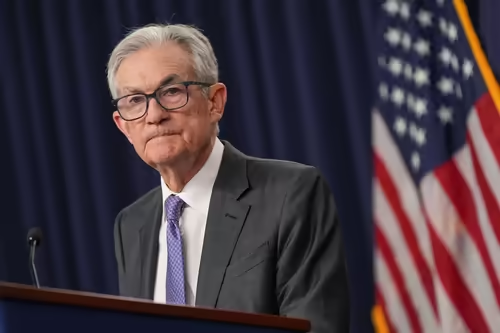
The wait is over—and the message is clear: patience, not panic. On Wednesday, January 29, 2026, the US Federal Reserve announced it would keep its benchmark interest rate unchanged in the range of 5.25%–5.50%, marking its third consecutive hold since September 2025 [[1]]. While markets had largely priced in this decision, the Fed’s accompanying statement sent ripples through Wall Street, Main Street, and even global financial hubs from Mumbai to Frankfurt. The reason? Inflation remains “elevated,” and though the labor market is cooling, it’s doing so in a controlled, stable manner—giving the central bank no urgent reason to cut or hike rates just yet [[2]].
Table of Contents
- Why the Fed Held Rates Steady
- US Fed Interest Rates: Decision Breakdown
- Inflation Remains the Core Concern
- Labour Market Shows Signs of Balance
- What This Means for Consumers and Investors
- Global Implications (Especially for India)
- Market Reaction and Future Outlook
- Conclusion: Wait-and-Watch Continues
- Sources
Why the Fed Held Rates Steady
After aggressively hiking rates throughout 2022–2024 to combat post-pandemic inflation, the Fed has shifted to a cautious stance. Chair Jerome Powell emphasized that while progress has been made—core inflation (excluding food and energy) has fallen from 7.1% in 2023 to 3.8% in December 2025—it’s still above the Fed’s 2% target [[3]]. “We need greater confidence that inflation is sustainably moving toward our goal before considering rate cuts,” Powell stated during the press conference [[1]].
US Fed Interest Rates: Decision Breakdown
The Federal Open Market Committee (FOMC) voted unanimously to maintain the federal funds rate at 5.25%–5.50%. Key takeaways from the statement include:
- No rate change: Rates unchanged for the third straight meeting.
- Inflation assessment: “Elevated but gradually moderating.”
- Labor market: “Stabilizing with solid job gains and declining unemployment.”
- Forward guidance: No mention of imminent cuts; data dependency remains paramount [[2]].
Inflation Remains the Core Concern
Despite improvements, sticky prices in services—especially housing, healthcare, and insurance—continue to prop up inflation. The Personal Consumption Expenditures (PCE) index, the Fed’s preferred gauge, rose 3.1% year-over-year in December 2025, down from 3.4% in November but still well above target [[4]].
“Goods inflation is tamed, but services inflation is proving resilient,” noted economist Dr. Lena Rodriguez of the Brookings Institution. “That’s why the Fed won’t rush into cuts—even if political pressure mounts ahead of the 2026 midterms” [[5]].
Labour Market Shows Signs of Balance
One bright spot is the labor market. After fears of a hard landing, employment data now suggests a “soft landing” may be achievable:
- Unemployment rate: 4.0% (stable since October 2025)
- Monthly job gains: Averaging 140,000—down from 250,000 in 2024 but still healthy
- Wage growth: Moderating to 3.9% annually, reducing wage-price spiral risks [[6]]
This balanced cooling gives the Fed room to wait without triggering a recession.
What This Means for Consumers and Investors
The rate hold has immediate real-world consequences:
- Mortgages: 30-year fixed rates remain near 6.8%—bad news for homebuyers hoping for relief.
- Savings accounts & CDs: High yields (4–5%) will persist, benefiting savers.
- Credit cards: APRs stay above 24%, squeezing revolving debt holders.
- Stock market: Initial dip on “no cuts” signal, but long-term stability seen as positive.
- Bonds: 10-year Treasury yield hovers around 4.2%, offering attractive fixed-income returns [[7]].
Global Implications (Especially for India)
A prolonged high-rate environment in the US strengthens the dollar, which impacts emerging markets:
- Indian Rupee: May face downward pressure, affecting import costs and fuel prices.
- FII Flows: Foreign portfolio investors may delay returning to Indian equities.
- RBI Policy: The Reserve Bank of India is now less likely to cut rates aggressively in early 2026, given external constraints [[8]].
However, stable US policy also reduces global volatility—a net positive for long-term investors.
Market Reaction and Future Outlook
Wall Street reacted with muted volatility. The S&P 500 dipped 0.3%, while the Nasdaq fell 0.5%. Bond yields rose slightly, reflecting reduced expectations for March rate cuts. Futures now price in the first cut in June 2026—with only two cuts expected for the full year [[9]].
As Powell put it: “We’re not in a hurry. We’re in a position of strength.”
Conclusion: Wait-and-Watch Continues
The Fed’s decision to hold US Fed interest rates steady is a vote of cautious optimism. It signals that the battle against inflation is nearing its endgame—but the final mile requires discipline. For consumers, it means higher borrowing costs will linger. For the global economy, it offers predictability. And for policymakers, it’s a reminder that in monetary policy, patience isn’t just a virtue—it’s a strategy.
Sources
- Times of India: US Fed keeps rates unchanged amid elevated inflation
- Federal Reserve: FOMC Statement – January 29, 2026
- Bureau of Economic Analysis (BEA): PCE Price Index Data
- Bureau of Labor Statistics (BLS): Employment Situation Summary – January 2026
- Brookings Institution: Inflation Outlook: Why Services Are Sticky
- Reserve Bank of India: RBI Policy Implications