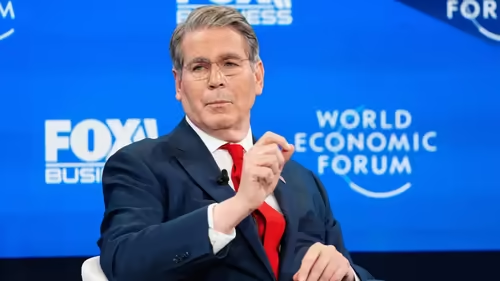
The geopolitical landscape just got a lot more complicated. In a stunning public rebuke, US Treasury Secretary Scott Bessent has slammed the European Union over its landmark India-EU trade deal, finalized on January 27, 2026 [[7]]. His core accusation? That Europe is putting its economic interests ahead of its moral and strategic obligation to support Ukraine in its war against Russia [[6]]. This isn’t just a policy disagreement; it’s a fundamental clash of values that threatens to strain the transatlantic alliance at a critical juncture.
Table of Contents
- The Landmark Deal and the US Backlash
- Bessent’s Core Argument: The Russian Oil Loop
- What the India-EU Trade Deal Actually Covers
- Europe in a Bind: Sanctions vs. Commerce
- Geopolitical Fallout for India and the US
- Conclusion: A Transatlantic Tug-of-War
- Sources
The Landmark Deal and the US Backlash
Celebrated in New Delhi and Brussels as the “mother of all trade deals,” the agreement between India and the EU was hailed as a historic moment that would slash tariffs on over 90% of traded goods and unlock massive economic potential for both sides [[10], [11]]. Prime Minister Narendra Modi himself called it his government’s biggest trade achievement ever [[9]]. However, the fanfare was quickly drowned out by the sharp criticism from Washington.
During a CNBC interview, Bessent didn’t mince words. He stated he was “very disappointed” with European nations for moving forward with the pact [[2]]. His primary concern wasn’t the trade itself, but the context in which it was signed—specifically, the complex web of energy trade involving Russia, India, and Europe.
Bessent’s Core Argument: The Russian Oil Loop
Bessent’s frustration centers on what he sees as a glaring loophole in the West’s sanctions regime against Russia. His argument goes like this:
- India continues to be a major buyer of discounted Russian crude oil [[15]].
- Indian refineries process this Russian crude into refined products like diesel and naphtha.
- Despite an EU ban that came into effect on January 21, 2026, on imports of refined products derived from Russian crude, Europe has been purchasing these Indian-made products [[18], [19]].
In Bessent’s view, this creates a direct financial pipeline from Europe back to Moscow. “Europe is financing the war against itself,” he argued, suggesting that the revenue India earns from selling these products to Europe allows it to keep buying more Russian oil, thereby propping up the Kremlin’s war chest [[16]]. By rewarding India with a massive trade deal while this cycle continues, Bessent believes Europe is effectively undermining its own sanctions and betraying Ukraine [[3]].
What the India-EU Trade Deal Actually Covers
It’s important to understand the scope of the agreement that has caused such a stir. The India-EU trade deal is a comprehensive Free Trade Agreement (FTA) that aims to eliminate or reduce tariffs on a vast array of goods and services. Key sectors expected to benefit include pharmaceuticals, textiles, auto parts, and electronics from India, while the EU gains better access for its machinery, chemicals, and wines [[10], [14]]. The deal is ambitious and is expected to be implemented within the 2026 calendar year, pending technical reviews and ratification [[9], [13]].
Europe in a Bind: Sanctions vs. Commerce
Europe finds itself caught between a rock and a hard place. On one hand, it is committed to a strong, unified front against Russian aggression. On the other, it needs to secure its own economic future and diversify its supply chains away from China—a key objective of the deal with India [[14]]. Enforcing the letter of the law on Russian oil derivatives is also incredibly complex. As the EU’s own guidance notes, if Russian and non-Russian crude are mixed in a refinery’s tanks, it becomes nearly impossible to certify the origin of the final product [[21]]. This practical difficulty may explain some of the trade Bessent is criticizing.
Recent data even suggests a shift, with India reportedly halting diesel exports to the EU after the new rules took effect, redirecting shipments to West Africa instead [[22]]. This indicates the sanctions are having an impact, but the damage to trust, from the US perspective, may already be done.
Geopolitical Fallout for India and the US
This public spat puts India in a delicate position. While it has successfully deepened its strategic partnership with Europe through the FTA, it now faces increased scrutiny from its other key partner, the United States. The US has its own burgeoning trade relationship with India, and Bessent’s comments could signal a more cautious approach from Washington going forward [[5]]. For India, the challenge will be to navigate this complex triangle, balancing its energy needs, its economic ambitions with Europe, and its strategic alignment with the US-led West.
Conclusion: A Transatlantic Tug-of-War
The controversy surrounding the India-EU trade deal is far more than a simple trade dispute. It’s a stark illustration of the messy reality of modern geopolitics, where economic interests, energy security, and moral imperatives often collide. Scott Bessent’s “very disappointed” remark is a clear warning shot to Europe: in the eyes of the US Treasury, there can be no compromise on supporting Ukraine, even if it means sacrificing a lucrative trade opportunity. As the world watches, the question remains whether Europe will heed this warning or continue to chart its own, more commercially-driven course.
Sources
- Times of India: ‘Very disappointed’: Scott Bessent hits out at Europe over India-EU trade deal [[2]]
- News18: Trump’s Commerce Secy Says Europe Put Trade Above Ukraine [[3]]
- The Hindu: Bessent says disappointed by EU-India deal [[5]]
- TaxGuru: Summary of India–EU Trade Deal [[7]]
- NDTV: India-EU trade deal is a ‘make haste slowly’ moment [[12]]
- European Commission: FAQs on sanctions on Russian oil import ban [[21]]