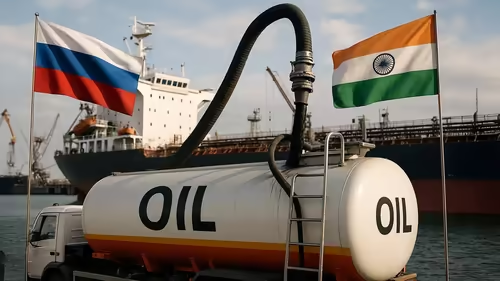
In a high-stakes diplomatic maneuver, the United States has laid down a clear ultimatum for India: curb your appetite for cheap Russian oil, or forget about a favorable trade deal and relief from steep tariffs. The message, delivered by US Trade Representative (USTR) Jamieson Greer, cuts to the heart of a complex geopolitical and economic tussle between two major democracies.
As India celebrates its landmark free trade agreement with the European Union, a deal hailed as a “mother of all trade deals” [[14]], it finds itself in a delicate balancing act with its other key strategic partner, the United States. The core of the friction? **India Russian oil tariffs**.
Table of Contents
- The US Ultimatum: A Clear Link Between Oil and Tariffs
- Why India is Hooked on Russian Crude
- The Stakes for a US-India Trade Deal
- Is India Already Diversifying Away from Russia?
- The Path Forward for India
- Conclusion
- Sources
The US Ultimatum: A Clear Link Between Oil and Tariffs
Speaking on the sidelines of the World Economic Forum in Davos, USTR Jamieson Greer did not mince words. He acknowledged that India has been a significant beneficiary of discounted Russian energy since the Ukraine conflict began, bluntly stating, “They like the discount…” [[2]]. However, he followed this with a firm condition: for India to secure relief from the existing 50% tariffs on its exports to the US—which include a specific 25% levy tied directly to its Russian oil imports—it must take concrete steps to address Washington’s concerns [[2], [6]].
This isn’t just a casual request; it’s a direct linkage of trade policy to foreign policy. The Trump administration views India’s massive purchases of Russian oil as indirectly funding Moscow’s war machine, a stance that has created a significant point of contention in an otherwise growing strategic partnership. The message is clear: a foundational US-India trade deal is contingent on New Delhi demonstrating a more decisive pivot away from Russian energy.
Why India is Hooked on Russian Crude
From India’s perspective, the calculus is purely economic. Since early 2022, Russian crude has offered a massive discount compared to global benchmarks, providing a lifeline for Indian refiners and helping to keep domestic fuel prices stable. The numbers are staggering: India has imported Russian oil worth an estimated €144 billion since the start of the Ukraine war [[15]]. For much of 2023 and 2024, India was the world’s largest buyer of Russian oil, with state-owned giants like Indian Oil Corporation leading the charge [[18]].
This influx of cheap energy has been a boon for India’s economy, allowing its refineries to process crude at low cost and export high-value petroleum products to Europe and elsewhere. It’s a pragmatic, market-driven decision that has served India’s national interest well, even if it complicates its relationship with the West.
The Stakes for a US-India Trade Deal
The potential rewards for India in securing a trade pact with the US are immense. Such a deal is expected to unlock opportunities in critical sectors like defense, aviation, and technology [[10]]. With momentum reportedly strong and both governments aiming for a March 2026 deadline [[9]], the timing is critical. However, the shadow of the Russian oil issue looms large over these negotiations.
While the US has its own trade agreements with other partners, a deal with India represents a strategic counterweight in the Indo-Pacific and a massive market opportunity for American businesses. But for the US, this economic partnership cannot come at the cost of undermining its broader geopolitical strategy against Russia. This creates a classic dilemma for India: how to balance its immediate economic needs with its long-term strategic alignment.
Is India Already Diversifying Away from Russia?
There are signs that India is getting the message. Recent data shows a notable, albeit gradual, shift. In January 2026, imports of Russian crude have reportedly dropped to around 1.1 to 1.3 million barrels per day, down from peaks of nearly 2 million barrels per day [[16], [21]]. One report even noted a 29% month-on-month drop in December 2025 [[19]].
Greer himself has acknowledged this trend, stating that India appears to be “starting to diversify” its sources [[3]]. However, the US seems to view these moves as insufficient. The sheer volume of oil still flowing from Russia to India suggests that while diversification is beginning, it is far from a complete break. The US is likely looking for a more accelerated and definitive reduction to feel confident that India is truly aligning with its strategic objectives.
The Path Forward for India
India now faces a complex negotiation. On one hand, it can leverage its new EU trade pact as a sign of its growing global clout and argue that its energy choices are a matter of sovereign economic necessity. On the other, it must convince the US that it is a reliable strategic partner willing to make difficult choices.
The path forward likely involves a multi-pronged approach:
- Accelerated Diversification: Speeding up efforts to source crude from traditional suppliers like Iraq, Saudi Arabia, and the US itself.
- Strategic Communication: Clearly articulating its energy security needs to Washington while demonstrating a genuine commitment to reducing reliance on Russian oil over a defined timeline.
- Leveraging Other Areas of Cooperation: Highlighting its contributions in other areas of the US-India partnership, such as defense collaboration and technology, to build goodwill.
Ultimately, India must navigate this tightrope walk carefully. The goal is to secure the economic benefits of a US trade deal without completely sacrificing the financial advantages of its current energy mix, all while maintaining its strategic autonomy.
Conclusion
The standoff over India Russian oil tariffs is more than just a trade dispute; it’s a test of the maturity and depth of the US-India strategic partnership. Jamieson Greer’s comments have thrown down the gauntlet, forcing New Delhi to make a choice that will have long-lasting implications for its economy and its place in the global order. While India has begun to diversify its oil imports, the pace and scale of this shift will be the key determinant in whether it can unlock the door to a lucrative trade agreement with the United States. The next few months of negotiation will be critical in defining the future of this vital relationship.
Sources
- Times of India: ‘They like the discount..’: Trump aide says India has to do more on Russian oil to get tariff relief
- Al Jazeera: India, EU agree on ‘mother of all’ trade deals
- Angel One: India’s Russian Oil Imports Hit €144 Billion Since Start of Ukraine War
- Baker McKenzie: What’s on the Horizon for Business with India in 2026?
- Times of India: ‘Starting to diversify’: Is India cutting back on Russian oil amid tariffs?