Table of Contents
- The Fiery Warning That Shook the Political Arena
- What is the Special Intensive Revision (SIR)?
- Allegations of Harassment and Human Tragedy
- Political Implications for the 2026 Elections
- Conclusion: A State on Edge
- Sources
The Fiery Warning That Shook the Political Arena
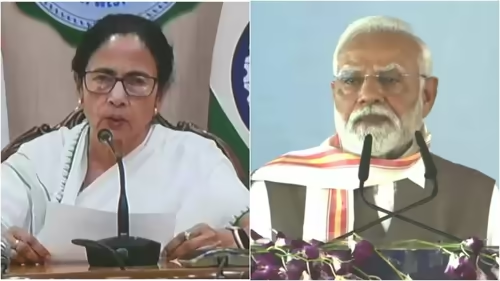
In a moment that has sent shockwaves through India’s political landscape, West Bengal Chief Minister Mamata Banerjee has delivered a direct and personal ultimatum to Prime Minister Narendra Modi. Her message was clear and chilling: “If you hurt me, I will become dangerous.” This Mamata Banerjee warning Modi comes amidst a growing crisis over the implementation of the Special Intensive Revision (SIR) of electoral rolls in her state, which she claims is a systematic campaign of harassment against Bengalis.
The Trinamool Congress (TMC) supremo, known for her fiery oratory, framed the issue as an attack not just on her administration but on the very identity and dignity of the Bengali people. This isn’t just political posturing; it’s a high-stakes gambit that could define the trajectory of West Bengal politics heading into the crucial 2026 assembly elections [[5]].
What is the Special Intensive Revision (SIR)?
To understand the gravity of the situation, one must first grasp what the SIR is. The Special Intensive Revision is a process mandated by the Election Commission of India (ECI) to update the voter list by verifying the residence of all registered electors. On paper, it’s a routine administrative exercise designed to ensure the integrity of the electoral roll by removing duplicate or non-existent entries.
However, in West Bengal, this process has been met with unprecedented resistance. The state government and opposition parties allege that the manner in which the SIR is being conducted is deeply flawed and politically motivated. They argue that the verification process is being used as a tool to intimidate and disenfranchise legitimate voters, particularly those from marginalized communities who may lack extensive documentation [[3]].
Allegations of Harassment and Human Tragedy
The core of Mamata Banerjee’s outrage lies in the alleged human cost of the SIR. She has painted a grim picture of a state in distress, claiming that the aggressive and often insensitive implementation of the verification process has led to severe mental trauma for countless citizens. In a deeply disturbing claim, the Chief Minister stated that nearly 70 people have died by suicide due to the fear and anxiety generated by the SIR-related harassment [[3]].
Protests have erupted across multiple districts of West Bengal, with citizens blocking national highways and staging large-scale demonstrations. The public anger is palpable, fueled by stories of officials demanding excessive documentation and creating an atmosphere of suspicion around ordinary citizens’ right to vote [[2], [6]].
Adding a unique cultural layer to her protest, Banerjee revealed that she has already penned 26 poems in January 2026 alone, each one a testament to the suffering she believes her people are enduring under this “inhumane” exercise [[1]]. This blend of political defiance and poetic expression is a hallmark of her leadership style, designed to resonate deeply with the Bengali public.
The Wider Target: Bengali Speakers Across India
Banerjee’s concerns extend beyond the borders of West Bengal. She has also raised the alarm about the alleged harassment of Bengali-speaking workers and residents in other states like Uttar Pradesh and Bihar. She sees this as part of a larger, coordinated effort to target and marginalize the Bengali community nationwide, further justifying her strong stance against the central government [[5], [7]].
Political Implications for the 2026 Elections
With the West Bengal assembly elections scheduled for 2026, the SIR controversy has become the central battleground for the next electoral war. For Mamata Banerjee, this is a golden opportunity to consolidate her base by positioning herself as the sole protector of Bengali interests against a hostile central government. By issuing such a direct Mamata Banerjee warning Modi, she is rallying her supporters and framing the upcoming election as a fight for the state’s autonomy and dignity.
On the other hand, the BJP, which has been trying to make significant inroads into West Bengal, finds itself on the defensive. The party must now navigate the delicate balance between supporting the ECI’s constitutional mandate and addressing the genuine public anger on the ground. The central government’s handling of this crisis will be a critical factor in determining its electoral fortunes in the state.
As a strategic move, Banerjee has announced her intention to challenge the SIR process in court, arguing that it is arbitrary and causing immense human suffering [[4], [8]]. This legal battle will run parallel to the political one, ensuring that the issue remains in the public eye for months to come.
Conclusion: A State on Edge
The standoff between Mamata Banerjee and the central government over the SIR is more than just a bureaucratic dispute. It is a potent mix of administrative procedure, deep-seated political rivalry, and raw public emotion. Banerjee’s declaration that she will become “dangerous” is a clear signal that she is prepared for a prolonged and intense conflict. For the people of West Bengal, caught in the crossfire, the hope is that their right to a fair and peaceful democratic process will ultimately prevail. The coming months will be a critical test for India’s federal structure and its commitment to inclusive democracy. Stay tuned to our coverage of the [INTERNAL_LINK:west-bengal-politics-2026] for the latest developments.
Sources
- The Hindu on Facebook: Mamata’s 26 Poems
- Rediff: Protests over SIR ‘Harassment’
- The Newsmill: Mamata Slams ECI over SIR
- The Savera Online: Mamata to Move Court Against SIR
- Asianet News: Mamata Warns Centre Over Bengali Speakers
- Times of India: West Bengal Districts Erupt in Protest
- The Federal: Mamata Warns BJP Over Harassment of Bengali Workers
- The Kashmir Images: Mamata to Move Court Against Arbitrary SIR