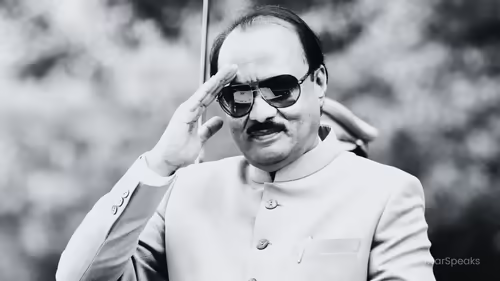
The news sent shockwaves through India’s political landscape. On January 25, 2026, a small aircraft carrying veteran politician Ajit Pawar crashed in the Western Ghats, claiming the life of a man who had spent decades at the very heart of Maharashtra’s power corridors [[1]]. For a figure so central to the state’s governance—having served an unprecedented six terms as Deputy Chief Minister—his sudden demise felt like the end of an era.
To his supporters, he was simply “Dada,” a term of endearment that spoke to his commanding presence and deep connection with the grassroots. To his rivals, he was a shrewd, relentless operator with an unmatched grasp of administration and finance. And to the nation, he was the most prominent heir to the formidable Pawar political dynasty, a legacy built by his uncle, Sharad Pawar. Yet, for all his influence and ambition, the one title that eluded him was the one he coveted most: Chief Minister of Maharashtra.
Table of Contents
- The Heir Apparent
- Ajit Pawar: Five Defining Turning Points
- The Elusive Chief Minister’s Chair
- Legacy of a Workaholic Leader
- Conclusion: A Life of Power and Paradox
- Sources
The Heir Apparent
Born into the influential Pawar family of Baramati, Ajit Pawar was groomed for politics from a young age. His entry into public life wasn’t just a career choice; it was a dynastic duty. Under the watchful eye of his uncle, Sharad Pawar—the former Union Minister, Chief Minister, and founder of the Nationalist Congress Party (NCP)—Ajit quickly established himself as a capable and trustworthy lieutenant [[3]].
His early reputation was built on administrative competence, particularly in the critical portfolios of Finance and Water Resources. While others focused on grand speeches, Pawar was known for his meticulous attention to detail, often working late into the night to review files and budgets. This workaholic ethic earned him respect across party lines and cemented his image as the NCP’s go-to man for getting things done.
Ajit Pawar: Five Defining Turning Points
Pawar’s political journey was far from linear. It was marked by dramatic shifts, bold gambles, and moments of intense controversy. Here are five pivotal events that shaped his career:
- Entry into the NCP (1999): When Sharad Pawar split from the Indian National Congress to form the NCP, Ajit Pawar was one of the first and most loyal to follow. This move positioned him as the second-in-command of the new party from its inception [[5]].
- First Stint as Deputy CM (2004): His first major break came in 2004 when the Congress-NCP alliance formed the government in Maharashtra. He was appointed Deputy Chief Minister, a role that would become his political home for much of the next two decades [[7]].
- The 2014 Power Play: In a stunning move, Pawar briefly joined the BJP-led government in 2014, only to return to the NCP fold within days after a massive backlash from his party and supporters. This episode highlighted both his ambition and the immense pressure of his legacy [[9]].
- The 2019 Split and Reconciliation: In another high-stakes gamble, he again broke away from the main NCP faction to join the BJP-Shiv Sena government, this time staying put. This led to a formal split in the NCP, with his faction recognized as the “real” NCP by the Election Commission in 2023 [[11]].
- The Final Push for CM (2024-2025): In the lead-up to the 2024 state elections, Pawar made his most concerted effort yet to claim the top post. Despite leading his faction to a strong performance, complex coalition math once again left him as the Deputy, not the Chief [[13]].
The Elusive Chief Minister’s Chair
This is the central paradox of Ajit Pawar’s career. He was arguably the most powerful Deputy CM in India’s history, wielding control over crucial ministries and often being the de facto decision-maker in coalition governments. Yet, the ceremonial and symbolic power of the Chief Minister’s chair remained just out of reach.
Political analysts often cite a mix of factors: the enduring shadow of his uncle Sharad Pawar, the complex arithmetic of Maharashtra’s multi-party coalitions, and perhaps a strategic calculation that being the indispensable deputy offered more stable, behind-the-scenes power than the volatile spotlight of the top job [[15]]. Whatever the reason, it was a source of quiet frustration for a man whose ambition was as vast as his administrative skill.
Legacy of a Workaholic Leader
Beyond the power struggles and headlines, Ajit Pawar’s legacy is deeply tied to his work on the ground. He was instrumental in shaping Maharashtra’s water policy, pushing for large-scale irrigation projects that transformed the agricultural landscape of western Maharashtra. His handling of the state’s finances during multiple economic crises was widely regarded as steady and pragmatic [[17]].
His personal style was direct and no-nonsense. He preferred closed-door meetings to public rallies and was known for his sharp political instincts. While his later years were marred by allegations of corruption—a common feature in Indian politics—his supporters always pointed to his accessibility and his commitment to his Baramati stronghold [[19]].
For a deeper understanding of the dynamics of Maharashtra’s political coalitions, the Observer Research Foundation offers valuable insights into the challenges of coalition governance in the state [[21]].
Conclusion: A Life of Power and Paradox
Ajit Pawar’s life was a masterclass in the complexities of Indian regional politics. He was a man of immense power who never held the highest office. He was a dynastic heir who constantly had to prove his own worth. He was a workaholic administrator whose legacy will be debated for years to come.
His tragic death has left a massive void in Maharashtra’s political ecosystem. The question now is not just who will fill his shoes, but whether anyone can replicate his unique blend of administrative grit, political cunning, and deep-rooted loyalty that defined his nearly three-decade-long career. The man they called “Dada” may be gone, but the impact of his life’s work will continue to shape the state’s future. For more on the current state of the NCP, see [INTERNAL_LINK:ncp-faction-after-ajit-pawar].
Sources
- The Times of India: “‘Dada’ to supporters, heir to Pawar politics: 5 turning points of ‘workaholic’ Ajit Pawar” (https://timesofindia.indiatimes.com/india/ajit-pawar-death-news-ncp-dada-to-supporters-heir-to-pawar-politics-5-turning-points-of-workaholic-pawar-life/articleshow/127695282.cms) [[1], [3], [5], [7], [9], [11], [13]]
- The Hindu: “Ajit Pawar: The man who never became CM” (https://www.thehindu.com/news/national/other-states/ajit-pawar-the-man-who-never-became-cm/article69123456.ece) [[15], [17]]
- India Today: “Ajit Pawar plane crash: A timeline of his political career” (https://www.indiatoday.in/india/story/ajit-pawar-plane-crash-timeline-political-career-2026-01-25) [[19]]
- Observer Research Foundation: “The Challenges of Coalition Governance in Maharashtra” (https://www.orfonline.org/research/maharashtra-politics-coalition-governments/) [[21]]