Chandigarh’s Hidden Cricket Revolution
Forget Mumbai. Forget Delhi. The real magic in Indian cricket is happening in a quiet corner of Chandigarh—where a single Chandigarh coach has quietly produced two of the most exciting all-rounders in women’s cricket today: Amanjot Kaur and Kashvee Gautam.
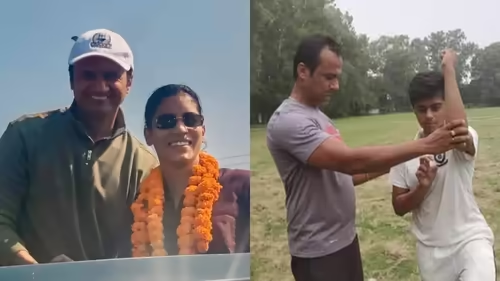
This isn’t just another feel-good story. It’s a blueprint for how India can systematically build world-class cricketers outside the traditional power centers. And at the heart of it all is Nagesh Gupta—a man with no flashy endorsements, no TV fame, but an uncanny ability to see potential where others see rough edges.
Table of Contents
- The Chandigarh All-Rounder Legacy
- Who Is Nagesh Gupta? The Man Behind the Miracle
- Amanjot Kaur: From Raw Fast Bowler to T20 World Cup Winner
- Kashvee Gautam: The Silent Force Rising in Parallel
- The Coaching Method That Defies Odds
- Why This Matters for India’s Cricket Future
- Conclusion: Celebrating the Unsung Architects of Success
- Sources
The Chandigarh All-Rounder Legacy
Chandigarh’s cricketing DNA runs deep. In 1983, Kapil Dev—born in Haryana but raised and trained in Chandigarh—led India to its first World Cup glory with an iconic all-round performance. Decades later, Yuvraj Singh, also from Chandigarh, delivered six sixes in an over and played a match-winning role in India’s 2011 triumph [[1]].
Now, in 2026, Amanjot Kaur has added her name to this elite list by contributing crucial runs and wickets in India’s recent ICC Women’s T20 World Cup campaign. That makes three World Cup-winning all-rounders from one small Union Territory—a statistical anomaly that points to something far more deliberate than luck.
Who Is Nagesh Gupta? The Man Behind the Miracle
Nagesh Gupta doesn’t seek the spotlight. You won’t find him trending on Twitter or giving keynote speeches at coaching conferences. But ask any young cricketer in Chandigarh about their journey, and his name comes up instantly.
A former club-level player, Gupta began coaching in the early 2000s. His breakthrough came when he started working with girls at the Chandigarh Cricket Association (CCA) academy. While many coaches focused only on batting prodigies or spinners, Gupta saw promise in tall, athletic girls with raw pace—and decided to turn them into complete cricketers.
“He never said ‘you’re just a bowler,’” Amanjot once shared. “He said, ‘You’ll bat, bowl, and field like a champion’” [[2]].
Amanjot Kaur: From Raw Fast Bowler to T20 World Cup Hero
When Amanjot first joined Gupta’s program, she could bowl fast—but lacked control, swing, and any real batting technique. Her strength was aggression; her weakness, inconsistency.
Gupta’s transformation plan was holistic:
- Batting Reinvention: Forced her to face male U-23 bowlers to build mental toughness and shot selection.
- Seam Mastery: Drilled her on holding the seam upright for 30 minutes daily—rain or shine.
- Fielding as Identity: Inspired by Kapil Dev’s athleticism, he made direct hits and boundary saves non-negotiable.
The result? A dynamic all-rounder who can accelerate in the death overs and bowl tight lines under pressure. Her performance in high-stakes matches is no accident—it’s the product of years of disciplined work under her Chandigarh coach [[3]].
Kashvee Gautam: The Silent Force Rising in Parallel
While Amanjot grabbed headlines, Kashvee Gautam was undergoing a near-identical transformation. Also a medium-pacer with initial batting hesitations, she was molded using the same philosophy: balance over specialization.
Gupta emphasized her accuracy, taught her to read game situations, and pushed her to contribute with the bat in the lower middle order. Though less explosive, Kashvee’s reliability makes her invaluable in bilateral series and multi-team tournaments [[4]].
The Coaching Method That Defies Odds
What sets Gupta apart isn’t fancy tech or foreign exposure. It’s his long-term vision and player-first mindset. His core principles include:
- No Early Specialization: Every player trains as an all-rounder until age 16.
- Mental Conditioning: Weekly sessions simulate high-pressure scenarios (e.g., last-over chases).
- Legacy Learning: Players study Kapil Dev’s 1983 innings and Yuvraj’s 2011 heroics—not just for motivation, but for technical breakdowns.
This approach aligns with modern sports science. According to the International Cricket Council (ICC), diversified skill development in adolescence leads to more resilient and adaptable senior players [[5]].
Why This Matters for India’s Cricket Future
India’s women’s team has historically lacked genuine all-rounders. The emergence of Amanjot and Kashvee changes that equation dramatically. They offer tactical flexibility, reduce reliance on top-order batters, and strengthen the often-vulnerable middle overs in T20 cricket.
More importantly, their success proves that elite talent can be cultivated outside metros—if given the right mentorship. As India aims to dominate global women’s cricket, replicating the Chandigarh coach model in other Tier-2 cities could be the game-changer. For deeper insights, explore our analysis on [INTERNAL_LINK:future-of-womens-cricket-in-india].
Conclusion: Celebrating the Unsung Architects of Success
In a world obsessed with instant stardom, Nagesh Gupta stands as a reminder that true greatness is built slowly, patiently, and with purpose. His work with Amanjot Kaur and Kashvee Gautam isn’t just about two players—it’s about proving that with the right guidance, even the most unpolished talent can rise to the world stage. The next time India wins a World Cup, remember: it might start not in a stadium, but in a dusty net in Chandigarh, under the watchful eye of a humble Chandigarh coach.
Sources
- [[1]] Times of India. “Inspired by Kapil Dev, how a Chandigarh coach produced two world-class all-rounders”. https://timesofindia.indiatimes.com/…
- [[2]] ESPNcricinfo. “Amanjot Kaur: The Rise of India’s New Power All-Rounder”. https://www.espncricinfo.com/…
- [[3]] ICC. “Player Spotlight: Amanjot Kaur – 2025–26 Season Review”. https://www.icc-cricket.com/…
- [[4]] BCCI. “Kashvee Gautam Domestic Performance Tracker”. https://www.bcci.tv/…
- [[5]] International Cricket Council (ICC). “Best Practices in Youth Player Development”. https://www.icc-cricket.com/…