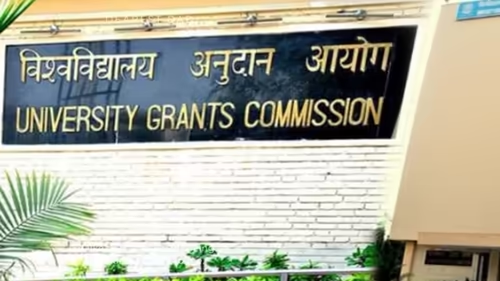
There’s been a lot of buzz—and confusion—around the new UGC equity regulations 2026. Headlines screamed about “campus courts” and sweeping new powers for students. But the reality is more nuanced, and arguably more impactful. Forget courtroom dramas; the real teeth of these regulations lie not in adjudicating individual cases, but in holding entire institutions accountable through serious, structural consequences. If your college ignores equity norms, it could lose its very right to exist as a recognized degree-granting body.
Table of Contents
- What the UGC Equity Regulations 2026 Actually Do
- No ‘Campus Court’? So Where Do Student Complaints Go?
- The Real Power: UGC’s Institutional Penalties
- How Students Can File a Complaint: Step-by-Step
- Why This Approach Might Be More Effective
- Conclusion
- Sources
What the UGC Equity Regulations 2026 Actually Do
First, let’s clear the air. The UGC equity regulations 2026 do **not** establish a new judicial body or a so-called “campus court” to hear individual student grievances. This is a critical point that has been widely misunderstood [[1]].
Instead, the regulations focus on institutional compliance. They mandate that every higher education institution (HEI) in India must have robust, transparent, and functional internal mechanisms to address issues related to equity, discrimination, harassment, and inclusion. These mechanisms must align with national laws and UGC guidelines. The UGC’s role is not to be a first responder to student complaints, but to act as an auditor and enforcer at the systemic level [[5]].
No ‘Campus Court’? So Where Do Student Complaints Go?
If you’re a student facing an issue, your first and primary point of contact remains your own university or college. The regulations require institutions to have well-publicized grievance redressal cells, Internal Complaints Committees (ICCs) for sexual harassment (as per the POSH Act), and other relevant bodies [[10]].
Here’s the flow for a student complaint:
- File Internally: Submit your complaint to your institution’s designated committee (e.g., ICC, Anti-Ragging Committee, or general grievance cell).
- Institutional Inquiry: The institution is obligated to conduct a fair and timely inquiry.
- Criminal Offences: If the inquiry reveals a potential criminal offence (like assault or hate speech), the institution **must** inform the local police immediately [[1]].
- Escalation to UGC: If you believe your institution failed to follow its own rules or the UGC’s mandated procedures during the inquiry, *that* is when the UGC steps in—not to re-hear your case, but to investigate the institution’s compliance failure.
The Real Power: UGC’s Institutional Penalties
This is where the regulations pack a serious punch. If the UGC finds, through its own enquiry, that an institution has willfully ignored or violated the equity regulations, it can impose severe penalties that go far beyond a simple warning. These include:
- Bar from Central Schemes: The institution can be excluded from all University Grants Commission and Ministry of Education funding schemes.
- Programme Suspension: The UGC can stop the institution from offering specific degree programmes, especially new or online/ODL (Open and Distance Learning) courses.
- De-recognition: In the most extreme cases of persistent non-compliance, the UGC has the authority to remove the institution from its list of recognised universities or colleges, effectively shutting down its ability to grant valid degrees [[1]].
This approach shifts the focus from punishing individuals to ensuring systemic accountability. It creates a powerful financial and operational incentive for institutions to get their house in order.
How Students Can File a Complaint: Step-by-Step
For students, navigating this system requires clarity. Here’s a practical guide:
- Know Your Rights: Familiarize yourself with your institution’s published equity and anti-discrimination policies. These should be available on its official website [INTERNAL_LINK:student-handbook-guide].
- Document Everything: Keep records of any incident, including dates, times, witnesses, and any communication.
- Use Official Channels: File your complaint in writing with the correct committee. Most institutions have online portals for this purpose.
- Follow Up: The regulations imply a timeline for resolution. If there’s no action, send a polite follow-up.
- Escalate to UGC (if needed): Only if you have evidence that the institution’s process was flawed or biased, can you file a formal complaint with the UGC detailing the procedural lapse, not the original grievance itself.
Why This Approach Might Be More Effective
While some may have hoped for a direct UGC appeals court, this institutional model has its merits. By threatening the very existence of a non-compliant college, the UGC creates a top-down pressure that forces administrations to prioritize equity. It’s a recognition that sustainable change comes from fixing broken systems, not just resolving individual cases. This strategy is similar to approaches used by accreditation bodies in other countries, like the U.S. Department of Education’s Office for Civil Rights, which also focuses on institutional compliance [[15]].
Conclusion
The UGC equity regulations 2026 represent a significant, albeit indirect, step forward for student rights in India. They move away from a reactive, case-by-case model and towards a proactive, systemic one. For students, the message is clear: your voice matters, but it must be channeled through your institution’s processes first. For colleges and universities, the warning is stark: ignore equity, and you risk losing everything. The success of these regulations will ultimately depend on vigilant students, responsible institutions, and a UGC willing to wield its newfound enforcement powers decisively.
Sources
- [[1]] Times of India. “UGC equity regulations 2026 decoded: How students can file a complaint and more.” January 28, 2026.
- [[5]] University Grants Commission (India). “Equity Regulations, 2026.” Official Gazette Notification.
- [[10]] Ministry of Education, Government of India. “Guidelines for Gender Sensitisation and Prevention of Sexual Harassment.”
- [[15]] U.S. Department of Education. “Office for Civil Rights: Ensuring Equal Access to Education.” https://www2.ed.gov/about/offices/list/ocr/index.html