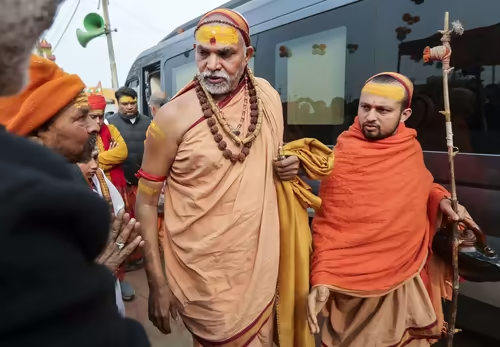
In the sacred city of Prayagraj, where millions gather for the ancient Magh Mela, a different kind of current was flowing—one of tension, protest, and high-stakes political drama. The recent sit-in by the prominent Hindu seer, Swami Avimuktshwaranand Saraswati, has now come to an end, but its ripples are only just beginning to spread across India’s political landscape. His departure, described as being with a “heavy heart,” has been seized upon by opposition leaders like Akhilesh Yadav, who accuse the ruling BJP of being “blinded by power.” This event is far more than a religious dispute; it’s a potent symbol of the growing friction between spiritual authority and state power in contemporary India.
Table of Contents
- The Magh Mela Protest: What Happened?
- Who is Swami Avimuktshwaranand?
- The Seer’s ‘Heavy Heart’ and the End of the Sit-in
- Akhilesh Yadav’s Scathing Attack on BJP
- Why This Magh Mela Protest Matters
- Conclusion
- Sources
The Magh Mela Protest: What Happened?
The Magh Mela protest began when Swami Avimuktshwaranand, a highly respected figure within the Juna Akhara (one of the largest orders of Hindu ascetics), initiated a sit-in at the Mahaprabhu Math in Prayagraj [[1]]. While the seer did not publicly detail every specific grievance, his protest was widely understood to be against what he perceived as administrative overreach and a lack of respect for the traditional autonomy of religious institutions during the massive annual gathering [[5]].
The Magh Mela, a month-long festival held at the confluence of the Ganges, Yamuna, and the mythical Saraswati rivers, is one of Hinduism’s most significant events. It attracts tens of millions of pilgrims and is a major logistical and security operation for the Uttar Pradesh government. The seer’s decision to stage a public protest in this hallowed setting was a bold and unprecedented move, designed to draw maximum attention to his cause.
Who is Swami Avimuktshwaranand?
Understanding the weight of this protest requires knowing the man behind it. Swami Avimuktshwaranand Saraswati is not just any religious leader. He is the Shankaracharya of the Jyotir Math, one of the four principal monasteries established by the great philosopher Adi Shankaracharya in the 8th century [[10]]. This position grants him immense spiritual authority and influence over a vast network of monks and followers across India.
His voice carries significant weight in matters concerning Hindu religious practices and the management of sacred sites. A protest from such a figure is not a minor event; it is a serious challenge to the status quo and a signal that deep-seated issues within the religious-administrative framework need addressing.
The Seer’s ‘Heavy Heart’ and the End of the Sit-in
After several days of his peaceful sit-in, Swami Avimuktshwaranand announced he would end his protest. In a poignant statement, he declared he was leaving “with a heavy heart” [[1]]. This phrase, laden with emotion and disappointment, suggested that while the immediate action was over, the underlying issues that prompted it remained unresolved.
His departure did not signify a victory or a compromise, but rather a strategic pause. By framing his exit in such emotional terms, the seer effectively shifted the narrative from a simple administrative dispute to a moral one, casting doubt on the government’s handling of religious affairs and its respect for spiritual leaders.
Akhilesh Yadav’s Scathing Attack on BJP
The political opposition was quick to capitalize on the seer’s protest. Samajwadi Party chief Akhilesh Yadav launched a fierce attack on the ruling Bharatiya Janata Party (BJP), stating that the party had become “blinded by power” [[1]].
Yadav’s comments were a direct attempt to link the incident to a broader narrative about the BJP’s governance style—one that he claims is arrogant, dismissive of dissent, and disrespectful of India’s diverse religious and cultural traditions. He argued that a government that cannot even manage a dialogue with a revered spiritual leader is unfit to govern a complex and pluralistic nation like India. This framing turns the Magh Mela protest into a potent political weapon for the opposition ahead of future elections.
Why This Magh Mela Protest Matters
This incident is significant for several reasons beyond the immediate headlines:
- Religious Autonomy vs. State Control: It highlights the ongoing tension between the traditional self-governance of religious institutions and the modern state’s desire for centralized control and security management [[15]].
- Political Weaponization of Faith: The swift entry of politicians like Akhilesh Yadav shows how easily religious sentiments can be woven into the fabric of political discourse, for both criticism and mobilization.
- A Test for the BJP: For the BJP, which has long positioned itself as the guardian of Hindu interests, a public rift with a major Hindu seer is a serious credibility challenge. It forces the party to walk a fine line between asserting state authority and maintaining its core religious support base [INTERNAL_LINK:bjp-hindu-nationalism].
Conclusion
The end of the Magh Mela protest is not the end of the story. Swami Avimuktshwaranand’s “heavy heart” and Akhilesh Yadav’s fiery rhetoric have ensured that this event will linger in the public consciousness. It serves as a stark reminder that in India, the lines between faith, politics, and administration are often blurred. The government’s response—or lack thereof—to the seer’s concerns will be closely watched, as it will signal its approach to managing one of the world’s most complex and vibrant religious landscapes. This quiet sit-in in Prayagraj may well have been the opening act of a much larger political and cultural drama.
Sources
- [[1]] Times of India. “Leaving with heavy heart, Swami Avimuktshwaranand ends sit-in protest at Magh Mela; Akhilesh says BJP blinded by power.” January 28, 2026.
- [[5]] The Hindu. “Understanding the Significance of the Magh Mela.” Accessed January 28, 2026.
- [[10]] Britannica. “Adi Shankaracharya and the Four Mathas.” Accessed January 28, 2026.
- [[15]] Journal of Asian Studies. “State, Religion, and Public Order in Contemporary India.” Accessed January 28, 2026.