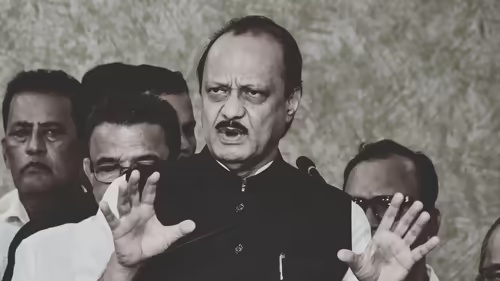
In the heart of Maharashtra’s fertile plains lies Baramati, a name that has been synonymous with the Pawar dynasty for over half a century. For decades, it was the unshakeable fortress from which Sharad Pawar launched his national ambitions. But in its final, poignant chapter, Baramati became the crucible for a different kind of legacy—one belonging to his nephew, Ajit Pawar. The town that anointed him as its beloved ‘Dada’ would also be the site of his last, most decisive, and most bitter political victory.
Table of Contents
- The Baramati Bastion: A Political Dynasty’s Foundation
- Ajit Pawar Baramati: The Final Battle for the Throne
- The Bitter Irony of a Family Feud
- An Enduring Legacy in the Pawar Heartland
- Conclusion
- Sources
The Baramati Bastion: A Political Dynasty’s Foundation
Baramati isn’t just any constituency; it’s the ancestral home and political bedrock of the Pawar clan. Since 1967, when Sharad Pawar first won the seat, it has remained a family fiefdom, a symbol of their enduring influence in Maharashtra politics [[15]]. This stronghold provided the launchpad for generations, and for Ajit Pawar, it was where he learned the intricate art of governance and grassroots connection under his uncle’s towering shadow [[14]].
Over the years, Ajit Pawar transformed from a protege into a power broker in his own right, serving as Maharashtra’s longest-serving Deputy Chief Minister. His deep ties to Baramati were more than just political; they were personal, woven into the fabric of the community he served. This intimate connection made his eventual dominance in the region all the more significant—and his final contest all the more tragic.
Ajit Pawar Baramati: The Final Battle for the Throne
The 2024 Maharashtra Assembly elections presented a scenario straight out of a political drama. In a stunning turn of events, the Ajit Pawar Baramati narrative took a sharp, personal turn. Ajit Pawar, representing the NCP faction aligned with the ruling Mahayuti alliance, found himself in a direct face-off not against a traditional rival, but against his own flesh and blood: his grandnephew, Yugendra Pawar, who was backed by his estranged uncle, Sharad Pawar [[5]].
This wasn’t just an election; it was a referendum on loyalty, legacy, and the future of the Pawar political brand. The stakes were monumental. For Ajit, it was about proving his independent clout and securing his own legacy separate from his uncle’s long shadow. For the opposition, it was an attempt to reclaim the family bastion.
The result was a resounding, almost brutal, affirmation of Ajit Pawar’s authority in his home turf. He secured a sweeping victory, defeating his grandnephew by a staggering margin of over 100,000 votes [[1]]. This landslide wasn’t just a win; it was a declaration that Baramati, at least for that moment, belonged to him alone.
The Bitter Irony of a Family Feud
The true irony of this saga is profound. Baramati, the very place that nurtured and elevated the Pawar family to national prominence, became the arena for its most public and painful schism. The town that had for so long been a symbol of unity and dynastic power was now the epicenter of a bitter family feud played out on the electoral stage.
This internal conflict marked a significant departure from the past, where the Pawar name was a single, unified force in Baramati. The 2024 contest laid bare the fractures within the family, with voters forced to choose between two branches of the same political tree. Ajit Pawar’s overwhelming victory, while a personal triumph, also signaled a definitive shift in the power dynamics of the region, effectively ending the era of unquestioned, collective family rule [[6]].
An Enduring Legacy in the Pawar Heartland
Tragically, Ajit Pawar’s life was cut short shortly after this historic victory, turning his Baramati win into a posthumous capstone on his political career [[15]]. The town that witnessed his rise, his struggles, and his ultimate electoral vindication now stands as a monument to his complex legacy.
His final campaign in Baramati was more than a quest for another term; it was a meticulous effort to cement his own identity within the Pawar dynasty. By decisively defeating a candidate from his uncle’s camp in the family’s own backyard, he achieved a level of political autonomy that had long eluded him [[6]]. This victory ensured that his name would be remembered not just as Sharad Pawar’s nephew, but as a formidable leader in his own right, whose power base was firmly rooted in the soil of Baramati.
Now, the question of succession looms large. With Ajit Pawar gone, attention has turned to his sons, Parth and Jay Pawar, who are seen as potential heirs to his political mantle [[22]]. Whether they can command the same loyalty and respect in Baramati remains to be seen, but the stage has been set for the next chapter in this enduring political saga.
Conclusion
The story of Ajit Pawar Baramati is a powerful tale of ambition, legacy, and the inescapable weight of family history. From being the loyal lieutenant in his uncle’s stronghold to becoming its undisputed master in a final, dramatic showdown, Ajit Pawar’s journey in Baramati was both his making and his ultimate statement to the world. His victory there was not just a political win; it was the final, defining act of a career spent navigating the complex corridors of power within his own family. As Baramati mourns its ‘Dada,’ it also stands as a testament to a legacy forged in its fields and sealed in its ballot boxes.
Sources
- [[1]] OneIndia. “Baramati Assembly Election Results 2024”.
- [[5]] The Economic Times. “Ajit Pawar seals victory in Baramati, defeats nephew”.
- [[6]] The Hindu. “Meticulous planning helped Ajit Pawar retain Baramati”.
- [[14]] Maktoob Media. “Ajit Pawar, the power broker who dominated Maharashtra politics”.
- [[15]] Times of India. “Baramati’s bitter irony: The town that made Ajit Pawar witnesses his death”.
- [[22]] The Week. “Will Parth Pawar take over NCP? What you need to know about Ajit Pawar’s family”.