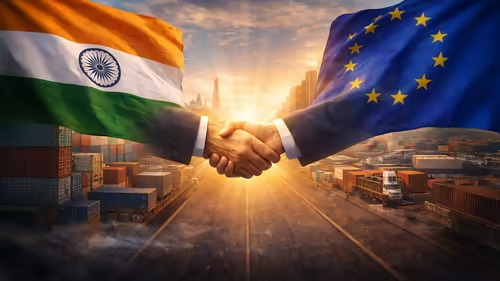
After nearly two decades of on-and-off negotiations, the wait is over. The India-EU FTA has been finalized, marking a seismic shift in the economic landscape for both India and the European Union. This isn’t just another trade deal; it’s a strategic partnership that will touch the lives of millions, from the factory floor in Gujarat to the supermarket aisle in Berlin.
Gone are the days of high tariffs acting as a barrier. This agreement promises a future where your favorite European chocolate is more affordable, your next car might come with a friendlier price tag, and Indian-made goods—from textiles to pharmaceuticals—will flood the lucrative EU market with unprecedented ease [[1]].
Table of Contents
- What is the India-EU FTA? A Simple Breakdown
- The Consumer Wins: Cheaper Cars, Chocolates, and More
- A Golden Ticket for Indian Exporters
- Beyond Goods: Services and Intellectual Property
- The Bigger Picture: Strategic Implications
What is the India-EU FTA? A Simple Breakdown
At its core, the India-EU FTA is a comprehensive pact designed to eliminate or significantly reduce tariffs—the taxes governments place on imported goods—on a vast majority of products traded between the two partners. The EU is India’s third-largest trading partner, while India is the EU’s tenth-largest, making this a deal of immense mutual importance [[5]].
The agreement covers far more than just physical goods. It creates a robust framework for cooperation in services, intellectual property rights, and even sustainable development, ensuring that the partnership is not just about profit, but also about shared values and long-term stability.
The Consumer Wins: Cheaper Cars, Chocolates, and More
For the average Indian consumer, this deal translates directly into savings. One of the most immediate and visible impacts will be on the price of imported goods.
- Automobiles: Tariffs on cars imported from the EU, which can be as high as 100%, will be progressively lowered. This means luxury and premium European car brands could become significantly more accessible to the Indian middle and upper classes [[1]].
- Food & Beverages: Get ready for a treat. Duties on popular European imports like Swiss chocolates, French wines, and Italian cheeses will see substantial cuts, bringing these gourmet items within closer reach of everyday shoppers [[3]].
- Electronics & Machinery: From high-end smartphones to industrial equipment, the cost of a wide range of European technology and machinery is expected to decrease, benefiting both individual buyers and Indian businesses looking to upgrade their operations.
A Golden Ticket for Indian Exporters
While consumers celebrate, Indian businesses are preparing for a massive opportunity. The EU market, with its 450 million affluent consumers, is one of the most desirable in the world. The India EU Free Trade Agreement benefits for exporters are profound.
Key Indian sectors stand to gain immensely:
- Textiles & Apparel: Indian garments, known for their quality and craftsmanship, will now enter the EU with little to no duty, making them far more competitive against rivals from Bangladesh and Vietnam.
- Pharmaceuticals: As the ‘pharmacy of the world,’ India’s generic drug manufacturers will find it easier and cheaper to supply life-saving medicines to European patients.
- Jewelry & Gems: India’s world-renowned diamond and jewelry industry will get a significant boost, with smoother access to a key luxury market.
- Agriculture: Products like basmati rice, spices, and tea are expected to see increased demand in Europe due to reduced trade barriers [[6]].
This duty-free or low-duty access is a game-changer, potentially adding billions of dollars to India’s export revenue and creating thousands of new jobs.
Beyond Goods: Services and Intellectual Property
The deal’s scope extends well beyond the movement of physical products. It includes strong provisions for trade in services, which is a critical sector for India’s economy, home to its massive IT and business process outsourcing (BPO) industry.
Furthermore, the agreement establishes clear and balanced rules on intellectual property rights (IPR). This is a win-win: it protects European innovations and brands in the Indian market, while also providing a secure environment for Indian companies to develop and market their own intellectual property. This framework fosters innovation and builds trust between the two partners [[7]].
The Bigger Picture: Strategic Implications
The India-EU FTA is as much a geopolitical statement as it is an economic one. In an era of global supply chain disruptions and rising protectionism, this deal signals a strong commitment to a rules-based, open, and multilateral trading system.
For India, it deepens a crucial strategic partnership with a major Western power, diversifying its economic relationships beyond its traditional partners. For the EU, it secures a reliable and dynamic partner in a critical region of the world. Together, they are building a counterweight to other dominant economic blocs, promoting a vision of trade that is fair, sustainable, and mutually beneficial [[8]].
Conclusion
The finalization of the India-EU FTA is a watershed moment. It promises tangible benefits for consumers in the form of lower prices and greater choice, while simultaneously unlocking a treasure trove of opportunities for Indian businesses on the global stage. This deal is not just about economics; it’s about forging a deeper, more resilient partnership for the 21st century. The real work of implementation begins now, but the potential for transformative growth is undeniable. For more on how global trade deals shape our economy, check out [INTERNAL_LINK:global-trade-agreements-impact].
Sources
- [[1]] Times of India: India-EU FTA: Why is the trade deal significant?
- [[3]] Business Standard: India, EU close in on FTA after 19 years of talks
- [[5]] European Commission: EU-India Trade and Investment Relations
- [[6]] Ministry of Commerce and Industry, Government of India: India-EU Bilateral Trade
- [[7]] World Trade Organization (WTO): TRIPS Agreement
- [[8]] Brookings Institution: The strategic logic of the EU-India trade deal