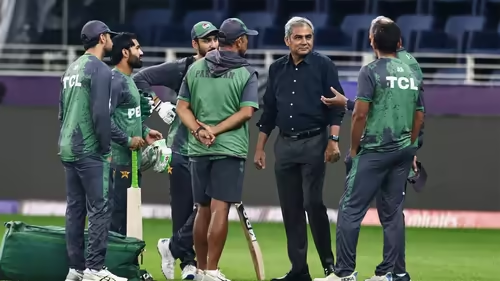
Cricket diplomacy just got a whole lot hotter. In a stunning and blunt public statement, 1983 Cricket World Cup hero **Krishnamachari Srikkanth** has told Pakistan: “Don’t come” to the upcoming **T20 World Cup 2026**—because if they do, they’ll be “thrashed.”
This explosive comment comes on the heels of controversial remarks by Pakistan Cricket Board (PCB) chairman **Mohsin Naqvi**, who recently suggested Pakistan might withdraw from the tournament in solidarity with Bangladesh—a move that’s sent shockwaves through the cricketing world.
Table of Contents
- The Trigger: Mohsin Naqvi’s Boycott Threat
- Srikkanth’s Fiery Response: ‘Don’t Come, You’ll Be Thrashed’
- T20 World Cup 2026: Why This Tournament Matters
- The Politics Behind the Pitch
- What Happens Next for Pakistan and the ICC?
The Trigger: Mohsin Naqvi’s Boycott Threat
On January 25, 2026, PCB Chairman Mohsin Naqvi made headlines when he publicly questioned Pakistan’s participation in the **T20 World Cup 2026**, which is set to be co-hosted by India and Sri Lanka [[1]].
Naqvi cited “double standards” by the International Cricket Council (ICC) after Bangladesh was barred from the tournament due to unresolved security and governance issues. In a show of regional solidarity, he declared, “If Bangladesh can’t play, why should we?”—effectively dangling Pakistan’s participation as a political lever [[2]].
While the PCB later clarified that no final decision had been made, the mere suggestion of a boycott ignited immediate backlash—not just from fans, but from former players across the subcontinent.
Srikkanth’s Fiery Response: ‘Don’t Come, You’ll Be Thrashed’
Never one to mince words, former Indian captain and current BCCI official **Krishnamachari Srikkanth** fired back with characteristic bluntness. In an interview with a leading Indian news outlet, he said:
“Hey Pakistan, don’t come—you’ll be thrashed. If you’re looking for an excuse not to play, go ahead and find one. But if you do come to India, be ready to lose badly.”
Srikkanth’s confidence isn’t unfounded. India’s current T20 squad—featuring stars like Suryakumar Yadav, Jasprit Bumrah, and Hardik Pandya—is widely regarded as one of the strongest in the world. Moreover, India has dominated Pakistan in recent ICC encounters, winning all their last eight meetings in global tournaments [[3]].
His comments reflect not just sporting bravado, but also the deep emotional weight of the India-Pakistan rivalry—a fixture that transcends sport and taps into national identity.
T20 World Cup 2026: Why This Tournament Matters
Scheduled from **February 7 to March 8, 2026**, the **T20 World Cup 2026** will be the first ICC men’s event hosted primarily in India since the 2016 edition. With matches also in Sri Lanka, the tournament promises massive viewership, especially around the marquee India-Pakistan clash in Group A [[4]].
Key facts about the tournament:
- Hosts: India and Sri Lanka
- Teams: 20 nations, including debutants
- Group A: India, Pakistan, USA, Namibia, Netherlands
- Expected Viewership: Over 1.5 billion globally
A Pakistani withdrawal would not only dent the ICC’s commercial plans but also disappoint millions of fans who see this match as the pinnacle of cricketing theatre.
The Politics Behind the Pitch
Cricket between India and Pakistan has long been entangled with geopolitics. Bilateral series have been suspended since 2012, making ICC events the only stage for this high-stakes rivalry.
Naqvi’s comments—while framed as support for Bangladesh—also echo longstanding domestic pressures in Pakistan, where playing in India remains a sensitive political issue. Yet, pulling out of an ICC-sanctioned event could lead to serious consequences, including fines, suspension of voting rights, or even exclusion from future tournaments [[5]].
As [INTERNAL_LINK:icc-regulations-and-team-participation] experts note, the ICC’s regulations are clear: qualified teams are expected to participate unless under extraordinary circumstances like war or natural disaster—neither of which applies here.
What Happens Next for Pakistan and the ICC?
All eyes are now on Islamabad. Reports suggest the Pakistani government will make a final call by **early February 2026**, after consultations between the PCB and the Prime Minister’s office [[6]].
If Pakistan backs out:
- The ICC may reallocate their group matches.
- Broadcasters could seek compensation for lost revenue.
- Fans worldwide would lose cricket’s biggest spectacle.
If they stay, they’ll face a hostile yet electric atmosphere—and a supremely confident Indian side eager to prove Srikkanth right.
Conclusion
Kris Srikkanth’s warning is more than just trash talk—it’s a reflection of the immense stakes surrounding the **T20 World Cup 2026**. With politics threatening to overshadow sport, the coming weeks will determine whether cricket can rise above division and deliver the festival fans deserve. One thing’s for sure: the world will be watching.