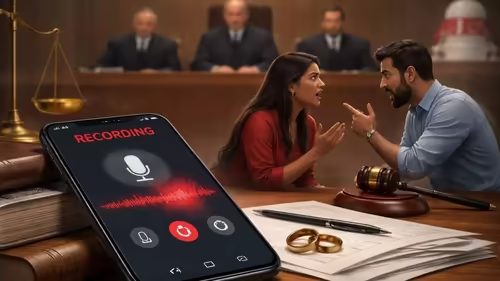
If you’ve ever wondered whether that late-night call you recorded from your spouse could hold up in court—wonder no more. In a major legal development, the **Supreme Court of India** has officially declared that **secretly recorded calls between spouses are admissible as evidence in divorce cases** [[1]]. This ruling flips the script on a previous decision by the Punjab and Haryana High Court and reopens a critical debate at the intersection of privacy, marital trust, and legal fairness.
The case in question involved a husband who submitted audio recordings of his wife’s private phone conversations to support his claim for divorce. The Family Court initially accepted the evidence, but the High Court later rejected it, citing violations of the right to privacy. Now, the Supreme Court has stepped in—and its verdict could change how thousands of divorce cases are argued across the country.
Table of Contents
- What the Supreme Court Actually Said
- Secretly Recorded Calls in Divorce: Legal Precedent Explained
- Privacy vs. Justice: The Core Debate
- How This Affects Your Divorce Case
- Practical Tips for Recording Conversations (Legally)
- Conclusion: A New Chapter in Family Law
- Sources
What the Supreme Court Actually Said
The Supreme Court didn’t just say “yes” to using secret recordings—it provided nuanced reasoning. The bench emphasized that while the **right to privacy is fundamental**, it is not absolute, especially within the confines of a marriage where one party alleges misconduct such as cruelty, adultery, or desertion [[1]].
Crucially, the Court reinstated the Family Court’s original order that admitted the recordings as evidence. It noted that the recordings were made by one spouse (a participant in the conversation), not a third party, which significantly alters the privacy calculus. As per Indian evidence law, a conversation recorded by one of the parties involved is generally not considered illegal wiretapping under the Indian Telegraph Act [[3]].
Secretly Recorded Calls in Divorce: Legal Precedent Explained
This isn’t the first time Indian courts have grappled with this issue. Previous judgments have been inconsistent:
- In R.M. Malkani v. State of Maharashtra (1973), the Supreme Court held that a tape-recorded conversation is admissible if it’s relevant, authentic, and not obtained through coercion [[4]].
- However, in People’s Union for Civil Liberties (PUCL) v. Union of India (1996), the Court affirmed that telephone tapping without due process violates Article 21 (right to life and personal liberty) [[5]].
The key distinction lies in **who made the recording**. If you’re part of the conversation, you’re not “tapping” in the surveillance sense—you’re documenting an interaction you were already privy to. The Supreme Court’s latest ruling reinforces this principle in the context of matrimonial disputes.
Privacy vs. Justice: The Core Debate
Critics argue that allowing secret recordings erodes marital trust and could encourage spouses to become amateur spies. There’s a legitimate fear that this ruling might normalize covert surveillance in relationships already fraught with tension.
On the other hand, proponents—including many family law attorneys—point out that in cases of domestic abuse, financial fraud, or emotional cruelty, victims often have no other way to prove their claims. Written evidence is rare; witnesses are scarce. Audio recordings can provide the only objective proof of threats, admissions, or hostile behavior [[6]].
As the Supreme Court noted, the **interest of justice** sometimes outweighs strict privacy concerns—especially when the recording is used to uncover truth in a legal proceeding, not for public dissemination or blackmail.
How This Affects Your Divorce Case
If you’re considering divorce or are already in proceedings, here’s what this ruling means for you:
- Evidence matters more than ever. If you have recordings that support your claims (e.g., verbal abuse, infidelity confessions), they may now be usable in court.
- Authenticity is key. The court will scrutinize whether the recording is unedited, genuine, and directly relevant to the grounds for divorce.
- Don’t record third-party calls. This ruling applies only to conversations you are part of. Recording your spouse’s calls with others without consent remains legally risky.
For more on navigating divorce evidence, see our guide on [INTERNAL_LINK:how-to-document-abuse-for-court].
Practical Tips for Recording Conversations (Legally)
If you find yourself in a situation where recording seems necessary, follow these best practices to stay on the right side of the law:
- Only record calls you are actively participating in.
- Do not edit, splice, or alter the audio in any way.
- Keep the original file with metadata intact (date, time, duration).
- Consult a family lawyer before submitting any recording as evidence.
Remember: just because something is admissible doesn’t mean it’s always advisable. Strategic legal counsel is essential.
Conclusion: A New Chapter in Family Law
The Supreme Court’s decision on **secretly recorded calls divorce** cases marks a pivotal moment in Indian family jurisprudence. It acknowledges the messy reality of modern marriages while attempting to balance individual privacy with the pursuit of truth in court. For spouses seeking justice—especially those who’ve suffered in silence—this ruling offers a powerful new tool. But with great power comes great responsibility: recordings should be used ethically, sparingly, and always under legal guidance.
Sources
- [[1]] Times of India: “Secretly recorded calls between spouses admissible in divorce cases: SC – what it means”
- [[3]] Indian Evidence Act, Section 65B: Admissibility of electronic records
- [[4]] R.M. Malkani v. State of Maharashtra, AIR 1973 SC 157
- [[5]] PUCL v. Union of India, AIR 1997 SC 568
- [[6]] National Legal Services Authority (NALSA): Guidelines on Matrimonial Disputes