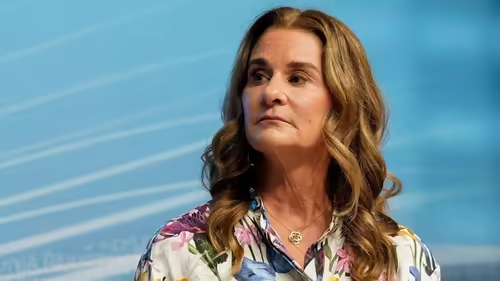
In a moment that has reignited national debate over law enforcement and civil liberties, philanthropist and advocate Melinda French Gates has spoken out forcefully against the ICE shootings in Minneapolis. Her statement—raw, principled, and deeply human—comes amid growing outrage over the violent targeting of two individuals engaged in what many describe as peaceful civic action.
Table of Contents
- What Happened in Minneapolis?
- Melinda French Gates’ Response
- Why Her Statement Matters
- The Broader Context of ICE and Civic Protest
- Constitutional Rights and Government Accountability
- Public Reaction and Next Steps
- Conclusion: A Call for the America We Believe In
- Sources
What Happened in Minneapolis?
On January 24, 2026, U.S. Immigration and Customs Enforcement (ICE) agents opened fire during an operation in South Minneapolis, critically injuring two individuals: Renée Nicole Good and Alex Pretti. According to eyewitnesses and local reports, both were participating in a non-violent demonstration outside an ICE facility, advocating for immigrant rights and transparency in federal immigration practices [[1]].
The incident quickly drew condemnation from community leaders, civil rights organizations, and public figures. Questions have since mounted about the use of lethal force against civilians engaged in what appears to be constitutionally protected activity—raising alarms about the militarization of federal agencies and the erosion of protest rights in America.
Melinda French Gates’ Response
In a widely shared social media post, Melinda French Gates did not mince words. She called the ICE shootings in Minneapolis “unconscionable,” adding: “No one should fear for their life when engaging in peaceful civic action.”
Her most resonant line struck a chord across political lines: “Our country is not this.” She went on to emphasize that the true spirit of America lies in its people—not its institutions acting without accountability. “The country is us. We the people,” she wrote, invoking the opening words of the U.S. Constitution to underscore her point [[2]].
Why Her Statement Matters
Melinda French Gates isn’t just a billionaire philanthropist; she’s a globally recognized advocate for gender equity, public health, and democratic participation. Her voice carries weight precisely because she often avoids partisan rhetoric in favor of human-centered values.
By framing the issue not as a political dispute but as a moral failing, she reframes the conversation:
- She centers the victims as citizens exercising fundamental rights.
- She challenges the narrative that government force is always legitimate.
- She reclaims patriotism as active citizenship—not blind obedience.
This approach resonates with a broad swath of Americans who feel alienated by increasing polarization yet still believe in the nation’s founding ideals.
The Broader Context of ICE and Civic Protest
This isn’t the first time ICE operations have sparked controversy. Over the past decade, the agency has faced repeated criticism for aggressive tactics, lack of transparency, and alleged human rights violations—particularly in detention centers and during raids [[3]].
Peaceful protests at ICE facilities have become a regular feature of the American activist landscape, especially since 2018. Demonstrators argue that holding the government accountable for its immigration policies is not just legal—it’s patriotic. The ICE shootings in Minneapolis now threaten to chill that essential democratic practice, raising fears of a surveillance state where dissent is met with bullets instead of dialogue.
Constitutional Rights and Government Accountability
At the heart of Gates’ message is a foundational American principle: the right to petition the government for redress of grievances (First Amendment). Peaceful assembly near government buildings—even controversial ones like ICE offices—is a long-standing tradition.
When federal agents use deadly force against unarmed protesters, it doesn’t just violate policy—it undermines the very contract between citizen and state. As legal scholars from the American Civil Liberties Union (ACLU) have noted, such incidents erode public trust and set dangerous precedents for future civic engagement [[4]].
Gates’ insistence that “exercising constitutional rights to hold government accountable is fundamentally American” is not just rhetoric—it’s a call to defend democracy itself.
Public Reaction and Next Steps
Following Gates’ statement, social media erupted with support under hashtags like #OurCountryIsNotThis and #ProtectPeacefulProtest. Local Minneapolis organizers have announced plans for a citywide vigil and a renewed push for federal oversight of ICE operations.
Meanwhile, members of Congress, including Rep. Ilhan Omar (D-MN), have demanded an independent investigation into the shootings. Calls are also growing for legislation that would explicitly protect non-violent protesters from excessive force by federal agents—a move that could turn Gates’ moral appeal into concrete policy.
For readers interested in how civic action shapes policy, see our guide on [INTERNAL_LINK:how-to-engage-in-peaceful-protest-safely].
Conclusion: A Call for the America We Believe In
Melinda French Gates’ response to the ICE shootings in Minneapolis transcends celebrity commentary. It’s a reminder that democracy thrives not in silence, but in the courage to speak up—even when facing armed authority. By declaring “our country is not this,” she invites every American to reclaim the nation’s highest ideals: justice, accountability, and the unwavering right to peaceful dissent. In a time of deep division, that message may be exactly what the country needs to hear.