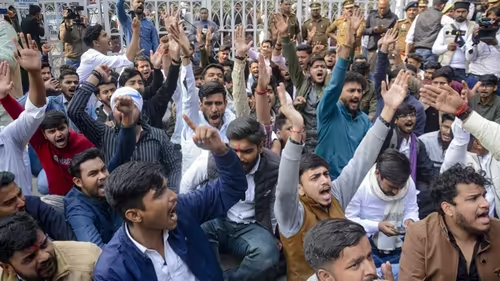
In a move that has sent shockwaves through India’s academic and political corridors, the Supreme Court is set to hear a critical plea challenging the very foundation of the University Grants Commission’s (UGC) newly minted UGC equity regulations. At the heart of this national debate is a seemingly simple but deeply contentious phrase: a ‘non-inclusionary’ definition of caste.
So, what’s the fuss all about? In January 2026, the UGC rolled out its ‘Promotion of Equity in Higher Education Institutions Regulations, 2026,’ replacing the older 2012 advisory guidelines with a binding framework. The stated goal is noble—eradicate caste-based discrimination on campuses. But the method has ignited a firestorm of protest, with critics claiming the rules are fundamentally exclusionary [[5]].
Table of Contents
- What Are the New UGC Equity Regulations?
- The Core of the Controversy: ‘Non-Inclusionary’ Caste Definition
- Why is the Supreme Court Getting Involved?
- Key Differences Between 2012 and 2026 Rules
- What This Means for Indian Higher Education
- Conclusion: A Balancing Act for Justice
- Sources
What Are the New UGC Equity Regulations?
The 2026 regulations are a comprehensive, mandatory directive for all Higher Education Institutions (HEIs). They aim to create a robust anti-discrimination infrastructure on every campus. Key mandates include:
- Equal Opportunity Centres (EOCs): Every university must establish an EOC as a central hub for all equity-related matters.
- Equity Committees: A 10-member committee is required, with a crucial stipulation: at least 50% of its members must be from SC, ST, OBC, and PwD communities [[25]].
- Equity Squads: These proactive teams will monitor campus areas to prevent discriminatory behaviour before it escalates [[2]].
- Ombudsperson Oversight: An independent ombudsperson will be appointed to handle complaints and ensure accountability [[3]].
These rules are not mere suggestions; they come with teeth. Non-compliance can lead to severe penalties, including the potential loss of a university’s recognition [[18]].
The Core of the Controversy: ‘Non-Inclusionary’ Caste Definition
Here’s where the UGC equity regulations have run into trouble. The regulations explicitly define ‘caste-based discrimination’ as discrimination *only* against members of the Scheduled Castes (SC), Scheduled Tribes (ST), and Other Backward Classes (OBC) [[19]].
This narrow framing has been labelled ‘non-inclusionary’ by its detractors. Their argument is straightforward: if a student or faculty member from the so-called ‘General Category’ faces bias, harassment, or exclusion based on their caste identity, they are left without a formal grievance redressal mechanism under these new rules [[17]].
Critics contend that this creates a two-tiered system of justice on campus—one for reserved categories and another for everyone else. They argue that true equity should be caste-neutral in its protection, safeguarding every individual from any form of casteist abuse, regardless of their official classification [[14]].
Why is the Supreme Court Getting Involved?
The legal challenge argues that this exclusionary definition violates the fundamental right to equality guaranteed under Article 14 of the Indian Constitution. The petitioners claim the regulation creates an ‘unreasonable classification’ by denying a whole section of citizens the same legal protections afforded to others [[14]].
The Supreme Court has agreed to hear this plea, recognizing the significant constitutional questions it raises. The case is no longer just about administrative rules; it’s about the very principles of fairness and equal protection under the law in India’s educational spaces [[12]].
Key Differences Between 2012 and 2026 Rules
To understand the scale of the shift, it’s vital to compare the old with the new.
| Feature | UGC 2012 Guidelines | UGC 2026 Regulations |
|---|---|---|
| Nature | Advisory | Mandatory & Binding |
| Definition of Caste Discrimination | More general, not explicitly exclusionary | Explicitly limited to SC/ST/OBC only |
| Committee Composition | Guidelines for representation | Strict 50% quota from SC/ST/OBC/PwD |
| Enforcement | Limited, relied on institutional goodwill | Strong penalties, including de-recognition |
This table shows a clear evolution from a flexible, advisory framework to a rigid, top-down enforcement model with a highly specific—and now contested—scope [[5]].
What This Means for Indian Higher Education
The outcome of this Supreme Court case will have far-reaching consequences. If the court upholds the current definition, it will solidify a system where protection from caste discrimination is a right tied to one’s official reservation status. This could deepen existing social fissures on campuses.
Conversely, if the court finds the definition unconstitutional, the UGC will be forced back to the drawing board. The new framework would need to be truly inclusive, offering a safe harbour for any student who experiences caste-based prejudice, a principle that aligns with the broader vision of an equitable society. This situation also highlights the complex balancing act between providing targeted support for historically marginalized groups and ensuring universal rights for all. For more on the history of such policies, see our deep dive on [INTERNAL_LINK:affirmative-action-in-india].
Conclusion: A Balancing Act for Justice
The controversy over the UGC equity regulations is more than a policy dispute; it’s a national conversation about the future of social justice in India. On one hand, there’s a powerful and necessary push to protect the most vulnerable from systemic discrimination. On the other, there’s a legitimate demand that the law’s shield should not have holes in it. The Supreme Court now holds the pen that will help write the next chapter in this ongoing story of equity and inclusion in our nation’s classrooms.
Sources
- India Today: UGC anti-discrimination rules 2026 vs 2012
- The Hindu: Plea in Supreme Court contests UGC regulations
- Live Law: Plea In Supreme Court Challenges UGC Regulation
- Samvad Patar: The Siege of Academe: Why UGC’s 2026 Rules Triggered a Firestorm
- Jagran Josh: UGC Equity Regulations 2026: Key Changes, Powers & Concerns Explained