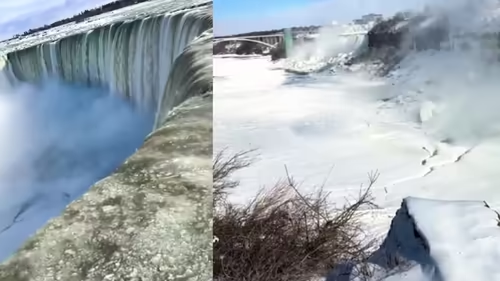
When the Mighty Roar Turns to Silence: Niagara Falls Freezes in Historic Cold Snap
It’s a sight that seems ripped from a fantasy novel—a thunderous cascade of water, one of the most powerful natural wonders on Earth, brought to a near standstill by sheer cold. In early 2026, the iconic Niagara Falls freezes partially under an intense Arctic blast that sent temperatures plummeting to **minus 20 degrees Celsius**. This rare event, driven by a record-breaking polar vortex, transformed the falls into a glistening, otherworldly ice sculpture—drawing photographers, tourists, and climate watchers from around the globe.
Table of Contents
- What Caused Niagara Falls to Freeze?
- Can Niagara Falls Fully Freeze? The Science Explained
- Historical Precedents of Frozen Niagara
- Tourism and Safety During the Ice Event
- Climate Change Connection or Cold Anomaly?
- Conclusion: A Rare Winter Miracle
- Sources
What Caused Niagara Falls to Freeze?
The dramatic transformation was triggered by an unusually strong and persistent **polar vortex**—a large area of low pressure and cold air surrounding the Earth’s poles—that dipped deep into North America in January 2026. Regions across the U.S. and Canada experienced life-threatening wind chills, with parts of Ontario and New York recording sustained temperatures of **-20°C (-4°F)** or lower for several days [[1]].
While the massive volume of water flowing over Niagara Falls (averaging 85,000 cubic feet per second) prevents it from freezing completely, the extreme cold caused surface mist, spray, and slower-moving sections along the riverbanks and American Falls to solidify into thick, sculptural ice formations. The result? A surreal, snow-globe-like landscape that left even locals stunned.
Can Niagara Falls Fully Freeze? The Science Explained
A common myth is that Niagara Falls can “completely freeze.” In reality, thanks to the immense flow rate and hydroelectric diversions regulated by the 1950 Niagara Treaty, the **main Horseshoe Falls (Canadian side) never fully stops moving**, even in the harshest winters [[2]].
However, what *does* happen is the formation of an **ice bridge**—a thick accumulation of frozen spray and slush that can extend dozens of feet from the shoreline. During this 2026 event, the ice bridge grew so large it nearly obscured the base of the American Falls, creating the illusion of a frozen waterfall. The National Weather Service confirmed that while the water keeps flowing beneath, the visual impact is undeniably spectacular—and photogenic.
Historical Precedents of Frozen Niagara
This isn’t the first time Niagara has donned its icy crown, but such events are increasingly rare:
- 1932 & 1936: Among the coldest winters on record; ice bridges formed extensively.
- 1963: One of the last times the American Falls appeared almost entirely frozen.
- 2014 & 2019: Partial freezes occurred during Arctic outbreaks, but nothing as dramatic as 2026.
Interestingly, since the installation of the **ice boom**—a series of floating steel pontoons placed at the mouth of Lake Erie each December—the amount of ice flowing into the Niagara River has been controlled, reducing the likelihood of massive ice jams and full visual freezes [[3]]. Yet, the 2026 cold snap was so severe it overwhelmed even these modern safeguards.
Tourism and Safety During the Ice Event
Despite the dangers of extreme cold, the frozen spectacle became an instant tourist magnet. Authorities in both Niagara Falls, Ontario, and Niagara Falls, New York, reported a surge in visitors braving the elements for that perfect Instagram shot.
However, officials issued stern warnings: the ice bridge is **not safe to walk on**. Beneath its deceptively solid surface lies fast-moving water and unstable layers that can collapse without warning. Tragically, several deaths have occurred in past decades due to people venturing onto the ice [[4]]. Today, viewing is strictly limited to designated observation areas like Terrapin Point and Queen Victoria Park.
[INTERNAL_LINK:best-time-to-visit-niagara-falls]
[INTERNAL_LINK:winter-travel-tips-for-canada]
Climate Change Connection or Cold Anomaly?
Many wonder: how can such extreme cold coexist with global warming? Climate scientists explain that a warming Arctic can actually **weaken the polar vortex**, causing it to become wobbly and spill frigid air southward more frequently—a phenomenon known as “Arctic amplification” [[5]].
So while the planet warms overall, regions like the Great Lakes may experience more volatile swings between heatwaves and deep freezes. The 2026 Niagara freeze, therefore, may be less a sign of cooling and more a symptom of a destabilized climate system.
Conclusion: A Rare Winter Miracle
The sight of Niagara Falls freezes is a fleeting reminder of nature’s raw power and beauty. Though the water never truly stops, the ice-laden cliffs and silent mist create a moment of stillness that feels almost sacred. As temperatures eventually rise and the ice melts away, the roar will return—but for now, the world pauses to marvel at this rare winter miracle.