Table of Contents
- A Shocking Act of Teen Revenge
- What Happened in Nashik: The Facts
- The Nashik Juvenile Crime Case Unfolds
- How India’s Juvenile Justice System Responds
- Public Outrage and Road Safety Concerns
- Could This Have Been Prevented?
- Conclusion: A Wake-Up Call for Parents and Policymakers
- Sources
A Shocking Act of Teen Revenge
It started as a personal feud between teenagers—but ended with shattered bones, a luxury car used as a weapon, and a community demanding answers. In a deeply troubling incident that has gripped Nashik, a 16-year-old boy allegedly drove his family’s BMW into a scooter carrying two 14-year-old boys, not by accident, but as an act of vengeance over a grudge simmering for seven months.
This isn’t just another traffic mishap. Police reports confirm the collision was intentional—a calculated move rooted in long-standing animosity. The victims sustained serious injuries and are now recovering, while the accused has been taken into custody under India’s Juvenile Justice Act. At the heart of this story lies a growing national concern: the rise of Nashik juvenile crime involving affluent minors and high-risk behavior.
What Happened in Nashik: The Facts
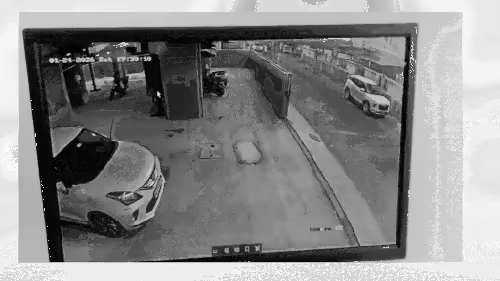
According to the Nashik City Police, the incident occurred in a residential area during broad daylight. The 16-year-old, who was not legally permitted to drive, was behind the wheel of a BMW owned by his family. Surveillance footage and eyewitness accounts suggest he spotted the two 14-year-olds on a scooter and accelerated toward them without warning.
The impact was severe. Both scooter riders were thrown several feet and rushed to a nearby hospital with fractures and internal injuries. Fortunately, their lives are not in danger—but the emotional and physical trauma is profound.
During interrogation, the teen admitted to holding a grudge against one of the victims for nearly seven months, stemming from what police describe as a “personal dispute” among school peers. Authorities believe the attack was premeditated, not impulsive.
The Nashik Juvenile Crime Case Unfolds
Following his arrest, the minor was produced before the Juvenile Justice Board (JJB) in Nashik. Given the gravity of the charges—which may include attempted murder, rash driving, and endangering life—the board ordered him to be placed in a special home or observation facility pending further investigation.
Under the Juvenile Justice (Care and Protection of Children) Act, 2015, individuals aged 16–18 can be tried as adults for heinous offenses if the JJB determines they possessed the mental and physical capacity to understand the consequences of their actions. While it’s too early to say whether this provision will apply here, legal experts note that the deliberate nature of the act could influence that decision.
Key Steps in the Juvenile Justice Process
- Initial Apprehension: Police take the minor into protective custody, not arrest.
- Production Before JJB: Within 24 hours, the child appears before the Juvenile Justice Board.
- Preliminary Assessment: For heinous crimes, the board assesses whether the minor should be tried as an adult.
- Placement Order: The child is sent to a special home or observation facility during inquiry.
- Final Disposition: The board issues rehabilitation or correctional orders based on findings.
How India’s Juvenile Justice System Responds
This case puts India’s juvenile justice framework under the spotlight once again. While the system prioritizes rehabilitation over punishment, incidents like this test its limits. According to data from the National Crime Records Bureau (NCRB), Maharashtra consistently ranks among the top states for juvenile crimes, with property offenses and violent acts on the rise [[1]].
Critics argue that lenient penalties for minors embolden privileged youth to act with impunity—especially when expensive vehicles are involved. Others stress that the focus should remain on counseling, parental accountability, and systemic reform rather than punitive measures.
For more on how juvenile cases are handled nationally, the Ministry of Women and Child Development provides official guidelines on the Juvenile Justice Act implementation.
Public Outrage and Road Safety Concerns
Social media has erupted with anger over the incident. Hashtags like #NashikBMWAttack and #StopJuvenileRecklessness trended locally, with citizens demanding stricter enforcement of driving laws and greater oversight of underage vehicle access.
Parents across Maharashtra are now questioning how a 16-year-old gained unsupervised access to a high-powered luxury car. [INTERNAL_LINK:underage-driving-laws-india] This raises broader concerns about vehicle ownership, parental responsibility, and the normalization of teen driving in urban India.
Why This Case Is Different
- It wasn’t an accident—it was allegedly intentional.
- The use of a luxury vehicle as a tool of aggression adds a class dimension to the crime.
- Both victims and perpetrator are minors, complicating legal and moral narratives.
- The feud lasted over half a year, suggesting a failure in early intervention by schools or families.
Could This Have Been Prevented?
Experts in adolescent psychology point to missed red flags. Long-standing interpersonal conflicts among teens often escalate without proper mediation. Schools, parents, and community counselors must create safe channels for conflict resolution before resentment turns violent.
Moreover, vehicle access control is critical. Many families unknowingly enable risky behavior by allowing teens to “practice” driving without licenses. Enforcing Section 3 of the Motor Vehicles Act—which prohibits unlicensed driving—is essential to prevent future tragedies.
Conclusion: A Wake-Up Call for Parents and Policymakers
The Nashik juvenile crime involving a BMW and a vengeful teenager is more than a local news story—it’s a symptom of deeper societal issues. From gaps in juvenile oversight to lax attitudes toward underage driving, this incident demands a multi-pronged response.
While the justice system works through its process, families must reflect on supervision, empathy, and accountability. And authorities must ensure that privilege doesn’t become a shield against consequence. As the two young victims heal, their ordeal should serve as a catalyst for change—not just in Nashik, but across India.
Sources
- [[1]] Times of India: 16-year-old driving BMW hits scooter over past feud in Nashik
- [[2]] National Crime Records Bureau (NCRB) – Crime in India Reports
- [[3]] Ministry of Women & Child Development – Juvenile Justice Act, 2015
- [[4]] Ministry of Home Affairs – Guidelines on Juvenile Justice Implementation