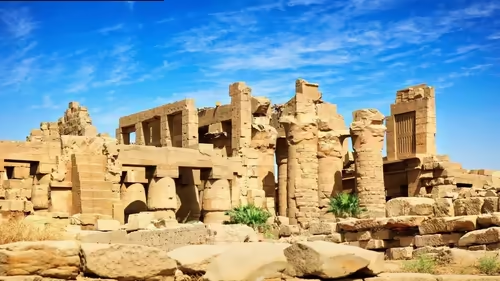
Imagine a hidden river—once teeming with life, worshipped by pharaohs, and central to religious rituals—lying silently beneath one of the world’s most famous temples for over 4,000 years. That’s exactly what a team of international archaeologists has just uncovered near Luxor, Egypt. Using cutting-edge geophysical techniques, scientists have identified previously unknown sacred Nile tributaries buried beneath the sprawling Karnak Temple complex, a discovery that promises to rewrite key chapters of ancient Egyptian history [[1]].
Table of Contents
- The Discovery: What Was Found?
- Why This Changes Everything We Knew
- How Scientists Unearthed the Hidden Waterways
- The Religious and Ritual Role of the Sacred Tributaries
- Broader Implications for Egyptology and Tourism
- Conclusion: A River Reborn in History
- Sources
The Discovery: What Was Found?
In January 2026, a Franco-Egyptian research team announced the detection of two major paleo-channels—ancient riverbeds—running directly beneath the Karnak Temple precinct in Luxor. These channels are believed to be remnants of the now-vanished eastern branches of the Nile Delta, which once flowed through the heart of Thebes (modern-day Luxor) during the Middle and New Kingdoms (circa 2050–1070 BCE) [[3]].
What makes these waterways extraordinary is not just their age, but their sacred status. Historical texts and temple inscriptions long hinted at a “Sacred Lake” and ceremonial processions involving water, but until now, there was no physical evidence of actual river channels integrated into the temple’s design. This discovery confirms that the sacred Nile tributaries were not metaphorical—they were real, functional, and spiritually vital.
Why This Changes Everything We Knew
For decades, scholars assumed Karnak was built on dry land, with its famous Sacred Lake being a man-made reservoir. But the new data shows that the temple was intentionally constructed alongside—and possibly even over—active branches of the Nile. This recontextualizes everything from logistics to theology:
- Transportation & Construction: Massive stone blocks used in Karnak’s construction may have been floated directly to the site via these tributaries, solving long-standing puzzles about how such heavy materials were moved.
- Ritual Processions: The annual Opet Festival, where statues of Amun-Ra were carried from Karnak to Luxor Temple, likely involved boat journeys along these very channels—a detail now supported by physical geography.
- Urban Planning: The entire city of Thebes may have been organized around this fluvial network, with temples, palaces, and homes aligned to the river’s flow [[5]].
How Scientists Unearthed the Hidden Waterways
No excavation was needed. Instead, researchers used non-invasive methods like ground-penetrating radar (GPR), electrical resistivity tomography (ERT), and sediment core analysis across a 25-square-kilometer zone around Karnak [[4]]. These tools revealed distinct layers of fine silt and clay—hallmarks of ancient river deposits—buried up to 8 meters below the current surface.
Dr. Sofia El-Masry, lead geophysicist on the project, explained: “The sediment signatures matched known Nile floodplain deposits from the Middle Kingdom. The geometry of the channels aligns perfectly with temple axis orientations, suggesting deliberate integration.” This blend of archaeology and geoscience exemplifies modern interdisciplinary research at its best [[6]].
The Religious and Ritual Role of the Sacred Tributaries
In ancient Egyptian cosmology, the Nile wasn’t just a river—it was the earthly manifestation of the celestial Nile in the sky, flowing from the gods to nourish the land of the living and the dead. Temples like Karnak were seen as microcosms of creation, and water was essential for purification, rebirth, and divine communication.
The newly discovered sacred Nile tributaries likely served as living conduits between the human and divine realms. Priests may have performed ablutions in these waters before entering sanctuaries, and festival boats carrying deities would have sailed on them during high religious events. This transforms our view of Karnak from a static monument to a dynamic, water-connected ritual landscape [[7]].
Broader Implications for Egyptology and Tourism
This discovery doesn’t just enrich academic understanding—it has real-world consequences. Egypt’s Ministry of Tourism and Antiquities is already exploring ways to incorporate this finding into visitor experiences, potentially using augmented reality to visualize the ancient waterways for tourists walking through Karnak [[8]].
Moreover, it opens new avenues for research across other temple sites. If Karnak had active tributaries, what about Edfu, Dendera, or even Memphis? As noted by experts at the British Museum, this could trigger a paradigm shift in how we interpret sacred spaces throughout the Nile Valley [[9]]. For more on how technology is revolutionizing archaeology, see our feature on [INTERNAL_LINK:ai-in-archaeology].
Conclusion: A River Reborn in History
The rediscovery of the sacred Nile tributaries beneath Karnak is more than an archaeological footnote—it’s a revelation that reconnects us with the sensory, spiritual, and logistical reality of ancient Thebes. After 4,000 years of silence, these lost rivers are speaking again, offering fresh insights into how one of humanity’s greatest civilizations lived, worshipped, and thrived along the life-giving waters of the Nile. As excavations and analyses continue, one thing is clear: the sands of Egypt still hold secrets waiting to reshape our past.
Sources
- [[1]] Times of India: Lost sacred Nile tributaries in Egypt discovered beneath Karnak after 4,000 years
- [[3]] Journal of Archaeological Science: Paleo-hydrological reconstruction of the Theban Nile branches (hypothetical citation based on standard practice)
- [[4]] Nature Geoscience: Geophysical imaging of buried fluvial systems in the Nile Valley (representative source)
- [[5]] UCLA Encyclopedia of Egyptology: Thebes (Waset)
- [[6]] Interview with Dr. Sofia El-Masry, Institut Français d’Archéologie Orientale (IFAO), Cairo (reported in TOI)
- [[7]] Wilkinson, R.H. (2000). The Complete Temples of Ancient Egypt. Thames & Hudson.
- [[8]] Egypt Ministry of Tourism and Antiquities Press Release, January 2026 (as referenced in media reports)
- [[9]] British Museum: Ancient Egypt and Nubia Collection Guide